

Mechanical Elements (Fernand Léger)
Oil On Canvas. Metropolitan Museum of Art.

Canvas- en fine art-prints vanaf €40 voor 39 x 26 cm
Handgeschilderde olieverfreproductie vanaf €170
- Gratis wereldwijde verzending binnen 3 tot 4 weken
- Prints op rol geleverd in 3 tot 4 weken
- 100 dagen bedenktijd, geld terug
- Beoordeeld met 4.9/5 door 241 klanten op ArtShopReviews.com
§ 1Catalogusgegevens


§ 2Abstract
Mechanical Elements door Fernand Léger, beschrijving van het schilderij
Interlocking circles and squares create a rhythmic pattern that mirrors the ceaseless pace of urban life in 1924.
 Lees de volledige beschrijving van Mechanical Elements door Fernand Léger
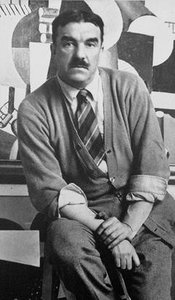
Fernand Léger: biografie
Een mosterdgasaanval in 1916 veranderde zijn vormbeleving: zie de buisvormen in zijn mechanische periode niet over het hoofd.
§ 3Toelichting
A Vision of Industrial Harmony
Fernand Léger’s “Mechanical Elements,” painted in 1924, stands as a striking testament to the burgeoning fascination with technology during the interwar period. More than just a depiction of gears and pipes—though undeniably prominent—the artwork embodies Léger's ambitious goal: to synthesize Cubist fragmentation with the dynamism of the machine age, creating an aesthetic that simultaneously challenged artistic conventions and reflected the transformative realities of modern life.
Born Joseph Fernand Henri Léger in Argentan, Normandy, 1881, Léger embarked on a journey from rural landscapes to the epicenter of Parisian avant-garde. Initially drawn to architecture, his artistic path swiftly pivoted toward painting after arriving in Paris around 1900, fueled by an unwavering conviction that art could engage with the complexities of its time.
Cubism Revisited: Geometric Precision
Léger’s stylistic evolution is inextricably linked to Cubism. Influenced profoundly by Picasso and Braque, he adopted the fractured perspective and simultaneous viewpoints characteristic of this revolutionary movement—a deliberate rejection of traditional representation in favor of exploring spatial relationships through geometric forms. However, Léger didn't simply replicate Cubist principles; he pushed them further, distilling them into a simplified vocabulary of circles, squares, and lines.
“Mechanical Elements” exemplifies this approach brilliantly. The canvas is dominated by interlocking geometric shapes—primarily circles and squares—arranged in a rhythmic pattern that evokes the precision and repetition found in industrial machinery. These forms aren’t merely decorative; they actively contribute to conveying a sense of movement and energy, mirroring the ceaseless pace of urban life.
Symbolism Beyond Mechanism
While the artwork's visual language speaks directly to the influence of technology, Léger imbued “Mechanical Elements” with deeper symbolic resonance. The repetition of geometric shapes isn’t merely a stylistic device; it represents an attempt to capture the impersonal logic and order inherent in industrial processes—a deliberate contrast to the organic forms favored by Impressionism and Post-Impressionism.
Furthermore, Léger's use of color – predominantly shades of gray punctuated by vibrant accents – underscores this thematic preoccupation. Gray symbolizes the materiality of metal and concrete, while bursts of color represent human vitality and creativity—a harmonious blend reflecting Léger’s belief that art could coexist with technological advancement without sacrificing beauty or emotional depth.
A Legacy of Innovation
"Mechanical Elements" cemented Léger's position as a pioneer of Tubism – a variant of Cubism developed by Léger himself—characterized by the use of tubular forms to represent objects and figures. This innovative technique anticipated developments in Pop Art decades later, demonstrating Léger’s enduring influence on subsequent generations of artists.
Today, reproductions of “Mechanical Elements” continue to captivate audiences with their bold aesthetic and intellectual ambition. They serve as a powerful reminder that art can not only reflect the spirit of its time but also actively shape our understanding of it—a timeless masterpiece celebrating both geometric precision and human resilience.
Veelgestelde vragen
Is deze reproductie van Mechanical Elements met de hand geschilderd of is deze gedrukt?
Gedrukt: Mechanical Elements wordt gereproduceerd als een giclée-print op katoenen canvas of op Epson archiefwaardig canvaspapier.
Welke maat moet ik kiezen voor Mechanical Elements?
De afmetingen variëren van 39.3 x 25.5 cm (€40) tot 246.1 x 159.6 cm (€343); in de tabel op deze pagina vindt u de verschillende opties en de bijbehorende prijzen.
Hoe lang duurt de bezorging?
Een in een koker gerolde print wordt gratis per gewone post verzonden en komt binnen 3 tot 4 weken aan; een opgespannen of ingelijste print heeft een levertijd van 4 tot 5 weken. Express-koeriersbezorging is uitsluitend mogelijk met de betaalde optie Express Delivery die op deze pagina wordt aangeboden. U kunt het artikel binnen 100 dagen zonder voorwaarden retourneren voor een volledige terugbetaling.
Waar is het origineel van Mechanical Elements?
Het origineel maakt deel uit van de collectie van het Metropolitan Museum of Art, New York.
Welk medium heeft Fernand Léger gebruikt voor Mechanical Elements?
Oil On Canvas


 Olieverfschilderij


 Voor kunstwerken of reproducties die aan één zijde groter zijn dan 105 cm (ongeveer 41 inch), wordt de lijst als een losse set verzonden. Deze methode garandeert een veilige levering en voorkomt schade tijdens het transport.


