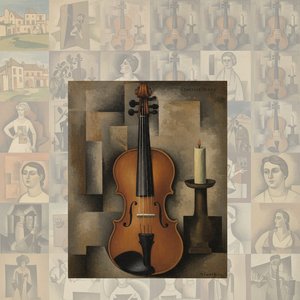
Acrylic On Canvas.

§ 1Catalogue data


Dit kunstwerk is auteursrechtelijk beschermd
De kunstwerken die op deze pagina worden weergegeven, zijn beschermd door de auteursrechtwetgeving, wat betekent dat het ons wettelijk niet is toegestaan om identieke reproducties te maken of te verkopen. Deze bescherming wordt gehandhaafd onder internationale overeenkomsten zoals de Conventie van Bern en door nationale wetgeving, waaronder de bepalingen van de Amerikaanse auteurswet - Titel 17. Alle rechten voorbehouden. Reproduceren of distribueren van afbeeldingen is niet toegestaan zonder uitdrukkelijke schriftelijke toestemming van WahooArt.com en de rechthebbenden.
Als een respectvol en legaal alternatief bieden wij op maat gemaakte, handgeschilderde kunstwerken aan die geïnspireerd zijn op het origineel. Onze bekwame en professionele kunstenaars bestuderen zorgvuldig de stijl, sfeer en artistieke essentie van het origineel om een nieuw, uniek werk te creëren dat dezelfde emotie oproept – terwijl het een op zichzelf staande, originele creatie blijft.
Deze methode voldoet volledig aan de auteursrechtwetgeving, omdat het niet gaat om het kopiëren of dupliceren van het beschermde kunstwerk. In plaats daarvan is er sprake van een creatieve herinterpretatie — een nieuw schilderij dat door het origineel wordt geïnspireerd, maar er niet identiek aan is.
 Lees meer over
§ 2Abstract
Beschrijving verzamelobject
Georges Braque’s "Bistre Bird" is a pivotal Cubist study of avian form & flight. Explore fragmented shapes, earthy tones, and the dawn of modern art's revolutionary perspective. Hand-painted reproduction.
Biografie kunstenaar
Georges Braque (1882-1963): Pionier van het kubisme & fauvisme. Ontdek zijn baanbrekende kunst, van 'Houses at L'Estaque' tot indrukwekkende collages. Een meester van de moderne kunst!
§ 3Commentary
Georges Braque’s “Bistre Bird”: A Study in Form and Flight
Georges Braque's "Bistre Bird," a captivating study in avian form, offers a glimpse into the artist’s pivotal role in the development of Cubism. Painted around 1908-1912 – a period of intense experimentation and collaboration with Pablo Picasso – this work transcends mere representation, becoming a profound exploration of perception and spatial relationships. The painting depicts a bird in mid-flight, its wings outstretched as if caught in an eternal moment of propulsion. Its plumage is rendered in shades of brown—a “bistre” hue that lends the piece a quiet dignity and earthy resonance – contrasting beautifully against the vibrant blue expanse of the sky. Noticeably, Braque doesn’t aim for photographic realism; instead, he dissects the bird's form into fragmented geometric shapes, mirroring the core tenets of Cubism. This approach wasn’t born in isolation; Braque’s early training as a house painter instilled within him an acute awareness of structure and perspective – skills that would prove invaluable as he dismantled traditional artistic conventions.
The Dawn of Cubism: Deconstructing Reality
“Bistre Bird” is inextricably linked to the revolutionary movement of Cubism, a style that emerged in Paris around 1907. Braque and Picasso, driven by a shared desire to challenge established notions of perspective and representation, began to break down objects into their constituent parts and reassemble them on the canvas from multiple viewpoints simultaneously. This wasn’t simply an aesthetic choice; it was a philosophical one, reflecting a growing interest in scientific theories of optics and the way our eyes perceive depth. The painting exemplifies this approach – the bird's wings are not presented as a single, continuous surface but rather as a series of overlapping planes, each rendered with careful attention to light and shadow. The background sky is similarly fragmented, suggesting an infinite space beyond the confines of the canvas. This deliberate distortion of reality aimed to capture the essence of an object – its underlying structure – rather than merely imitating its appearance.
Influences and Techniques: Cézanne’s Legacy
Braque's artistic journey leading up to "Bistre Bird" was profoundly shaped by the work of Paul Cézanne, a Post-Impressionist painter whose emphasis on geometric forms and multiple perspectives served as a crucial precursor to Cubism. Cézanne’s meticulous studies of landscapes and still lifes, particularly his exploration of how light interacts with solid objects, deeply influenced Braque's approach to composition and form. The artist spent considerable time studying Cézanne’s retrospective exhibition in 1907, recognizing the profound impact it would have on the avant-garde movement. Technically, Braque employed a technique known as “Analytical Cubism,” characterized by monochromatic color palettes – predominantly browns, grays, and ochres – and a focus on dissecting objects into their basic geometric components. The brushstrokes are often subtle and precise, contributing to the painting’s overall sense of controlled fragmentation.
Symbolic Resonance: Flight, Freedom, and Observation
Beyond its formal innovations, “Bistre Bird” carries a potent symbolic weight. The act of flight itself represents freedom, aspiration, and transcendence – themes that resonated deeply with the artists of the early 20th century. The bird’s poised stance suggests both vulnerability and strength, inviting contemplation on the delicate balance between observation and interpretation. Braque's choice of “bistre,” a muted brown tone, adds to this sense of quiet introspection. It evokes the earth, grounding the soaring image while simultaneously hinting at the vastness of the sky. Ultimately, "Bistre Bird" is not simply a depiction of a bird in flight; it’s an invitation to engage with the complexities of perception and the enduring power of art to transform our understanding of the world.
Veelgestelde vragen
Wat stelt "Bistre bird" door Georges Braque voor, en welke stemming straalt het uit?
"Bistre bird" toont bird flight, blue sky, brown bird, composition, movement, aviary, braque en de vastgelegde stemming is Earthy.
Hoe komen contrast en harmonie samen in "Bistre bird"?
De kleurcompositie van "Bistre bird" door Georges Braque combineert een Statement contrast met een Discordant Palette harmonie.
Is "Bistre bird" vrij van auteursrecht?
"Bistre bird" door Georges Braque valt onder nog steeds auteursrechtelijk beschermd. Deze status bepaalt hoe de afbeelding van het werk mag worden gereproduceerd.


 Schakel over naar print


 Voor kunstwerken of reproducties die aan één zijde groter zijn dan 105 cm (ongeveer 41 inch), wordt de lijst als een losse set verzonden. Deze methode garandeert een veilige levering en voorkomt schade tijdens het transport.