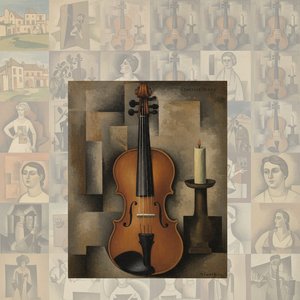
1949. Acrylic.

§ 1Catalogue data


Dit kunstwerk is auteursrechtelijk beschermd
De kunstwerken die op deze pagina worden weergegeven, zijn beschermd door de auteursrechtwetgeving, wat betekent dat het ons wettelijk niet is toegestaan om identieke reproducties te maken of te verkopen. Deze bescherming wordt gehandhaafd onder internationale overeenkomsten zoals de Conventie van Bern en door nationale wetgeving, waaronder de bepalingen van de Amerikaanse auteurswet - Titel 17. Alle rechten voorbehouden. Reproduceren of distribueren van afbeeldingen is niet toegestaan zonder uitdrukkelijke schriftelijke toestemming van WahooArt.com en de rechthebbenden.
Als een respectvol en legaal alternatief bieden wij op maat gemaakte, handgeschilderde kunstwerken aan die geïnspireerd zijn op het origineel. Onze bekwame en professionele kunstenaars bestuderen zorgvuldig de stijl, sfeer en artistieke essentie van het origineel om een nieuw, uniek werk te creëren dat dezelfde emotie oproept – terwijl het een op zichzelf staande, originele creatie blijft.
Deze methode voldoet volledig aan de auteursrechtwetgeving, omdat het niet gaat om het kopiëren of dupliceren van het beschermde kunstwerk. In plaats daarvan is er sprake van een creatieve herinterpretatie — een nieuw schilderij dat door het origineel wordt geïnspireerd, maar er niet identiek aan is.
 Lees meer over
§ 2Abstract
Beschrijving verzamelobject
Georges Braque’s Studio captures a serene monochrome composition reflecting Cubist principles—a meticulously arranged vase alongside complementary vessels evokes geometric abstraction and humanist observation within the early 1950s.”
Biografie kunstenaar
Georges Braque (1882-1963): Pionier van het kubisme & fauvisme. Ontdek zijn baanbrekende kunst, van 'Houses at L'Estaque' tot indrukwekkende collages. Een meester van de moderne kunst!
§ 3Commentary
A Still Life Reverie: Georges Braque’s “The Studio”
- Georges Braque's "The Studio" (II), painted in 1949, stands as a testament to the artist’s mastery of Cubist principles and his profound engagement with the aesthetic concerns of postwar Europe. This deceptively simple composition—a monochrome depiction of a studio interior—holds within it layers of intellectual and artistic significance that continue to resonate with viewers today.
- The painting's stylistic core resides in Braque’s unwavering commitment to Cubism, specifically Analytical Cubism developed alongside Pablo Picasso during their formative years. Unlike Impressionistic explorations of fleeting light and color, Braque sought to represent objects from multiple viewpoints simultaneously, fracturing them into geometric planes that overlap and interpenetrate. This technique isn't merely a stylistic choice; it’s an epistemological one—a deliberate attempt to challenge traditional notions of perspective and representation.
Compositional Harmony and Fragmented Reality
- The central focus is undeniably a vase, positioned prominently on a table. However, Braque doesn’t present this vase as a singular entity but rather dissects it into fragmented planes—a hallmark of Cubist methodology. Surrounding the main vase are several other vases scattered throughout the scene, creating a visual dialogue that emphasizes the multiplicity of perception.
- Alongside the vases is a bowl and a cup, meticulously arranged on the table surface. These objects contribute to the overall sense of stillness despite the fractured geometry dominating the composition. Braque’s careful placement guides the viewer's eye across the canvas, fostering contemplation about how we perceive and interpret visual information.
Figures Within Stillness: Presence and Observation
- Two figures inhabit the studio space—one positioned closer to the left side of the image and another situated centrally. Their presence introduces an element of human observation into what might otherwise appear as a purely formal exercise. Braque’s inclusion of these individuals subtly underscores the idea that art is not merely about depicting objects but also about capturing the act of seeing itself.
- The figures are rendered in muted tones, mirroring the monochrome palette of the painting and reinforcing its contemplative mood. They serve as anchors within the geometric abstraction, grounding the visual experience and inviting viewers to consider their own role as observers.
Symbolism and Contextual Significance
- "The Studio" reflects the broader artistic currents of the postwar period—a time marked by a renewed interest in abstraction and a desire to grapple with the trauma of World War II. Braque’s deliberate simplification of form aligns with the movement's rejection of sentimentalism and its embrace of intellectual rigor.
- The vases themselves can be interpreted as symbols of artistic creation—representing vessels for ideas, inspirations, and creative endeavors. Their repetition reinforces this thematic concern, prompting viewers to consider the role of art in shaping our understanding of the world.
Emotional Resonance: Quiet Contemplation
- Despite its geometric abstraction, “The Studio” possesses a remarkable emotional resonance. The subdued palette and careful composition evoke a sense of quiet contemplation—a stillness that invites viewers to pause and reflect on the beauty of form and structure. It’s a painting that speaks not to the senses but to the intellect, fostering an appreciation for the power of visual art to convey profound ideas.
Veelgestelde vragen
Met welke techniek is "The Studio (II)" gemaakt?
Georges Braque gebruikte de Acrylic-techniek voor "The Studio (II)". De techniek bepaalt de materiële aard van het originele werk.
In welke oriëntatie staat "The Studio (II)" door Georges Braque?
Het formaat van "The Studio (II)" is Landscape. Dit is handig bij het plannen van de plek waar een reproductie zal worden geplaatst.
Is "The Studio (II)" in zijn geheel eerder licht of donker?
"The Studio (II)" heeft een algehele helderheid van shadow en een luminantie van Soft Shadow.



 Schakel over naar print


 Voor kunstwerken of reproducties die aan één zijde groter zijn dan 105 cm (ongeveer 41 inch), wordt de lijst als een losse set verzonden. Deze methode garandeert een veilige levering en voorkomt schade tijdens het transport.