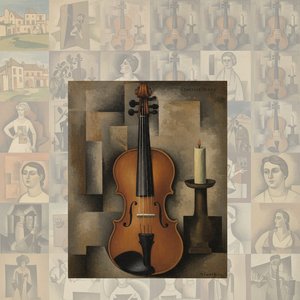
Oil On Canvas.

§ 1Catalogue data


Dit kunstwerk is auteursrechtelijk beschermd
De kunstwerken die op deze pagina worden weergegeven, zijn beschermd door de auteursrechtwetgeving, wat betekent dat het ons wettelijk niet is toegestaan om identieke reproducties te maken of te verkopen. Deze bescherming wordt gehandhaafd onder internationale overeenkomsten zoals de Conventie van Bern en door nationale wetgeving, waaronder de bepalingen van de Amerikaanse auteurswet - Titel 17. Alle rechten voorbehouden. Reproduceren of distribueren van afbeeldingen is niet toegestaan zonder uitdrukkelijke schriftelijke toestemming van WahooArt.com en de rechthebbenden.
Als een respectvol en legaal alternatief bieden wij op maat gemaakte, handgeschilderde kunstwerken aan die geïnspireerd zijn op het origineel. Onze bekwame en professionele kunstenaars bestuderen zorgvuldig de stijl, sfeer en artistieke essentie van het origineel om een nieuw, uniek werk te creëren dat dezelfde emotie oproept – terwijl het een op zichzelf staande, originele creatie blijft.
Deze methode voldoet volledig aan de auteursrechtwetgeving, omdat het niet gaat om het kopiëren of dupliceren van het beschermde kunstwerk. In plaats daarvan is er sprake van een creatieve herinterpretatie — een nieuw schilderij dat door het origineel wordt geïnspireerd, maar er niet identiek aan is.
 Lees meer over
§ 2Abstract
Beschrijving verzamelobject
Explore Georges Braque's 'White Palette,' a striking black & white Cubist masterpiece featuring vases and plants. A unique, minimalist still life – available as a hand-painted reproduction.
Biografie kunstenaar
Georges Braque (1882-1963): Pionier van het kubisme & fauvisme. Ontdek zijn baanbrekende kunst, van 'Houses at L'Estaque' tot indrukwekkende collages. Een meester van de moderne kunst!
§ 3Commentary
Georges Braque’s “White Palette”: A Cubist Exploration of Form and Color
- The artwork "White Palette" by Georges Braque stands as a testament to the groundbreaking innovations of early 20th-century cubism. Executed sometime between 1913 and 1914, this piece exemplifies Braque’s pivotal role in shaping the artistic landscape alongside Pablo Picasso—a collaboration that irrevocably altered perceptions of representation.
- At first glance, “White Palette” presents a deceptively simple composition: a vase adorned with yellow flowers dominates the center stage. However, beneath this apparent stillness lies a complex interplay of geometric forms and fragmented perspectives characteristic of Braque’s cubist style. The vase itself is not depicted as a unified object but rather dissected into interlocking planes—a technique pioneered by Picasso and Braque to challenge traditional illusionistic painting.
Technique and Material Considerations
- Braque employed oil paint on canvas, utilizing a meticulous layering process that allowed him to achieve remarkable tonal gradations despite the predominantly monochrome palette. The artist’s careful attention to detail is evident in the rendering of textures—particularly within the vases and potted plants—creating a palpable sense of materiality. This technique reflects Braque's commitment to capturing not just visual appearance but also the essence of form itself.
- Furthermore, the inclusion of two smaller paintings nestled within the larger composition adds another layer of intrigue. These miniature canvases mirror the overarching cubist aesthetic, reinforcing the artist’s exploration of spatial relationships and simultaneity—a core principle of the movement.
Historical Context: The Birth of Cubism
- "White Palette" emerged during a period of intense artistic experimentation fueled by intellectual currents originating in Europe. Inspired by Cézanne’s emphasis on geometric simplification and influenced by African sculpture—particularly Picasso's fascination with Iberian terracotta figurines—Braque and Picasso embarked on a radical reimagining of pictorial space.
- Cubism wasn’t merely about stylistic novelty; it represented a profound philosophical shift away from representational art. Artists sought to depict objects as they appear simultaneously from multiple viewpoints, rejecting the single perspective that had dominated Western painting for centuries. This approach aimed to capture not just what was seen but also how it was perceived—a conceptual ambition that profoundly impacted subsequent artistic developments.
Symbolism and Emotional Resonance
- The vase itself, bathed in shades of white and yellow, carries symbolic weight. Yellow flowers traditionally represent joy and optimism—contrasting subtly with the monochrome backdrop. This juxtaposition underscores Braque’s desire to convey a sense of quiet contemplation amidst visual complexity.
- Ultimately, “White Palette” transcends mere aesthetic beauty; it invites viewers into a dialogue about perception and representation. By dismantling traditional conventions, Braque compels us to reconsider how we experience the world around us—a legacy that continues to inspire artists and collectors alike.
Interior Design Inspiration
- Reproductions of “White Palette” offer a captivating opportunity to infuse interior spaces with a touch of modernist elegance. The artwork’s restrained palette and geometric forms harmonize beautifully with contemporary design sensibilities, creating a serene yet intellectually stimulating atmosphere.
Veelgestelde vragen
Hoe kan ik "White Palette" door Georges Braque bekijken als een diavoorstelling?
"White Palette" door Georges Braque is te bekijken als een diavoorstelling op de Diavoorstelling-pagina van het kunstwerk.
Wat is de dominante kleur van "White Palette" door Georges Braque?
Black (#070402) is de dominante kleur van "White Palette" door Georges Braque.
Aan welke kunstenaar wordt "White Palette" toegeschreven?
"White Palette" is gemaakt door Georges Braque. De informatie op deze pagina beschrijft het originele werk van Georges Braque.


 Schakel over naar print


 Voor kunstwerken of reproducties die aan één zijde groter zijn dan 105 cm (ongeveer 41 inch), wordt de lijst als een losse set verzonden. Deze methode garandeert een veilige levering en voorkomt schade tijdens het transport.