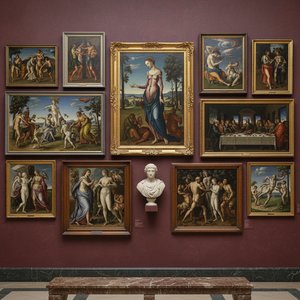
1563. Oil On Canvas, 66.0 x 50.0 cm. Real Academia de Bellas Artes de San Fernando.

§ 1Catalogusgegevens

- 66.0 x 50.0 cm


§ 2Abstract
Beschrijving verzamelobject
Explore Giuseppe Arcimboldo’s masterful Mannerist style—a portrait reimagined as Spring! Constructed from vibrant fruits and flowers, this iconic 1563 canvas embodies Renaissance allegory and invites you to bring a touch of timeless beauty into your home.
 Lees meer
Biografie kunstenaar
Giuseppe Arcimboldo (1527-1593) was een Italiaanse meester van surrealistische portretten, beroemd om zijn fantasierijke composities met fruit, bloemen en objecten. Zijn unieke stijl voorspelde Surrealisme en blijft fascinerend!
§ 3Toelichting
A Botanical Illusion: The Enchanting Vision of Spring
To gaze upon Giuseppe Arcimboldo’s Spring is to step into a realm where the boundaries between the human form and the natural world dissolve entirely. This masterpiece, part of his celebrated The Four Seasons series, presents us with a portrait that defies conventional perception. At first glance, one encounters a face of striking vitality, yet upon closer inspection, the features reveal themselves to be a meticulous mosaic of life itself. The subject’s visage is not composed of flesh and bone, but of a delicate arrangement of blossoms, petals, and verdant flora. This ingenious technique creates a breathtaking optical illusion, where the soft textures of flowers mimic the contours of a cheek or the curve of a brow, inviting the viewer into a state of perpetual discovery.
The artistry lies in the profound Mannerist sensibility that Arcimboldo mastered. Moving away from the balanced, idealized realism of the High Renaissance, he embraced a more theatrical and intellectual aesthetic. In Spring, every element is placed with surgical precision to evoke the burgeoning energy of the season. The vibrant reds and whites of the floral "skin" suggest the flush of new life, while the presence of birds and lush greenery surrounding the central figure reinforces the theme of seasonal rebirth. For the discerning collector or interior designer, this piece offers a sophisticated focal point that marries whimsical imagination with classical technical mastery.
Symbolism and the Renaissance Mind
Beyond its visual trickery, Arcimboldo’s work is steeped in the complex allegories of the 16th century. During this era, the natural world was viewed as a divine tapestry of symbols, and Spring serves as a profound meditation on the cycle of existence. The choice to construct a human identity from ephemeral blossoms reflects the fleeting nature of beauty and the inevitable transition of time. There is an inherent tension in the work—a marriage of the organic and the artificial—that speaks to the Renaissance fascination with science, botany, and the hidden order within chaos.
For those seeking to adorn a space with art that stimulates conversation, this painting provides endless layers of meaning. It is not merely a decorative object but an intellectual journey. The interplay of light and shadow, achieved through masterful chiaroscuro, lends a sculptural depth to the floral elements, making the composition feel as though it might bloom right off the canvas. Whether placed in a contemporary gallery setting or a classic study, the painting radiates an aura of mystery and wonder, making it an incomparable choice for those who value art that challenges the eye and nourishes the soul.
Veelgestelde vragen
Hoe oud was Giuseppe Arcimboldo toen "Spring" werd gemaakt?
Giuseppe Arcimboldo maakte "Spring" op 36-jarige leeftijd. De kunstenaar werd geboren in 1527 en het werk dateert uit 1563.
Waar kan ik een print van "Spring" door Giuseppe Arcimboldo kopen?
Om een print van "Spring" door Giuseppe Arcimboldo te bestellen, kunt u terecht op de Fine Art Print pagina: een fine art print op katoenen canvas of archiefwaardig canvaspapier.
Tot welke periode in de carrière van Giuseppe Arcimboldo behoort "Spring"?
"Spring" behoort tot de Mature Period in de carrière van Giuseppe Arcimboldo. Deze classificatie plaatst het werk in de context van de ontwikkeling van de kunstenaar.


 Schakel over naar print


 Voor kunstwerken of reproducties die aan één zijde groter zijn dan 105 cm (ongeveer 41 inch), wordt de lijst als een losse set verzonden. Deze methode garandeert een veilige levering en voorkomt schade tijdens het transport.