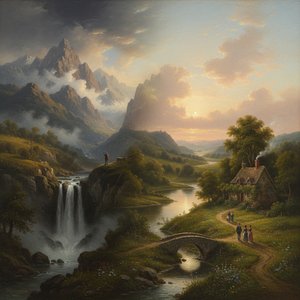
1798. Oil On Canvas. Staatliche Kunsthalle Karlsruhe.

§ 1Catalogusgegevens


§ 2Abstract
Beschrijving verzamelobject
Explore 'Project for The Disposition of the ''Grande Galerie''' by Hubert Robert, a captivating capriccio showcasing Roman ruins & French landscapes. A masterpiece of 18th-century art.
 Lees meer
Biografie kunstenaar
Hubert Robert (1733-1808): Een Franse schilder van sfeervolle landschappen & 'capriccio' ruïnes, die geschiedenis, verval en fantasie combineren. Ontdek zijn kunst!
§ 3Toelichting
A Symphony of Decay and Grandeur
In the twilight of the eighteenth century, as the echoes of the French Revolution began to settle into the broader European consciousness, Hubert Robert captured a vision of Rome that transcends mere architectural documentation. His 1798 masterpiece, Roman Capriccio, is not simply a landscape; it is an evocative journey into the heart of memory and the sublime. Through his masterful use of the capriccio technique—a style defined by architectural fantasy rather than topographical accuracy—Robert invites the viewer to wander through a dreamscape where the boundaries between reality and imagination dissolve. The canvas presents a breathtaking panorama of crumbling columns, weathered arches, and majestic statues, all bathed in a hazy, golden light that suggests the warmth of a setting sun over an empire long passed.
The composition is a delicate dance of light and shadow, where Robert employs layered planes of color to create an illusionistic depth that draws the eye deep into the Roman ruins. This atmospheric approach allows the monumental structures to appear both physically imposing and ethereally transient. Amidst the skeletal remains of classical greatness, small figures—the staffage—are scattered throughout the scene. These individuals, engaged in quiet contemplation or casual interaction around the ancient sculptures, provide a vital sense of scale and human connection. Their presence transforms the ruins from cold, dead stone into a living stage, where the grandeur of the past meets the fleeting pulse of the present.
The Poetics of Time and Transformation
Beyond its visual splendor, Roman Capriccio serves as a profound meditation on the relentless march of time. To look upon these decaying structures is to witness the inevitable triumph of nature over human ambition. Robert utilizes the crumbling masonry as a powerful symbol of the ephemeral nature of power and the futility of even the most monumental architectural achievements. Yet, there is no sense of pure tragedy in this decay; instead, the artist weaves in elements of regeneration. The subtle emergence of vibrant blossoms amidst the rubble acts as a poignant counterpoint to the stone, suggesting that from the wreckage of old worlds, new beauty and hope can inevitably bloom.
For the discerning collector or interior designer, this painting offers more than just aesthetic appeal; it provides an emotional anchor for a space. The work possesses a unique ability to evoke nostalgia and a sense of wonder, making it an ideal centerpiece for rooms designed for reflection and intellectual engagement. Whether placed in a grand library or a contemporary living space, the Roman Capriccio brings with it a storied atmosphere of classical elegance and Romantic mystery. It is a piece that does not merely decorate a wall but tells a story of endurance, transformation, and the eternal beauty found within the ruins of history.
Veelgestelde vragen
Hoe is de kleurcompositie van "Roman Capriccio" door Hubert Robert opgebouwd?
In "Roman Capriccio" wordt een Gentle contrast gecombineerd met een Unified Palette harmonie.
Is er een factsheet over "Roman Capriccio" door Hubert Robert voor studenten?
Er is een Informatieblad pagina beschikbaar voor "Roman Capriccio" door Hubert Robert: een printbaar informatieblad over het kunstwerk, ontworpen voor studenten en gebruik in de klas.
Wie heeft "Roman Capriccio" gemaakt en in welke stijl is het uitgevoerd?
"Roman Capriccio" werd gecreëerd door Hubert Robert in de Romantic Landscape-stijl. De kunstenaar en de stroming bepalen de traditie van het werk.


 Schakel over naar print


 Voor kunstwerken of reproducties die aan één zijde groter zijn dan 105 cm (ongeveer 41 inch), wordt de lijst als een losse set verzonden. Deze methode garandeert een veilige levering en voorkomt schade tijdens het transport.