- Home

- Afdruk op canvas
- Jasper Johns
- Savarin monotype

 Bekijk op ware grootte
 Verstuur
 Delen
Delen
 Details bekijken

 Download
 Vergelijkbare werken
 Röntgenonderzoek
 Diavoorstelling
Savarin monotype

 Lees meer
Giclée / Kunstafdrukken
Giclée- of canvasafdruk van museumkwaliteit met een snelle productie en flexibele afwerkingsmogelijkheden. ( Bestel een handgeschilderde reproductie van dit verzamelobject Naar afbeelding wisselen)




P118B $10

P118H $10

P118W $10

P438Z $10

P508JH $12

P508YH $12

P805H $10

P805Z $10

P919BZ $10

P919G $10

P919XJ $10

P959ZH $10

P968JZ $12

W106C $8

W218G $10

W218JH $8

W218Y $10

W307PJ $10

W316G $10

W316PJ $8

W316Y $10

W398PJ $8

W4111J $10

W500HY $15

W500JH $15

W692G $12

W849H $8

W940BG $15

W953PJ $8




Kies uit onze vooraf ingestelde maten die overeenkomen met de originele verhoudingen van het kunstwerk.

U kunt uw eigen afmetingen opgeven om in een specifieke lijst of ruimte te passen. Als de door u gekozen maat niet overeenkomt met de proporties van het originele kunstwerk, zullen wij de afbeelding bijsnijden of uitbreiden met een gespiegelde of effen rand. Een digitaal mockup wordt ter goedkeuring naar u verzonden voordat de productie begint.
Houd er rekening mee dat de preview op het scherm de werkelijke bijsneding of uitbreiding niet weergeeft. Alleen de mockup toont de uiteindelijke compositie nauwkeurig.
Hoewel aangepaste maten beschikbaar zijn, raden wij aan een afmeting uit de vooraf bepaalde lijst te kiezen om de originele proporties te behouden.
Wereldwijde levering () binnen 2 weken in plaats van de standaard 4/5 weken. (3 augustus)

Gratis wereldwijde expressverzending

Hoogwaardig linnen canvas

Volledige verzendverzekering

Garantie op terugbetaling van invoerrechten

Garantie op exacte kleurweergave

60 dagen retourbeleid (alleen bij defecten)

100% Geld-terug-garantie

Korting bij meerdere afnames
 De optie voor glas is alleen beschikbaar bij een formaat kleiner dan 110 cm.

Savarin monotype
Giclée / Kunstafdrukken
Formaat reproductie
-


Totaalprijs
$ 64
Beschrijving verzamelobject
A Monotone Meditation on Everyday Objects
- Jasper Johns’ “Savarin monotype” isn't merely a depiction of a coffee can and its accompaniments; it’s an invitation to contemplate the profound beauty found within the commonplace. Executed in a strikingly reductive palette of reds and whites, this piece exemplifies Johns’ masterful manipulation of color and form—a deliberate departure from the expressive fervor of Abstract Expressionism that nonetheless retains a core connection to its predecessor.
- The artist's technique is characterized by meticulous layering and subtle gradations within the monochrome range. Johns employs encaustic wax mixed with pigment, fusing it onto canvas in multiple stages – an approach rooted in centuries-old artistic traditions but adapted for the demands of modern visual language. This painstaking process ensures that every brushstroke contributes to a textured surface imbued with depth and luminosity.
Historical Context: Bridging Expressionism and Pop Art
Created in the mid-1960s, “Savarin monotype” sits squarely at the crossroads of two influential artistic movements. Johns’ work emerged during a period of intense debate about the role of art in society—a reaction against the grand narratives of postwar idealism and a burgeoning fascination with popular culture. While acknowledging the legacy of Abstract Expressionists like Willem de Kooning and Jackson Pollock, Johns consciously distanced himself from their emotionally charged canvases, opting instead for a visual vocabulary grounded in recognizable symbols.
Symbolism Beyond Representation
The choice of a coffee can—a ubiquitous item found in kitchens across America—is laden with symbolic significance. It speaks to the rituals of daily life and the pursuit of comfort amidst uncertainty. Johns’ deliberate simplification of form – reducing the can and utensils to their essential contours – elevates these objects beyond mere representation, transforming them into emblems of stability and familiarity. The monochromatic color scheme reinforces this sense of calm and introspection.
Emotional Resonance: Quiet Contemplation
"Savarin monotype" possesses an understated emotional power that belies its apparent simplicity. It invites viewers to pause, observe, and consider the subtle nuances of texture and color. Unlike canvases saturated with emotion, this piece encourages a contemplative response—a recognition of beauty in restraint and a celebration of the enduring relevance of everyday experiences. Its monochrome aesthetic speaks to a desire for clarity and focus, mirroring Johns’ own artistic philosophy.
Gerelateerde kunstwerken



Biografie van de kunstenaar
A Life Painted in Symbols: The World of Jasper Johns
Jasper Johns emerged as a pivotal figure in the landscape of American art, bridging the emotive intensity of Abstract Expressionism with the burgeoning Pop Art movement that would soon redefine artistic boundaries. Born in Augusta, Georgia, in 1930, his early life was marked by a sense of displacement following his parents’ divorce, an experience that perhaps subtly informed his later explorations of identity and belonging within the context of American iconography. His formative years unfolded across various schools before he briefly attended the University of South Carolina, but it wasn't until his move to New York City in 1949 that Johns truly began to forge his artistic path. A period of service during the Korean War further shaped his perspective, exposing him to a world far removed from the burgeoning art scene he was eager to embrace upon his return.Breaking with Abstraction: The Dawn of a New Visual Language
The post-war American art world was dominated by Abstract Expressionism—a style characterized by spontaneous gesture and deeply personal emotional expression. While initially influenced by this movement, Johns felt compelled to move beyond its purely non-representational approach. He sought a new visual language, one that incorporated recognizable imagery not as illustrations but as vehicles for deeper contemplation. This wasn’t simply about *depicting* the world; it was about questioning how we perceive and interpret symbols within it. Key influences guided his departure: Marcel Duchamp's radical readymades challenged conventional notions of art-making, demonstrating that everyday objects could be elevated to the status of art through their presentation, while the emphasis on materiality in Abstract Expressionism informed Johns’ early techniques. However, it was the everyday objects and potent symbols of American culture—flags, targets, maps, numbers—that truly became central to his artistic vocabulary. He wasn’t interested in escaping representation; he wanted to dissect it, layer it with meaning, and ultimately reveal its inherent ambiguities. The influence of Robert Rauschenberg, a close friend and collaborator, was also crucial during this period, fostering a spirit of experimentation and pushing the boundaries of artistic practice through collaborative projects and shared ideas.Iconic Images: Flags, Targets, and the Language of Symbols
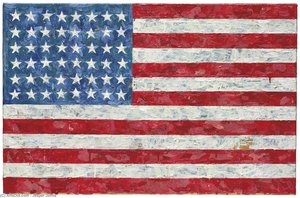
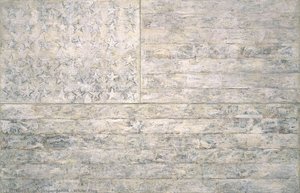
Johns’ breakthrough works arrived in the mid-1950s, instantly establishing him as a force to be reckoned with. His paintings of flags, most notably *Flag* (1954–55), were not patriotic declarations but rather investigations into the very nature of representation. Rendered in a semi-abstract style, using encaustic—pigment mixed with hot wax—and collage techniques, these flags weren’t simply images; they were textured surfaces laden with symbolic weight. The image of the flag, initially inspired by a childhood memory of his father pointing to a statue of William Jasper in Savannah, became a recurring motif, prompting questions about national identity, history, and the complexities of visual communication. The target series, beginning in 1958, further explored this fascination with recognizable forms, questioning perception and meaning through the seemingly straightforward image of a bullseye. *Map* (1961), with its fragmented and layered depictions of the United States, delved into themes of geography, identity, and the complexities of national representation. Works like *False Start* (1959) demonstrated his experimentation with language and visual codes, creating complex compositions that challenged viewers to decipher their underlying meanings. Even *White Flag* (1955), a seemingly simple monochrome canvas, prompted profound questions about absence, surrender, and the very act of seeing. Johns’ use of repetition, layering, and subtle shifts in perspective created works that demanded prolonged engagement and invited multiple interpretations.Technique and Materials: A Layered Approach
Jasper Johns' artistic process was characterized by a meticulous attention to detail and a deliberate manipulation of materials. He frequently employed encaustic—a mixture of beeswax and pigments—to build up layers of color and texture, creating surfaces that were both visually rich and physically complex. This technique allowed him to achieve a sense of depth and luminosity rarely seen in traditional painting. Collage elements, often incorporating newspaper clippings, maps, and other found objects, were integrated into his compositions, adding another layer of meaning and challenging the boundaries between representation and abstraction. Johns also experimented with various drawing techniques, including pen and ink, graphite, and charcoal, often using these methods to prepare surfaces for painting or to create preliminary sketches. His work is a testament to his mastery of materials and his willingness to push the limits of traditional artistic practices. The deliberate roughness and tactile quality of his surfaces further emphasized the physicality of the artwork and invited viewers to engage with it on a sensory level.Recognition and Enduring Impact
Jasper Johns’ impact on the trajectory of modern art is undeniable. He played a crucial role in the transition from Abstract Expressionism to Pop Art, challenging the prevailing aesthetic norms and opening up new avenues for artistic exploration. By embracing recognizable imagery, he paved the way for artists like Andy Warhol and Roy Lichtenstein, who would further blur the lines between high art and popular culture. His close collaboration with Robert Rauschenberg was also profoundly influential, fostering a spirit of experimentation and pushing the boundaries of artistic practice. Johns’ work continues to resonate today, inspiring generations of artists to question assumptions, challenge conventions, and explore the power of symbols in shaping our understanding of the world. He remains an active artist, constantly evolving his approach and solidifying his position as one of the most important figures in 20th and 21st-century art. His legacy is secured through numerous awards—including the Presidential Medal of Freedom in 2011—and a vast collection of works housed in major museums around the globe, ensuring that his innovative spirit continues to inspire and challenge viewers for years to come.
Jasper Johns
1930 - , Verenigde Staten van Amerika
Snelle feiten
- Artistic Movement Or Style: Pop & Abstract Exp.
- Artists Or Movements Influenced By This Artist:
- Warhol
- Lichtenstein
- Artists Who Influenced This Artist: ['Duchamp']
- Date Of Birth: 15 mei 1930
- Full Name: Jasper Johns
- Nationality: Amerikaans
- Notable Artworks:
- Flag
- Target
- Map
- Place Of Birth: Augusta, USA
Gerelateerde artikelen

Top 10 Minimalistische Kunstwerken voor een Rustige Interieurstijl | AllPaintingsStore.com
Ontdek 10 minimalistische kunstwerken van Malevich tot Rothko. Laat u inspireren door abstracte vormen, rustige kleuren & de kracht van eenvoud. Museumkwaliteit reproducties op AllPaintingsStore.com.

Sir John Tenniel: A Visual Chronicler of Victorian Society – Caricature, Illustration & Cultural Impact
Explore the life & work of Sir John Tenniel, Victorian England's master illustrator & political cartoonist. Discover his iconic 'Alice in Wonderland' art and lasting impact on satire & visual culture.

Challenging Conventions: Pop Art's Origins, Evolution & Enduring Legacy
Explore the fascinating history of Pop Art, from its rebellious origins to its enduring influence on contemporary artists. Discover key figures like Warhol & Lichtenstein and learn about collecting this iconic movement.

John Frederick Lewis: Orientalism, Detail & Genre Painting in 19th-Century British Art
Explore the captivating Orientalist paintings of John Frederick Lewis! Discover his mastery of detail, genre scenes & influence on 19th-century British art. Learn about his life, techniques & legacy at AllPaintingsStore.

Chromatic Atmospheres: The Psychological Impact of Minimalist Color Field Reproductions in Luxury Villa Interiors
Discover the profound psychological impact of minimalist Color Field paintings for luxury villas. Explore Rothko & curated art reproductions with AllPaintingsStore.com – expert guidance, museum-quality prints, and investment advice.