- Home

- Reproductie van olieverfschilderij
- Joan Miró
- Still Life with Rose

 Print kopen Koop afbeelding in hoge resolutie
 Verstuur
 Delen
Delen
 Details bekijken
 Toevoegen aan favorieten

 Download
 Vergelijkbare werken
 Röntgenonderzoek
 Diavoorstelling
Still Life with Rose
 Oil On Canvas
- WallArt
- Cubism and Fauvism
 1916
1916- Modern
 77.0 x 74.0 cm
 Lees meer
Handgemaakte olieverfreproductie
Met de hand geschilderd in olieverf op canvas in uw gewenste maat en lijst, op bestelling gemaakt door onze kunstenaars.




P118B $10

P118H $10

P118W $10

P438Z $10

P508JH $12

P508YH $12

P805H $10

P805Z $10

P919BZ $10

P919G $10

P919XJ $10

P959ZH $10

P968JZ $12

W106C $8

W218G $10

W218JH $8

W218Y $10

W307PJ $10

W316G $10

W316PJ $8

W316Y $10

W398PJ $8

W4111J $10

W500HY $15

W500JH $15

W692G $12

W849H $8

W940BG $15

W953PJ $8




Kies uit onze vooraf ingestelde maten die overeenkomen met de originele verhoudingen van het kunstwerk.

U kunt uw eigen afmetingen invoeren om in een specifieke lijst of ruimte te passen. Als de door u gekozen maat niet overeenkomt met de verhoudingen van het originele beeld, zullen we het kunstwerk bijsnijden of het schilderij uitbreiden met extra handgeschilderde elementen. Een digitale mockup wordt ter goedkeuring naar u verzonden voordat de productie begint.
Houd er rekening mee dat de preview op het scherm niet de werkelijke uitsnede of uitbreiding weergeeft. Alleen de mockup toont de uiteindelijke compositie nauwkeurig.
Hoewel aangepaste afmetingen mogelijk zijn, raden we aan een maat uit de vooraf gedefinieerde lijst te selecteren om de originele verhoudingen te behouden.
Na de bestelling zal het team van AllPaintingsStore.com per e-mail contact opnemen voor instructies en een mockup-voorbeeld sturen.
Wereldwijde levering () binnen 3/4 weken in plaats van de standaard 5 weken. (16 juli). Geen concessies aan de kwaliteit.

Gratis wereldwijde expressverzending

Hoogwaardig linnen canvas

Volledige verzendverzekering

Garantie op terugbetaling van invoerrechten

Garantie op exacte kleurweergave

60 dagen retourbeleid (alleen bij defecten)

100% Geld-terug-garantie

Korting bij meerdere afnames
 De optie voor glas is alleen beschikbaar bij een formaat kleiner dan 110 cm.

Still Life with Rose
Techniek reproductie
Afmetingen reproductie
-


Eindtotaal
-
Beschrijving kunstwerk
A Moment Frozen in Color: Joan Miró’s “Still Life with Rose”
Joan Miró’s “Still Life with Rose,” painted in 1916, isn't merely a depiction of objects; it’s an invitation into the artist’s subconscious. Emerging from the vibrant crucible of early 20th-century Barcelona, this oil on cardboard work embodies the revolutionary spirit of Fauvism and foreshadows the playful abstraction that would define Miró’s entire career. The painting immediately captivates with its bold palette – a symphony of greens, reds, and yellows—a deliberate departure from the muted tones favored by earlier generations. It's a visual declaration of emotion, prioritizing feeling over strict representation.
At first glance, the composition appears deceptively simple: a bottle of wine dominates the left foreground, its dark hue contrasting sharply with the luminous rose positioned centrally. Scattered amongst these key elements are several leaves, their delicate forms adding a touch of organic grace to the otherwise geometric arrangement. However, closer inspection reveals a deliberate distortion of reality. The bottle isn’t rendered realistically; instead, it's fragmented and simplified, echoing the Cubist exploration of form that was gaining momentum at the time. Similarly, the rose—a symbol of love, beauty, and fleeting life—is presented with an almost childlike directness, its petals boldly outlined against a vibrant background.
The Fauvist Spark and Catalan Roots
Miró’s “Still Life with Rose” is firmly rooted in the tenets of Fauvism, a movement that prioritized color as the primary means of expression. Artists like Henri Matisse and André Derain had shattered traditional artistic conventions by using pure, unmixed colors—often applied with loose, expressive brushstrokes—to evoke emotion rather than accurately depict reality. Miró embraced this approach wholeheartedly, injecting his Catalan heritage into the painting’s vibrant energy. The use of intense hues and simplified forms can be seen as a reflection of Barcelona's bustling street life and its rich artistic traditions, particularly the work of Antoni Gaudí, whose organic architecture profoundly influenced Miró’s visual vocabulary.
The influence of Cubism is also undeniable. Like Pablo Picasso and Georges Braque, Miró experimented with breaking down objects into geometric shapes and presenting them from multiple viewpoints simultaneously. This technique creates a sense of dynamism and movement within the painting, inviting the viewer to actively engage with the artwork and reconstruct its meaning.
Decoding Symbolism: Beyond the Still Life
While superficially resembling a traditional still life, “Still Life with Rose” is laden with symbolic weight. The wine bottle, often associated with celebration and indulgence, hints at themes of pleasure and perhaps even excess. The rose, as previously mentioned, represents love and beauty but also carries connotations of mortality—a poignant reminder of the ephemeral nature of existence. The scattered leaves suggest a connection to nature and the cyclical rhythms of life and death.
Miró himself often described his work as an attempt to capture “the dream,” drawing inspiration from memories, emotions, and subconscious imagery. In this painting, he seems to be inviting us into that dreamlike realm, where familiar objects are transformed and imbued with new meaning. The overall effect is one of both serenity and mystery—a testament to Miró’s ability to distill complex emotions into a deceptively simple composition.
A Legacy in Color: Miró's Enduring Influence
“Still Life with Rose” stands as a pivotal work in Joan Miró’s artistic development, marking a crucial transition from his early figurative paintings to the more abstract and symbolic works that would define his later career. Its bold colors, fragmented forms, and evocative symbolism paved the way for subsequent art movements, including Expressionism and Surrealism. The painting's influence can be seen in countless contemporary artists who continue to explore the expressive potential of color and form.
Today, “Still Life with Rose” is held within a private collection, offering rare glimpses into Miró’s creative process. Reproductions of this captivating artwork are available through platforms like AllPaintingsStore.com, allowing art enthusiasts worldwide to experience the power and beauty of Miró's vision. For those seeking a deeper understanding of this remarkable painting and the artist behind it, resources such as Wikipedia and the Fundació Joan Miró in Barcelona offer invaluable insights.
Vergelijkbare kunstwerken
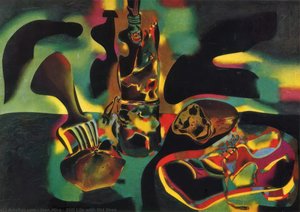
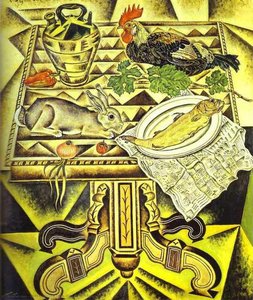


Biografie van de kunstenaar
A Catalan Visionary: The Life and Art of Joan Miró
Joan Miró i Ferrà, born in Barcelona in 1893, stands as one of the most significant figures in 20th-century art. His journey was not merely a progression through styles but an exploration of inner worlds, translating dreams, memories, and Catalan identity onto canvas with a uniquely poetic visual language. From humble beginnings marked by illness and initial parental reservations about his artistic pursuits, Miró persevered, driven by an innate need to express the intangible—the emotions, sensations, and subconscious currents that lie beneath the surface of reality. His early life was steeped in the traditions of Barcelona, a city brimming with architectural marvels thanks to Antoni Gaudí, whose organic forms would subtly influence Miró’s later abstractions. The goldsmithing profession of his father instilled an appreciation for meticulous craftsmanship, while the rugged Catalan landscape became a recurring motif and source of inspiration throughout his career.Early Influences and the Path to Surrealism
Miró's formal artistic training began at La Llotja in Barcelona, where he honed his skills in traditional techniques. However, it was exposure to the avant-garde movements sweeping through Paris that truly ignited his creative evolution. The vibrant colors of Fauvism and the fragmented forms of Cubism resonated deeply, prompting him to move to Paris in 1920. This period proved pivotal as he encountered artists like Pablo Picasso and began experimenting with increasingly abstract compositions. Yet, Miró didn’t simply adopt these styles; he synthesized them, forging a path toward his own distinctive aesthetic. He sought to distill forms to their essence, stripping away representational details in favor of symbolic shapes and evocative colors. This exploration led him to the Surrealist group in 1924, aligning him with artists such as Max Ernst and Salvador Dalí. While embracing the Surrealist interest in the subconscious, Miró maintained a unique sensibility—his work was less about shocking imagery or Freudian symbolism than it was about creating a world of playful forms and poetic suggestion.The Language of Symbols: Key Works and Artistic Innovations
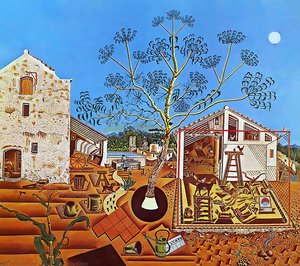
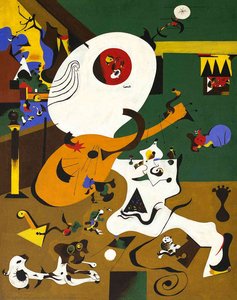
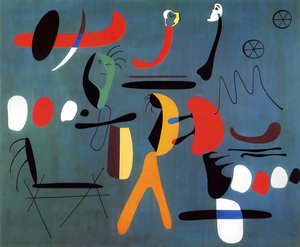
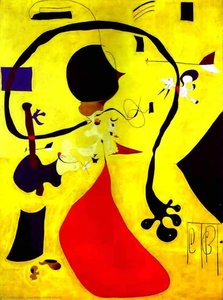
Throughout the 1920s and 30s, Miró developed his signature visual vocabulary—a universe populated by biomorphic shapes, floating forms, and vibrant colors. The Farm (1922), often considered a cornerstone of his oeuvre, exemplifies this transition. It’s not merely a depiction of rural life but an evocation of Catalan identity and a symbolic representation of the natural world. His collaborative spirit led to innovative techniques like *grattage*, pioneered with Max Ernst in 1926 for designs intended for Sergei Diaghilev's ballet, where textures were revealed by scraping paint across canvas. The Dutch Interiors (1928) series demonstrated his ability to reinterpret the Old Masters through a distinctly modern lens, transforming domestic scenes into dreamlike abstractions. Painting (1933), with its bold colors and simplified forms, encapsulates Miró’s exploration of the subconscious and his rejection of conventional artistic boundaries. Beyond painting, Miró fearlessly experimented with sculpture, ceramics, and printmaking, expanding his creative horizons and demonstrating a remarkable versatility.Legacy and Enduring Influence
Joan Miró's impact on 20th-century art is undeniable. He wasn’t simply a painter; he was a visionary who challenged the very definition of artistic expression. His work paved the way for abstract expressionism and continues to inspire artists across disciplines. He established two foundations—the Fundació Joan Miró in Barcelona (1975) and the Fundació Pilar i Joan Miró in Palma de Mallorca (1981)—ensuring that his legacy would endure, providing spaces for artistic exploration and education. Throughout his long career, he remained committed to pushing boundaries, questioning conventions, and exploring the depths of human imagination. Miró’s art is a testament to the power of abstraction, symbolism, and poetic expression—a vibrant celebration of life, dreams, and the enduring spirit of Catalan culture. His work continues to resonate with audiences worldwide, inviting us to enter a world where anything is possible and the boundaries between reality and fantasy blur into a captivating dance of color and form.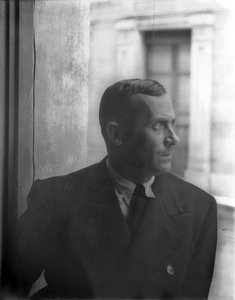
Joan Miró
1893 - 1983 , Spanje
Belangrijkste feiten
- Artistic Movement Or Style: Surrealisme, Abstract Art
- Artists Who Influenced This Artist:
- Pablo Picasso
- Sergei Diaghilev
- Date Of Birth: 20 april 1893
- Full Name: Joan Miró i Ferrà
- Nationality: Spanish
- Notable Artworks:
- The Farm
- Dutch Interiors
- Painting
- Place Of Birth: Barcelona, Spain
Gerelateerde artikelen
Joan Miró's Top 25 Meesterwerken: Kleurrijke Dromen voor Je Interieur | AllPaintingsStore
Ontdek de top 25 kunstwerken van Joan Miró! Duik in zijn kleurrijke wereld vol surrealisme & abstractie. Leer over zijn techniek en vind museumkwaliteit reproducties voor jouw interieur op AllPaintingsStore.com.

Deconstructing Reality: A Comprehensive Exploration of Cubist Still Life
Explore the revolutionary world of Cubist Still Life with AllPaintingsStore. Discover Picasso & Braque's groundbreaking techniques, its philosophical roots, and lasting impact on modern art. Expert insights for collectors.

De Kunst van het Vastleggen: Gepersonaliseerde Stilllevensschilderijen als Tijdloze Decoratie voor de Keuken en Eetkamer
Creëer een uniek stilleven schilderij op maat bij AllPaintingsStore! Handgeschilderde reproducties van topkwaliteit, perfect voor uw keuken of eetkamer. Ontdek luxe kunst & interieurdecoratie met onze expertise.

Bernard Cathelin: A Poetic Realist's Exploration of Still Life and the French Landscape
Explore the captivating world of Bernard Cathelin, a master of French Poetic Realism. Discover his stunning still lifes & landscapes, and learn about his legacy with AllPaintingsStore.

Van Klassieke Stilleven tot Hedendaagse Abstractie: Het Verrijken van Villa's en Ontvangstruimtes door Kunstzinnige Reproducies
Verrijk uw villa met prachtige kunstzinnige reproducties & abstracte schilderijen. Handgeschilderd, custom portretten en deskundig advies van AllPaintingsStore.com. Vind uw perfecte stuk!