

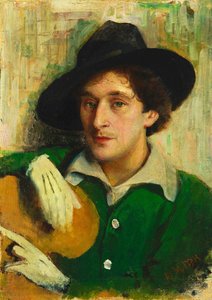
1914. Oil On Canvas.

§ 1Catalogusgegevens


Dit kunstwerk is auteursrechtelijk beschermd
De kunstwerken die op deze pagina worden weergegeven, zijn beschermd door de auteursrechtwetgeving, wat betekent dat het ons wettelijk niet is toegestaan om identieke reproducties te maken of te verkopen. Deze bescherming wordt gehandhaafd onder internationale overeenkomsten zoals de Conventie van Bern en door nationale wetgeving, waaronder de bepalingen van de Amerikaanse auteurswet - Titel 17. Alle rechten voorbehouden. Reproduceren of distribueren van afbeeldingen is niet toegestaan zonder uitdrukkelijke schriftelijke toestemming van WahooArt.com en de rechthebbenden.
Als een respectvol en legaal alternatief bieden wij op maat gemaakte, handgeschilderde kunstwerken aan die geïnspireerd zijn op het origineel. Onze bekwame en professionele kunstenaars bestuderen zorgvuldig de stijl, sfeer en artistieke essentie van het origineel om een nieuw, uniek werk te creëren dat dezelfde emotie oproept – terwijl het een op zichzelf staande, originele creatie blijft.
Deze methode voldoet volledig aan de auteursrechtwetgeving, omdat het niet gaat om het kopiëren of dupliceren van het beschermde kunstwerk. In plaats daarvan is er sprake van een creatieve herinterpretatie — een nieuw schilderij dat door het origineel wordt geïnspireerd, maar er niet identiek aan is.
 Lees meer over
§ 2Abstract
Beschrijving verzamelobject
Experience Marc Chagall's 'The Fiddler,' a vibrant Cubist masterpiece depicting a musician and his audience. Explore its surreal imagery, folklore-inspired style, and artistic significance.
Biografie kunstenaar
Ontdek Marc Chagall (1887-1985), een Russische kunstenaar die bekend staat om zijn droomachtige schilderijen, thema's uit het Joodse folklore en prachtige kleurrijke glaswerkkunst. Een artistieke erfenis die blijft inspireren!
§ 3Toelichting
A Portrait of Rural Reverie: Marc Chagall’s “The Fiddler”
Marc Chagall's "The Fiddler," painted in 1914 during his formative years in Paris, isn’t merely a depiction of a man playing an instrument; it’s a shimmering portal into a world steeped in folklore, memory, and the quiet beauty of rural life. This oil on canvas, currently residing within the Kunstsammlung Nordrhein-Westfalen in Düsseldorf, embodies the artist's unique synthesis of influences – a potent blend of Cubism’s fractured perspectives, the vibrant hues of Fauvism, and the deeply personal symbolism rooted in his Jewish heritage.
The scene unfolds with an immediate sense of dreamlike tranquility. A solitary fiddler, rendered with bold, almost childlike strokes, stands before a modest dwelling, its snow-dusted roof hinting at a harsh winter landscape. His face, etched with a gentle melancholy and framed by a flowing red coat, is instantly recognizable – a figure both familiar and profoundly enigmatic. Around him, the composition isn’t concerned with strict realism; instead, Chagall employs Cubist principles to deconstruct forms into geometric shapes, layering planes and creating an intriguing sense of spatial ambiguity. The figures observing from afar are rendered in muted tones, almost dissolving into the background, suggesting a community witnessing this solitary moment.
The Language of Cubism and Jewish Folklore
Chagall’s embrace of Cubism is evident not as a rigid adherence to its tenets but rather as a means to express his inner vision. The fragmented forms, tilted perspectives, and overlapping planes aren't simply stylistic choices; they mirror the artist’s desire to capture fleeting memories and emotional states. Crucially, however, “The Fiddler” transcends mere Cubist experimentation. It’s deeply intertwined with Chagall’s personal iconography – a vocabulary of symbols drawn from his childhood in Vitebsk, Belarus, a region where Jewish culture thrived alongside Orthodox Christianity.
The fiddle itself is a potent symbol, representing not just music but also storytelling, tradition, and the preservation of cultural memory. The red coat, a recurring motif in Chagall’s work, often signifies passion, vitality, or even sacrifice. The presence of the boy – presumably the fiddler's son – adds another layer of meaning, evoking themes of lineage, continuity, and the passing down of heritage. Furthermore, the snow-covered house suggests both hardship and resilience—a testament to the enduring spirit of a rural community.
A Window into Chagall’s Artistic Evolution
Painted in the wake of World War I, “The Fiddler” reflects a period of profound artistic upheaval. Chagall was grappling with new ideas and experimenting with different styles, seeking to forge his own distinct voice amidst the revolutionary currents sweeping through the art world. This work demonstrates his early exploration of abstraction while retaining a strong connection to representational imagery and deeply personal symbolism. It’s a pivotal piece in understanding his artistic trajectory – a bridge between his formative years in Vitebsk and his later, more overtly expressive works.
The influence of artists like Pablo Picasso and Henri Matisse is undeniable, yet Chagall skillfully integrates these influences into his own unique style. His use of bold colors—particularly the vibrant red against the muted blues and whites—creates a dynamic visual impact, drawing the viewer’s eye through the composition. The painting's emotional resonance stems from its ability to evoke a sense of nostalgia, solitude, and the quiet dignity of everyday life. It is a testament to Chagall’s extraordinary talent for transforming personal memories into universal symbols.
Reproductions and Experiencing Chagall’s Vision
Art enthusiasts now have the opportunity to bring the magic of “The Fiddler” into their homes through meticulously crafted oil painting reproductions offered by AllPaintingsStore.com and similar platforms. These reproductions strive to capture not only the visual details of the original but also its emotional essence – the dreamlike quality, the vibrant colors, and the profound sense of human connection. By owning a reproduction of “The Fiddler,” one gains access to a timeless masterpiece that continues to resonate with viewers across generations.
For further exploration into Marc Chagall’s life and work, we encourage you to visit AllPaintingsStore.com or the Stedel museum for a deeper understanding of this extraordinary artist.
Veelgestelde vragen
Welke afdrukinstellingen worden aanbevolen voor "The Fiddler" door Marc Chagall?
Voor een afdruk van "The Fiddler" door Marc Chagall wordt een formaat van Medium aanbevolen in Portrait oriëntatie.
Hoe groot is het contrast in "The Fiddler" door Marc Chagall?
Het licht-donkercontrast van "The Fiddler" wordt weergegeven als Statement. Contrast beschrijft hoe sterk de lichte en donkere vlakken van elkaar verschillen.
Maakt "The Fiddler" door Marc Chagall gebruik van sterke contrasten of zachte harmonieën?
De kleurcompositie van "The Fiddler" door Marc Chagall combineert een Statement contrast met een Discordant Palette harmonie.


 Schakel over naar print


 Voor kunstwerken of reproducties die aan één zijde groter zijn dan 105 cm (ongeveer 41 inch), wordt de lijst als een losse set verzonden. Deze methode garandeert een veilige levering en voorkomt schade tijdens het transport.


