


 Voorvertoning
 Verstuur
 Delen
Delen
 Details bekijken
 Gids
Gids

 Download
 Vergelijkbare items
 Röntgenonderzoek
 Diavoorstelling
 Vraag & antwoord
 Statistieken
The Chess Players

- 61.0 x 50.0 cm


 Lees meer
De kunstwerken die op deze pagina worden weergegeven, zijn beschermd door de auteursrechtwetgeving, wat betekent dat het ons wettelijk niet is toegestaan om identieke reproducties te maken of te verkopen. Deze bescherming wordt gehandhaafd onder internationale overeenkomsten zoals de Conventie van Bern en door nationale wetgeving, waaronder de bepalingen van de Amerikaanse auteurswet - Titel 17. Alle rechten voorbehouden. Reproduceren of distribueren van afbeeldingen is niet toegestaan zonder uitdrukkelijke schriftelijke toestemming van WahooArt.com en de rechthebbenden.
Deze methode voldoet volledig aan de auteursrechtwetgeving, omdat het niet gaat om het kopiëren of dupliceren van het beschermde kunstwerk. In plaats daarvan is er sprake van een creatieve herinterpretatie — een nieuw schilderij dat door het origineel wordt geïnspireerd, maar er niet identiek aan is.
Giclée / Kunstafdrukken
Giclée- of canvasafdruk van museumkwaliteit met een snelle productie en flexibele afwerkingsmogelijkheden. ( Bestel handgeschilderde reproductie Schakel over naar digitale afbeeldingen)




P118B €10

P118H €10

P118W €10

P438Z €10

P508JH €12

P508YH €12

P805H €10

P805Z €10

P919BZ €10

P919G €10

P919XJ €10

P959ZH €10

P968JZ €12

W106C €8

W218G €10

W218JH €8

W218Y €10

W307PJ €10

W316G €10

W316PJ €8

W316Y €10

W398PJ €8

W4111J €10

W500HY €15

W500JH €15

W692G €12

W849H €8

W940BG €15

W953PJ €8




Kies uit onze vooraf ingestelde maten die overeenkomen met de originele verhoudingen van het kunstwerk.

Voer de gewenste breedte en hoogte in, passend bij uw lijst of muur. Een afdruk kan alleen worden ingekort en nooit groter worden gemaakt dan het origineel; een formaat met andere verhoudingen zal daarom een deel van de afbeelding verliezen. Wij sturen u een digitaal mockup ter goedkeuring voordat we tot drukwerk overgaan. De afbeelding op deze pagina toont niet de werkelijke uitsnede — dit is alleen te zien op het mockup.
Wereldwijde levering () binnen 2 weken in plaats van de standaard 4/5 weken. (4 november)

Gratis wereldwijde expressverzending

Hoogwaardig linnen canvas

Volledige verzendverzekering

Garantie op terugbetaling van invoerrechten

Garantie op exacte kleurweergave

Retourbeleid van 100 dagen (alleen bij defecten)

100% Geld-terug-garantie

Korting bij meerdere afnames
 De optie voor glas is alleen beschikbaar bij een formaat kleiner dan 110 cm.

The Chess Players
Giclée / Kunstafdrukken
Afmetingen reproductie
-


Eindtotaal
€ 58
A Revolutionary Glance at Form and Perception
Marcel Duchamp’s The Chess Players isn't merely a depiction of two men engaged in a game; it’s a profound meditation on the nature of representation, perspective, and the very act of seeing. Completed in 1911, this seminal work stands as a pivotal piece within Proto-Cubism – a transitional phase between traditional representational art and the fully realized geometric abstractions of Cubism itself. Duchamp, a restless intellectual and provocateur, deliberately dismantled conventional artistic norms, inviting viewers to question what constitutes ‘art’ and how we interpret the world around us. The painting's power lies not in its realistic portrayal but in its fragmented forms, overlapping planes, and unsettling intimacy between the figures – a visual embodiment of the complex interplay of thought and emotion.

Proto-Cubism: A Seed of Geometric Revolution
To understand The Chess Players, one must grasp the context of Proto-Cubism. This movement, flourishing between 1906 and 1910, represented a crucial stepping stone towards Cubism’s revolutionary impact on art. Artists like Duchamp began to move away from faithfully replicating reality, instead experimenting with geometric simplification and multiple viewpoints simultaneously. The reduction in color palette – predominantly muted earth tones – further emphasized this shift toward abstraction. Duchamp's approach wasn’t about creating a visually pleasing image; it was an exploration of how objects could be broken down, analyzed, and reassembled within the confines of a single canvas, offering a new way to perceive spatial relationships.
Symbolism and the Intimate Game
The painting's composition is laden with symbolic weight. The two men, positioned close together with their heads touching or appearing to kiss, create an intensely intimate scene. This isn’t a casual encounter; it suggests a deep connection, perhaps even rivalry, fueled by the strategic complexities of chess. The chessboard itself, subtly integrated into the background, becomes a metaphor for life – a game of strategy, deception, and ultimately, human interaction. The presence of the third figure in the distance adds another layer of intrigue, hinting at an unseen force or influence shaping their dynamic. Duchamp’s genius lies in his ability to convey profound ideas through deceptively simple imagery.
A Legacy of Conceptual Art
The Chess Players is more than just a beautiful painting; it's a cornerstone of modern art history and a precursor to the rise of conceptualism. Duchamp’s deliberate rejection of traditional artistic conventions paved the way for artists like Dada, Surrealism, and Pop Art – movements that challenged established notions of beauty, skill, and the role of the artist. The painting’s influence extends far beyond the realm of visual art, impacting music, literature, and architecture as well. Today, owning a high-quality reproduction of The Chess Players offers a unique opportunity to connect with this groundbreaking artistic movement and appreciate Duchamp's enduring legacy. AllPaintingsStore.com provides an exceptional way to bring this iconic work into your home or office, allowing you to experience the power of Proto-Cubism firsthand.
Veelgestelde vragen
Wie heeft "The Chess Players" gemaakt en in welke stijl is het uitgevoerd?
"The Chess Players" werd gecreëerd door Marcel Duchamp in de Cubism-stijl. De kunstenaar en de stroming bepalen de traditie van het werk.
Wat is de dominante kleur van "The Chess Players" door Marcel Duchamp?
Putty (#efe8d9) is de dominante kleur van "The Chess Players" door Marcel Duchamp.
Hoe harmonieus is het kleurgebruik in "The Chess Players" door Marcel Duchamp?
De kleurharmonie van "The Chess Players" wordt beschreven als Unified Palette.
Vergelijkbare kunstwerken


Biografie kunstenaar
Een Revolutionaire Geest: Het Leven en de Kunst van Marcel Duchamp
Marcel Duchamp, geboren als Henri-Robert-Marcel Duchamp in 1887 in Blainville-Crevon, Normandië, was meer dan een kunstenaar; hij was een filosofische provocateur die de koers van de moderne kunst fundamenteel heeft veranderd. Zijn vroege leven, hoewel schijnbaar conventioneel – gevormd binnen een familie die artistieke expressie waardeerde en waarin beide broers succesvolle carrières als kunstenaar nastreefden – hintte al naar het iconoclasme dat nog zou komen. Duchamp volgde aanvankelijk een formele opleiding, waarbij hij traditionele technieken meester werd en experimenteerde met postimpressionistische stijlen. Deze academische basis diende echter niet als een doel op zich, maar als een springplank om de essentie van kunst, haar doel en haar definitie ter discussie te stellen. Hij was niet tevreden met het louter afbeelden van de wereld; hij zocht naar manieren om onze perceptie ervan uit te dagen en te bevragen wat werkelijke artistieke waarde vormt. Deze rusteloze intellectuele nieuwsgierigheid zou het kenmerkende aspect worden van zijn vruchtbare carrière.Van Cubisme naar Dada: Een Afwijzing van Conventie
Duchamps artistieke reis werd gekenmerkt door een constante evolutie, een doelbewuste ontmanteling van gevestigde normen. Zijn vroege betrokkenheid bij het Cubisme, duidelijk zichtbaar in werken zoals Portrait of Chess Players (1911), toonde een interesse in gefragmenteerde vormen en meervoudige perspectieven – een breuk met de traditionele representatie. Toch bewoog hij zich snel voorbij louter esthetische overwegingen, omdat hij besefte dat het simpelweg herordenen van visuele elementen niet volstond om de diepere vragen te beantwoorden die in hem opborrelden. De gruwelen van de Eerste Wereldoorlog voedden dit onbehagen, wat ertoe leidde dat Duchamp het Dadaïsme omarmde, een beweging die voortkwam uit desillusie en een verwerping van logica, rede en traditionele artistieke waarden. Het was binnen het Dadaïstische kader dat Duchamp werkelijk begon de conventionele opvattingen over kunst af te breken. Hij was niet geïnteresseerd in het creëren van mooie objecten; hij wilde gedachten prikkelen, aannames uitdagen en de willekeur van esthetisch oordeel blootleggen. Deze periode zag de geboorte van zijn meest radicale innovatie: de ‘readymade’.De Readymades en de Subversie van de Kunst
De introductie van readymades – alledaagse, industrieel vervaardigde objecten die geselecteerd en gepresenteerd werden als kunst – vormde Duchamps meest significante bijdrage aan de 20e eeuw. Dit waren niet simpelweg gevonden voorwerpen; het waren bewuste daden van artistieke subversie. Door een alledaags item, zoals een urinoir (Fountain, 1917), te voorzien van de handtekening “R. Mutt” en dit in te dienen voor een kunstexpositie, daagde Duchamp de definitie van artistiek vakmanschap en auteurschap uit. Was het de hand van de kunstenaar die het werk creëerde, of was het het idee van de kunstenaar? Deze vraag werd centraal in zijn oeuvre en legde de basis voor de conceptuele kunst. Andere opmerkelijke readymades, zoals L.H.O.O.Q. (1919) – een ansichtkaartreproductie van de Mona Lisa, bewerkt met een snor en een sikje – waren speelse maar scherpe kritieken op de kunstgeschiedenis en gevestigde culturele iconen. Deze werken waren niet bedoeld om bewonderd te worden om hun esthetische kwaliteiten; ze waren bedoeld om debat uit te lokken en toeschouwers te dwingen hun vooroordelen over wat kunst is, te heroverwegen. Duchamp geloofde dat kunst in de geest moet verblijven, en niet enkel in het oog.Nalatenschap en Blijvende Invloed
De impact van Marcel Duchamp op opeenvolgende generaties kunstenaars is onmeetbaar. Hij veranderde ons begrip van kunst fundamenteel en plaveide de weg voor bewegingen zoals de conceptuele kunst, het minimalisme, de popart en talloze anderen. Zijn nadruk op het idee van de kunstenaar – het concept achter het werk – boven de esthetische eigenschappen, blijft kunstenaars tot op de dag van vandaag inspireren.- Cubisme: Vroege verkenning van gefragmenteerde vormen en ruimtelijke representatie.
- Dadaïsme: Verwerping van logica, rede en traditionele artistieke waarden als reactie op de Eerste Wereldoorlog.
- Conceptuele Kunst: De nadruk op het idee achter het kunstwerk in plaats van de esthetische kwaliteiten.
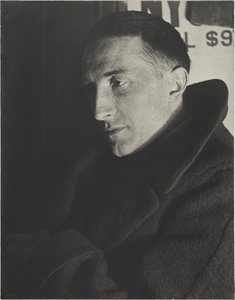
Marcel Duchamp
1887 - 1968 , Frankrijk
Belangrijkste feiten
- Artistic Movement Or Style:
- Cubisme
- Dadaïsme
- Conceptuele kunst
- Artists Or Movements Influenced By This Artist:
- Cubisme
- Surrealisme
- Conceptuele kunst
- Date Of Birth: 28 juli 1887
- Date Of Death: 2 oktober 1968
- Full Name: Marcel Duchamp
- Nationality: Frans-Amerikaans
- Notable Artworks:
- Fontein
- L.H.O.O.Q.
- Het grote glas
- Boîte-en-valise
- Place Of Birth: Blainville, Frankrijk
Gerelateerde artikelen

The Gilded Age Reimagined: Exploring the Aesthetic Principles & Enduring Legacy of Art Deco
Explore the captivating world of Art Deco! Discover its origins, defining features, cultural impact & enduring legacy. Expert insights for collectors and design enthusiasts. Shop handmade reproductions at AllPaintingsStore.

Meesterwerken in Zwart: Top 10 Schilderijen Gedreven door Donkere Tinten | AllPaintingsStore.nl
Ontdek de kracht van donker! Verlies jezelf in onze top 10 zwarte schilderijen, van Caravaggio tot Manet. Leer over meesterwerken, technieken & emotie. Museumkwaliteit reproducties op AllPaintingsStore.com – Kunst voor uw interieur.
Meesterwerken in Zwart: Top 10 Schilderijen Gedreven door Mars Black - AllPaintingsStore
Ontdek de kracht van 'Mars Black' in 10 iconische schilderijen! Van Rembrandt tot Manet, duik in de donkere esthetiek en emotionele diepgang van meesterwerken. Vind museumkwaliteit reproducties & decoratie-inspiratie op AllPaintingsStore.com.

Jean Dominique Antony Metzinger: Pioneering Cubism & the Evolution of Abstract Form
Explore the life & work of Jean Metzinger, a pivotal Cubist painter and theorist. Discover his innovations in proto-Cubism, 'Du Cubisme,' and Crystal Cubism – a journey through modern art's evolution.

Deconstructing Reality: Cubism's Revolutionary Impact on 20th-Century Art
Explore the revolutionary world of Cubism with AllPaintingsStore. Discover Picasso & Braque's groundbreaking techniques, its philosophical roots, and lasting impact on modern art. Expert insights for collectors.


