

Oil On Canvas.

§ 1Catalogue data


Dit kunstwerk is auteursrechtelijk beschermd
De kunstwerken die op deze pagina worden weergegeven, zijn beschermd door de auteursrechtwetgeving, wat betekent dat het ons wettelijk niet is toegestaan om identieke reproducties te maken of te verkopen. Deze bescherming wordt gehandhaafd onder internationale overeenkomsten zoals de Conventie van Bern en door nationale wetgeving, waaronder de bepalingen van de Amerikaanse auteurswet - Titel 17. Alle rechten voorbehouden. Reproduceren of distribueren van afbeeldingen is niet toegestaan zonder uitdrukkelijke schriftelijke toestemming van WahooArt.com en de rechthebbenden.
Als een respectvol en legaal alternatief bieden wij op maat gemaakte, handgeschilderde kunstwerken aan die geïnspireerd zijn op het origineel. Onze bekwame en professionele kunstenaars bestuderen zorgvuldig de stijl, sfeer en artistieke essentie van het origineel om een nieuw, uniek werk te creëren dat dezelfde emotie oproept – terwijl het een op zichzelf staande, originele creatie blijft.
Deze methode voldoet volledig aan de auteursrechtwetgeving, omdat het niet gaat om het kopiëren of dupliceren van het beschermde kunstwerk. In plaats daarvan is er sprake van een creatieve herinterpretatie — een nieuw schilderij dat door het origineel wordt geïnspireerd, maar er niet identiek aan is.
 Lees meer over
§ 2Abstract
Beschrijving verzamelobject
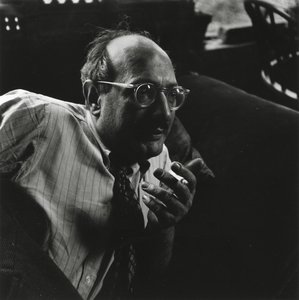
The painting depicts a man standing before a window, dressed in yellow shirt and black pants, gazing out at the scenery. A vibrant red wall serves as backdrop, enhancing the composition's dynamism. Rothko’s masterful technique captures the subject’s posture and expression.
Biografie kunstenaar
Ontdek Mark Rothko (1903-1970), een Amerikaanse kunstenaar die kleurgebruik revolutioneerde en emotionele kunst creëerde met zijn iconische Color Field schilderijen & Abstract Expressionisme.
§ 3Commentary
The Weight of Silence: Contemplating Rothko’s Existential Vision
In the quietude of Mark Rothko’s Portrait 1, one encounters more than just a visual arrangement; one enters a profound dialogue with mortality. This work, emerging from the twilight of the artist's life in 1963, serves as an arresting stillness—a portrait not merely of a man, but of the deep, heavy contemplation inherent in confronting one's own end. While the canvas presents a figure standing before a window, the true subject is the palpable tension between the physical presence of the man and the vast, psychological space he inhabits. The composition captures a moment of profound introspection, where the boundaries between the individual and the infinite begin to blur.
The technique employed here is a masterclass in emotional condensation. Eschewing the frantic gestures of his contemporaries, Rothko utilized thin, luminous washes of pigment—vibrant cadmium yellows, deep crimsons, and somber ultramarine blues—to create expansive planes that seem to breathe upon the canvas. These colors are not merely decorative; they are conduits for raw sensation. As the edges of the rectangular forms bleed into one another, the viewer is invited to bypass intellectual analysis and instead tap into a primal, visceral experience. The way the red wall behind the subject vibrates against his yellow shirt creates a chromatic tension that mirrors the internal struggle between life's vitality and the encroaching shadows of uncertainty.
A Mirror to a Turbulent Era
To understand the gravity of this piece, one must look toward the historical landscape of the 1960s. As the world grappled with the anxieties of the Vietnam War and the looming threat of nuclear annihilation, Rothko sought refuge in a deliberate stripping away of the extraneous. This movement toward a refined minimalism was a reaction against the chaotic energy of earlier Abstract Expressionism. In this portrait, the simplicity of the man’s posture—hands on hips, gaze fixed outward—acts as a vessel for the collective anxieties of an era. The window behind him does not merely provide depth; it serves as a threshold between the known and the unknown, much like the artist's own transition from the tangible world to the realm of pure abstraction.
For the discerning collector or interior designer, this reproduction offers more than just aesthetic beauty; it provides an anchor of contemplative depth. The painting’s ability to command a room through its symbolic weight makes it a centerpiece for spaces dedicated to reflection and intellectual engagement. It is a work that demands presence, inviting anyone who stands before it to pause, breathe, and confront the beautiful, terrifying mystery of existence. Whether placed in a modern gallery setting or a private study, Portrait 1 remains an enduring testament to the power of color to evoke the human soul.
Veelgestelde vragen
Zijn de kleuren van "Portrait 1" door Mark Rothko verzadigd of gedempt?
"Portrait 1" door Mark Rothko heeft een Clear Color Presence verzadiging.
Is de afbeelding van "Portrait 1" door Mark Rothko vrij van auteursrecht?
"Portrait 1" door Mark Rothko valt onder nog steeds auteursrechtelijk beschermd. Deze status bepaalt hoe de afbeelding van het werk mag worden gereproduceerd.
Behoort "Portrait 1" door Mark Rothko tot de meest gezochte Abstract Expressionism kunstwerken?
"Portrait 1" door Mark Rothko wordt geclassificeerd als Iconic en behoort tot de Abstract Expressionism-stroming.


 Schakel over naar print


 Voor kunstwerken of reproducties die aan één zijde groter zijn dan 105 cm (ongeveer 41 inch), wordt de lijst als een losse set verzonden. Deze methode garandeert een veilige levering en voorkomt schade tijdens het transport.



