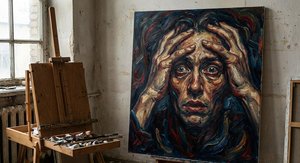
1926. Oil On Canvas, 101.0 x 71.0 cm. Metropolitan Museum of Art.

§ 1Catalogusgegevens

- 101.0 x 71.0 cm


§ 2Abstract
Beschrijving verzamelobject
The painting resides at The Metropolitan Museum of Art (MetCollects), acquired in 2017.
 Lees meer
Biografie kunstenaar
Ontdek het krachtige en symbolische kunstwerk van Max Beckmann (1884-1950). Een belangrijke figuur binnen Duitse Expressionisme, zijn schilderijen laten vervormde figuren zien en aangrijpende landschappen die terugblikken op WOI trauma's & existentiële thema's. Ontdek zijn erfenis vandaag.
§ 3Toelichting
A Gaze Through Time: The Soul of Max Beckmann’s The Old Actress
In the quiet, heavy atmosphere of 1926, Max Beckmann captured a moment that transcends mere portraiture to become a profound meditation on the human condition. The Old Actress is not simply a depiction of a woman in repose; it is a hauntingly beautiful window into the psyche of an era caught between the trauma of the past and the uncertainty of the future. As the viewer approaches this masterpiece, they are immediately met by the piercing, yet distant gaze of the subject, whose eyes seem to wander far beyond the confines of the canvas, searching for memories or perhaps contemplating the inevitable passage of time. This sense of introspection is palpable, inviting anyone who hangs a reproduction of this work in their home to participate in a silent dialogue with history.
The composition is anchored by the striking presence of the woman, seated with a dignified yet weary posture. Her attire—a severe black dress accented with delicate white lace—carries a weight of solemnity, subtly evoking the austerity of clerical garments and hinting at a life lived with deep moral or spiritual consideration. Nestled in her lap, a ginger cat provides the only warmth in an otherwise somber palette, acting as a tender symbol of companionship that simultaneously highlights the profound solitude of the sitter. Beckmann’s mastery of New Objectivity is on full display here; through his use of distorted spatial perspectives and thick, textured brushstrokes, he creates an environment that feels both physically present and psychologically unsettling.
The Texture of Melancholy and Modernity
Technically, the painting is a triumph of expressionistic depth. Beckmann utilizes oil on canvas to build a surface that is as much about tactile emotion as it is about visual representation. The heavy application of paint creates a palpable atmosphere of melancholy, where every stroke contributes to the sense of unease and gravity. This technique serves to ground the subject in a reality that feels weighted by experience. For the discerning collector or interior designer, this piece offers a sophisticated focal point that brings a layer of intellectual and emotional complexity to any space, whether it be a curated gallery wall or a contemplative study.
To understand The Old Actress is to understand the spirit of post-World War I Europe. The painting breathes the disillusionment of a generation that had witnessed the collapse of old certainties. Beckmann, having served as a medical orderly during the Great War, infused his work with an altered vision of humanity—one where figures are often compressed or slightly skewed to reflect internal tension. In this portrait, the stillness is deceptive; beneath the surface lies the restless energy of a world in transition. It is this duality—the outward calm of the actress and the inward turbulence of her era—that makes this work an enduring icon of modern art, offering timeless inspiration for those who appreciate art that speaks to the resilience of the human spirit.
Veelgestelde vragen
In welk jaar werd "The Old Actress" door Max Beckmann gemaakt?
"The Old Actress" door Max Beckmann werd gecreëerd in 1926.
Kan ik "The Old Actress" door Max Beckmann onder ander licht bekijken?
De röntgenweergave van "The Old Actress" door Max Beckmann is te vinden op de Röntgenanalyse-pagina van het kunstwerk: een interactieve verkenning van het beeld door middel van elf optische lagen.
Hoe is de kleurcompositie van "The Old Actress" door Max Beckmann opgebouwd?
De kleurcompositie van "The Old Actress" door Max Beckmann combineert een Statement contrast met een Strong Color Unity harmonie.


 Schakel over naar print


 Voor kunstwerken of reproducties die aan één zijde groter zijn dan 105 cm (ongeveer 41 inch), wordt de lijst als een losse set verzonden. Deze methode garandeert een veilige levering en voorkomt schade tijdens het transport.