

Acrylic On Canvas.

§ 1Catalogusgegevens

Dit kunstwerk is auteursrechtelijk beschermd
De kunstwerken die op deze pagina worden weergegeven, zijn beschermd door de auteursrechtwetgeving, wat betekent dat het ons wettelijk niet is toegestaan om identieke reproducties te maken of te verkopen. Deze bescherming wordt gehandhaafd onder internationale overeenkomsten zoals de Conventie van Bern en door nationale wetgeving, waaronder de bepalingen van de Amerikaanse auteurswet - Titel 17. Alle rechten voorbehouden. Reproduceren of distribueren van afbeeldingen is niet toegestaan zonder uitdrukkelijke schriftelijke toestemming van WahooArt.com en de rechthebbenden.
Als een respectvol en legaal alternatief bieden wij op maat gemaakte, handgeschilderde kunstwerken aan die geïnspireerd zijn op het origineel. Onze bekwame en professionele kunstenaars bestuderen zorgvuldig de stijl, sfeer en artistieke essentie van het origineel om een nieuw, uniek werk te creëren dat dezelfde emotie oproept – terwijl het een op zichzelf staande, originele creatie blijft.
Deze methode voldoet volledig aan de auteursrechtwetgeving, omdat het niet gaat om het kopiëren of dupliceren van het beschermde kunstwerk. In plaats daarvan is er sprake van een creatieve herinterpretatie — een nieuw schilderij dat door het origineel wordt geïnspireerd, maar er niet identiek aan is.
 Lees meer over
§ 2Abstract
Beschrijving verzamelobject
Biografie kunstenaar
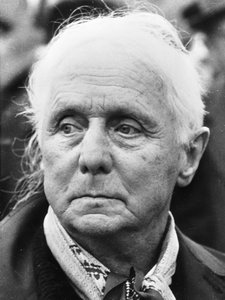
Max Ernst (1891-1976): Een baanbrekende Duitse surrealist! Bekend om frottage, collages & droomachtige schilderijen met vogels, landschappen en psychologische thema's. #MaxErnst #Surrealisme
§ 3Toelichting
Oiseau vert: A Surrealist Echo of Childhood Loss
Max Ernst’s “Oiseau vert,” a deceptively simple etching and aquatint depicting a bird adorned with spiraling patterns, transcends mere visual representation. It embodies the core tenets of Surrealism—a deliberate confrontation with the subconscious mind and an exploration of dreamlike imagery—and stands as a poignant testament to Ernst’s personal history.
- Subject Matter: The bird itself is rendered in shades of blue, immediately establishing a connection to themes of serenity and contemplation. However, its dominant feature – the intricate spiral design – isn't merely decorative; it symbolizes regeneration, cyclical time, and the transformative power of imagination. Spirals are found throughout Ernst’s oeuvre, representing journeys inward and outward, mirroring the artist’s own intellectual quest.
- Style & Technique: Ernst’s masterful execution showcases his signature frottage technique—a method he discovered serendipitously during a rainy afternoon in Pornic, France. As documented in Bukowskis auction records, Ernst described how rubbing a pencil across textured surfaces like burlap or wood unlocked unexpected visual impulses. This process deliberately disrupts conventional artistic conventions, prioritizing spontaneity and intuition over meticulous planning.
- Historical Context: Created in 1965, “Oiseau vert” emerged from the fertile ground of Surrealism’s heyday—a movement born out of Dada’s rejection of rationality during World War I. Ernst's exploration of psychological landscapes aligns perfectly with Surrealist artists like Yves Tanguy and Urs Fischer who sought to capture the elusive realm of dreams and unconscious desires.
- Symbolism: The bird, as a recurring motif in Ernst’s work, represents freedom—a concept deeply intertwined with his childhood experience. Ernst recounted how the death of his beloved parrot Hornebom coincided with his sister Loni's birth, triggering an imaginative leap where he envisioned Loni as Hornebom’s reincarnation. This narrative informs Lop Lop, Ernst’s alter ego – a mystical bird embodying liberation born from mortality—and underscores the artist’s preoccupation with confronting existential anxieties.
- Emotional Impact: “Oiseau vert” invites viewers to contemplate themes of loss and rebirth. The delicate etching captures a moment of quiet contemplation, mirroring Ernst's own introspective approach to artmaking. Its understated beauty speaks volumes about the power of Surrealism to evoke profound emotional responses and stimulate imaginative thought.
Further exploration into Max Ernst’s artistic journey can be found on Max Ernst’s Artist Database, where you can discover his groundbreaking contributions to Surrealism and Dada. Also, consider examining similar artworks by Ruan Zude (Ruan Zude’s Artist Database) or Urs Fischer (Yves Tanguy & Urs Fischer Artists Database), artists who share Ernst's fascination with dreamlike imagery and unconventional techniques.
Veelgestelde vragen
In welke ruimte wordt het tonen van "Oiseau vert" aanbevolen, gezien het kleurenpalet?
Gezien het Neutrals kleurenpalet wordt "Oiseau vert" aanbevolen voor een Living Room.
Waarvoor wordt het gebruik van "Oiseau vert" door Max Ernst aanbevolen?
Een reproductie van "Oiseau vert" door Max Ernst wordt aanbevolen voor Accent. Dit advies is gebaseerd op het onderwerp, de sfeer en de kleuren van het werk.
Waar kan ik statistieken vinden over "Oiseau vert" door Max Ernst?
Er bestaat een Statistieken-pagina voor "Oiseau vert". Deze brengt de maandelijkse bezoeken aan het kunstwerk en andere werken van de kunstenaar in kaart, met uitsplitsingen naar land en taal.


 Schakel over naar print


 Voor kunstwerken of reproducties die aan één zijde groter zijn dan 105 cm (ongeveer 41 inch), wordt de lijst als een losse set verzonden. Deze methode garandeert een veilige levering en voorkomt schade tijdens het transport.


