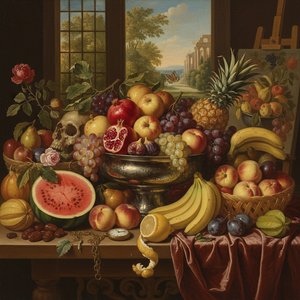
Acrylic On Canvas.

§ 1Catalogusgegevens


Dit kunstwerk is auteursrechtelijk beschermd
De kunstwerken die op deze pagina worden weergegeven, zijn beschermd door de auteursrechtwetgeving, wat betekent dat het ons wettelijk niet is toegestaan om identieke reproducties te maken of te verkopen. Deze bescherming wordt gehandhaafd onder internationale overeenkomsten zoals de Conventie van Bern en door nationale wetgeving, waaronder de bepalingen van de Amerikaanse auteurswet - Titel 17. Alle rechten voorbehouden. Reproduceren of distribueren van afbeeldingen is niet toegestaan zonder uitdrukkelijke schriftelijke toestemming van WahooArt.com en de rechthebbenden.
Als een respectvol en legaal alternatief bieden wij op maat gemaakte, handgeschilderde kunstwerken aan die geïnspireerd zijn op het origineel. Onze bekwame en professionele kunstenaars bestuderen zorgvuldig de stijl, sfeer en artistieke essentie van het origineel om een nieuw, uniek werk te creëren dat dezelfde emotie oproept – terwijl het een op zichzelf staande, originele creatie blijft.
Deze methode voldoet volledig aan de auteursrechtwetgeving, omdat het niet gaat om het kopiëren of dupliceren van het beschermde kunstwerk. In plaats daarvan is er sprake van een creatieve herinterpretatie — een nieuw schilderij dat door het origineel wordt geïnspireerd, maar er niet identiek aan is.
 Lees meer over
§ 2Abstract
Beschrijving verzamelobject
Michelangelo Merisi da Caravaggio's 'Boy with a Basket of Fruit' captures youthful innocence and tactile beauty through masterful light & shadow. A timeless Baroque masterpiece.
Biografie kunstenaar
Pablo Picasso (1881-1973) was een revolutionaire Spaanse schilder en beeldhouwer, medeoprichter van het kubisme en meester van diverse stijlen. Bekend om iconische werken zoals Guernica, blijft zijn nalatenschap inspireren.
§ 3Toelichting
The Allure of Still Life: Picasso’s Fruit Basket
Pablo Picasso's “Fruit Basket,” a seemingly simple depiction of a humble basket overflowing with ripe produce, is anything but straightforward. Created around 1593 (though often attributed to Caravaggio), this painting transcends the ordinary still life genre, becoming a profound exploration of form, light, and human interaction—a testament to the artist’s masterful manipulation of space and his keen observation of the natural world. It's a work that invites prolonged contemplation, revealing layers of meaning beneath its vibrant surface.
The scene itself is deceptively uncomplicated: a wooden basket rests on a table, laden with apples, oranges, pears, grapes, and bananas. However, Picasso—or rather, the artist who created this earlier version—doesn’t merely present these objects; he dissects them, reassembling them in a way that challenges our perception of reality. The arrangement isn't dictated by conventional rules of composition but by an internal logic, driven by the interplay of light and shadow, volume and flatness. The artist’s focus is not on photographic realism, but rather on capturing the essence of each fruit—its texture, its weight, its inherent beauty—through a carefully orchestrated visual vocabulary.
Caravaggio's Influence: A Dialogue Across Time
While often associated with Picasso, it’s crucial to acknowledge the significant influence of Caravaggio on this particular work. The painting shares a remarkable kinship with Caravaggio’s “Boy with a Basket of Fruit,” created around the same period and employing strikingly similar techniques. Both artists masterfully utilize chiaroscuro—the dramatic contrast between light and dark—to sculpt form and create a sense of depth. The strong directional lighting, originating from an unseen window, dramatically illuminates the fruit basket, casting deep shadows that emphasize its three-dimensionality. This technique, borrowed from Northern European painting traditions, was revolutionary for its time, injecting drama and realism into the still life genre.
However, Picasso’s approach diverges subtly. Unlike Caravaggio's meticulous rendering of individual objects, Picasso employs a more fragmented style, breaking down forms into geometric shapes and planes. This foreshadows his later development of Cubism, where he would further deconstruct reality and present multiple viewpoints simultaneously. The painting is not simply a representation of fruit; it’s an exploration of how we *see* fruit—a visual puzzle that invites the viewer to actively engage with the artwork.
Symbolic Resonance: Beyond the Bounty
The seemingly straightforward subject matter of “Fruit Basket” carries symbolic weight. The abundance of fruit can be interpreted as a representation of fertility, prosperity, and the bounty of nature—themes frequently explored in Renaissance art. However, Picasso’s use of muted colors – predominantly browns, grays, and ochres – tempers this celebratory mood, suggesting a sense of melancholy or quiet contemplation. The young seller, positioned centrally within the composition, embodies vulnerability and perhaps even loneliness. He is not actively engaged with the fruit; rather, he seems lost in thought, his gaze directed towards an unseen horizon.
Furthermore, the painting’s composition echoes the principles of *xenia*, a Roman custom of offering gifts of fruits and vegetables to guests. This gesture of hospitality subtly elevates the scene, suggesting a connection between the artist, the model, and the viewer—a shared appreciation for beauty and abundance. The careful arrangement of the fruit, almost like a still life sculpture, invites us to pause and consider the simple pleasures of everyday life.
A Legacy of Innovation: Picasso’s Early Masterpiece
“Fruit Basket” stands as a pivotal work in Picasso's artistic development—a bridge between his early training in naturalistic representation and his later revolutionary explorations of form and space. It demonstrates his remarkable ability to synthesize diverse influences, blending Caravaggio’s dramatic chiaroscuro with the emerging principles of Cubism. This painting is not merely a depiction of fruit; it’s a meditation on perception, symbolism, and the enduring power of art to capture the essence of human experience. Reproductions of this captivating artwork offer a unique opportunity to appreciate Picasso's genius and his profound understanding of the visual world.
Veelgestelde vragen
Kan ik een olieverfreproductie van "Fruit basket" bestellen?
Handgeschilderde reproducties van "Fruit basket" door Pablo Picasso zijn verkrijgbaar via deze website: een met de hand geschilderde olieverfreproductie op linnen canvas, te bestellen op de Handgeschilderde reproductie pagina.
Waarvoor wordt een reproductie van "Fruit basket" door Pablo Picasso aanbevolen?
Een afdruk van "Fruit basket" wordt aanbevolen voor Accent.
Welke afmeting voor de reproductie wordt aanbevolen voor "Fruit basket" door Pablo Picasso?
Voor "Fruit basket" door Pablo Picasso wordt een reproductie van Medium aanbevolen. De afmetingen kunnen worden aangepast met behoud van de verhoudingen.



 Schakel over naar print


 Voor kunstwerken of reproducties die aan één zijde groter zijn dan 105 cm (ongeveer 41 inch), wordt de lijst als een losse set verzonden. Deze methode garandeert een veilige levering en voorkomt schade tijdens het transport.