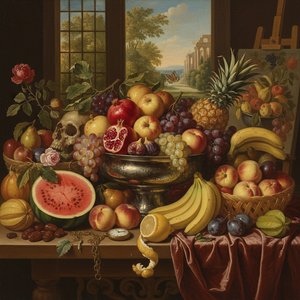
Acrylic On Canvas.

§ 1Catalogue data

§ 2Abstract
Beschrijving verzamelobject
 Lees meer
Biografie kunstenaar
De Evolutie van een Stijl</h2> Cézannes vroege werk weerspiegelde vaak de dramatische
§ 3Commentary
A Quiet Still Life Reflecting Cézanne’s Revolutionary Vision
Paul Cézanne's *untitled (3142)*, a deceptively simple depiction of fruit and kitchen utensils, embodies the artist’s groundbreaking approach to painting—a radical departure from Impressionism that paved the way for Cubism. Completed around 1896-97 during his prolific Parisian period, this canvas isn't merely an observation of objects; it’s a deliberate exploration of form and space, reflecting Cézanne’s unwavering conviction that art should strive to capture not just what is seen but also what is felt. The painting itself presents a meticulously arranged composition featuring apples, oranges, a basket, two cups, and a bowl against a muted backdrop—elements chosen with careful consideration for their visual relationships.The Style of Analytical Cubism: Beyond Impressionistic Illusion
Cézanne’s stylistic evolution began with Impressionism, where he initially sought to capture fleeting moments of light and color. However, disillusioned by the limitations of this approach, he embarked on a transformative journey toward Analytical Cubism. Unlike Impressionists who prioritized optical perception, Cézanne dismantled objects into geometric shapes—cylinders, cubes, spheres—representing their underlying structure rather than their surface appearance. This technique is evident in the flattened planes of color and form that dominate *untitled (3142)*, creating a sense of spatial ambiguity that challenges traditional perspective. The artist deliberately avoids blending colors, opting instead for juxtaposed hues to heighten visual impact and convey a feeling of solidity and permanence—a stark contrast to Impressionistic shimmer.Historical Context: Cézanne’s Influence on Modern Art
Cézanne's artistic experimentation occurred during a period of significant intellectual ferment in Europe. The burgeoning Symbolist movement, alongside the rise of Nietzschean philosophy questioning established moral values, fueled debates about the role of art and its ability to express deeper truths. Cézanne’s uncompromising pursuit of formal innovation resonated powerfully with artists like Picasso and Braque, who would subsequently develop Cubism—a revolutionary style that irrevocably altered the landscape of 20th-century art. His insistence on depicting objects from multiple viewpoints simultaneously foreshadowed the fragmentation characteristic of Cubist canvases, establishing him as a pivotal figure in artistic history.Symbolic Resonance: Apples and Vessels – Representations of Stillness and Transformation
The choice of fruit—specifically apples and oranges—holds symbolic significance within Cézanne’s oeuvre. Apples have long been associated with immortality and knowledge, representing the pursuit of enlightenment and beauty. The oranges contribute to a sense of warmth and vibrancy against the cool tones of the background, hinting at an underlying dynamism despite the apparent stillness of the scene. Furthermore, the cups and bowl serve as vessels—containers holding not only objects but also ideas and emotions. Their placement on the table underscores Cézanne’s preoccupation with capturing the essence of existence—the interplay between form and space, solidity and fragility.Emotional Impact: A Meditation on Perception and Form
Ultimately, *untitled (3142)* transcends mere visual representation; it invites contemplation about how we perceive the world around us. Cézanne's masterful manipulation of color and texture compels viewers to engage actively with the artwork, prompting them to consider its underlying structure and emotional resonance. The painting’s quiet grandeur speaks to a deeper yearning for permanence amidst the ephemeral nature of life—a sentiment that continues to captivate audiences today. Reproductions of this iconic piece offer an opportunity to experience Cézanne's revolutionary vision firsthand, bringing his profound artistic exploration into any interior space.Veelgestelde vragen
Onder welke pseudoniemen of andere namen is Paul Cézanne bekend?
Paul Cézanne staat ook bekend onder de namen Paul Cezanne.
Hoe harmonieus zijn de kleuren van "untitled (3142)" door Paul Cézanne?
"untitled (3142)" door Paul Cézanne vertoont een Discordant Palette kleurharmonie.
Waar kan ik een print van "untitled (3142)" door Paul Cézanne kopen?
"untitled (3142)" is verkrijgbaar als een fine art print op katoenen canvas of archiefwaardig canvaspapier. U kunt uw bestelling plaatsen op de Fine Art Print pagina, in de afmeting naar keuze.


 Schakel over naar print


 Voor kunstwerken of reproducties die aan één zijde groter zijn dan 105 cm (ongeveer 41 inch), wordt de lijst als een losse set verzonden. Deze methode garandeert een veilige levering en voorkomt schade tijdens het transport.