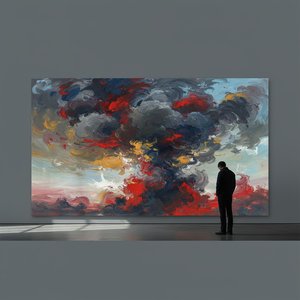
1948. Acrylic On Canvas. Museum of Modern Art.

§ 1Catalogusgegevens


§ 2Abstract
Beschrijving verzamelobject
Experience Jackson Pollock's iconic "Number 1", 1948! A vibrant drip painting embodying Abstract Expressionism’s raw energy & dynamic composition. A must-see masterpiece!
 Lees meer
Biografie kunstenaar
Jackson Pollock (1912-1956) was een baanbrekende Amerikaanse kunstenaar die bekend staat om zijn 'drip painting'-techniek en abstract expressionisme. Zijn iconische werken, zoals "Lavender Mist", verkennen emotie en beweging op ongekende wijze.
§ 3Toelichting
A Universe in Chaos and Control: Deconstructing Jackson Pollock’s “Number 1”
Jackson Pollock's "Number 1, 1948," housed within the hallowed halls of the Museum of Modern Art in New York, isn’t merely a painting; it’s an immersion. It’s a visceral experience that pulls you into the heart of Abstract Expressionism, demanding not just observation but engagement – a willingness to surrender to its dynamic energy and embrace the inherent ambiguity at its core. Created during a pivotal moment in Pollock's career, this monumental canvas represents a radical departure from traditional artistic conventions, embodying a new language of gesture, color, and emotion.
The painting’s genesis lies within Pollock’s revolutionary “drip” technique – a method he meticulously developed over years. Forget brushes and palettes; here, the artist became a conduit, channeling paint directly from cans onto an unstretched canvas laid flat on the floor of his studio. This unorthodox approach liberated him from the constraints of conventional composition, allowing for a breathtaking freedom of movement and a profound connection between the artist’s body and the artwork. The result is a surface teeming with layered pigments – yellows, blues, blacks, reds, and whites – all suspended in a chaotic yet strangely balanced arrangement. It's as if Pollock has captured a fleeting moment of pure, unadulterated energy, frozen in time.
Decoding the Composition: Order Within the Storm
At first glance, “Number 1” appears to be an explosion of color and form – a swirling vortex of seemingly random marks. However, beneath this surface chaos lies a carefully constructed composition. The painting is anchored by four distinct black masses that frame the central field, creating a sense of contained dynamism. These dark shapes act as boundaries, defining the space within which the vibrant colors dance and collide. A vertical element, resembling a column of black paint and canvas, powerfully directs the viewer’s eye across the expanse of the painting, mimicking the movement of a flowing river or a towering structure.
Furthermore, a diagonal line slicing through the composition from lower left to upper right generates a subtle tension, adding a layer of complexity to the overall visual experience. Scattered throughout the canvas are tiny, intensely colored drips – reds, yellows, oranges, and blues – that function as miniature focal points, each carrying its own symbolic weight. The prominent red dot near the center is often interpreted as a representation of individuality within the vastness of existence, a small beacon of self-awareness amidst an overwhelming universe.
The Soul of Abstraction: Pollock’s Legacy
“Number 1” isn't simply about color and form; it’s deeply rooted in the context of Abstract Expressionism, a movement that emerged in mid-20th century America as a reaction against European artistic traditions. Artists like Pollock sought to express raw emotion and subjective experience through non-representational imagery. Pollock himself struggled with personal demons – alcoholism and emotional instability – and many believe these internal conflicts found expression within his art. The frenetic energy of “Number 1” can be seen as a reflection of this turbulent inner world.
Jackson Pollock’s legacy extends far beyond the canvas. He fundamentally altered our understanding of what painting could be, paving the way for future generations of artists to explore new forms of expression. “Number 1, 1948” stands as a testament to his innovative spirit and his profound impact on the art world – a captivating masterpiece that continues to challenge and inspire viewers today.
Veelgestelde vragen
Hoe groot is het contrast in "Number 1" door Jackson Pollock?
"Number 1" door Jackson Pollock vertoont een Balanced contrast tussen de lichte en donkere partijen.
Zijn de kleuren van "Number 1" levendig of gedempt?
"Number 1" door Jackson Pollock is vastgelegd met een Muted verzadiging en een Monochromatic intensiteit.
Wie is de maker van "Number 1" en uit welk jaar stamt het werk?
"Number 1" werd in 1948 gecreëerd door Jackson Pollock.


 Schakel over naar print


 Voor kunstwerken of reproducties die aan één zijde groter zijn dan 105 cm (ongeveer 41 inch), wordt de lijst als een losse set verzonden. Deze methode garandeert een veilige levering en voorkomt schade tijdens het transport.