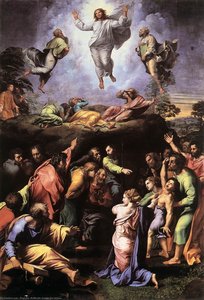
1506. Olieverf op paneel, 28.0 x 21.0 cm.

§ 1Catalogusgegevens

- 28.0 x 21.0 cm


§ 2Abstract
Beschrijving verzamelobject
Explore Raphael's 'Saint George and the Dragon', a symbol of Christian virtue battling evil, now available as stunning reproductions.
 Lees meer
Biografie kunstenaar
Raphael (1483-1520): Een meester van de Renaissance, bekend om zijn serene Madonnen, architectuur en iconische werken zoals 'De School van Athene'. Ontdek zijn Urbino wortels & artistieke nalatenschap.
§ 3Toelichting
St. George and the Dragon: A Renaissance Triumph of Heroic Idealism
The painting “St. George and the Dragon” by Raphael stands as an enduring emblem of High Renaissance artistic achievement, embodying the movement’s core principles of harmony, clarity, and profound human dignity—a testament to Raphael's unparalleled mastery of form and color. Created in 1506 during his formative years in Rome, this oil on wood panel artwork transcends mere depiction; it communicates a narrative steeped in Christian symbolism and infused with the humanist spirit that defined its era. Measuring just 28 x 21 cm, its modest size belies the monumental impact of Raphael’s vision.The Artistic Context: Leonardo, Michelangelo, and Raphael's Legacy
Raphael emerged as one of the triumvirate shaping the artistic landscape of Florence and Rome—alongside Leonardo da Vinci and Michelangelo—each pushing the boundaries of artistic innovation while upholding classical ideals. Unlike his contemporaries who often wrestled with dramatic emotion or experimental techniques, Raphael pursued a path of serene elegance, prioritizing balance and proportion to convey profound spiritual truths. His influence extended far beyond his lifetime, establishing him as a cornerstone of Neoclassical art and cementing his reputation as one of the most beloved artists in Western history. Giorgio Vasari famously lauded Raphael’s ability to “make things beautiful,” capturing the essence of his artistic philosophy—a pursuit of perfection rooted in observation and reasoned contemplation.A Narrative Embodied: The Dragon Slayer's Quest
The painting depicts St. George, mounted on horseback, confronting a fearsome dragon – a creature representing evil and pagan superstition – as he valiantly pursues its defeat. This iconic image draws upon ancient myths and legends, transforming them into a powerful allegory of Christian virtue battling darkness. Raphael skillfully utilizes perspective to create depth and dynamism within the confined space of the panel, guiding the viewer’s eye towards the central figure and emphasizing the drama unfolding before him. The dragon dominates the lower portion of the canvas, its serpentine coils conveying menace and power, while St. George, positioned on the left side, embodies courage and righteousness—his lance poised to deliver the decisive blow.Technical Brilliance: Light, Shadow, and Color Harmony
Raphael’s masterful technique exemplifies the Cinquecento Art Movement's fascination with manipulating light and shadow to achieve sculptural realism. He employs *tonal shading* – a subtle gradation of color—to sculpt the horse’s musculature and imbue St. George’s armor with palpable volume, creating an illusion of three-dimensionality that surpasses mere representation. Raphael’s palette is restrained yet vibrant, favoring warm hues like ochre and crimson to illuminate St. George's figure and convey his heroic spirit. The landscape backdrop—characterized by muted greens and blues—provides a tranquil counterpoint to the turbulent confrontation between saint and dragon, reinforcing the painting’s overarching theme of triumph over adversity.Symbolism and Emotional Resonance: A Meditation on Faith
Beyond its visual splendor, “St. George and the Dragon” resonates with profound symbolic meaning. The dragon represents temptation and evil, while St. George embodies faith, courage, and divine protection—a timeless depiction of the struggle between good and evil that continues to inspire viewers centuries later. Raphael’s composition deliberately evokes classical ideals of heroism and nobility, reflecting the humanist conviction that humans possess inherent dignity and potential for greatness. The painting's serene beauty serves as a reminder of the enduring power of faith to overcome darkness—a message conveyed with remarkable subtlety and grace by one of the greatest artists of all time.- Artist: Raphael
- Painting Title: St. George and the Dragon
- Year: 1506
- Medium: Oil on wood panel
- Size: 28 x 21 cm
- Style: High Renaissance
For a deeper understanding of the history of painting, refer to History of Painting and Western Painting on Wikipedia.
Veelgestelde vragen
Welke emotie straalt "St. George and the Dragon" door Rafaël uit?
"St. George and the Dragon" door Rafaël straalt een Sereniteit emotionele toon uit.
Waar kan ik een print van "St. George and the Dragon" door Rafaël kopen?
Een print van "St. George and the Dragon" door Rafaël kan rechtstreeks worden besteld op de Fine Art Print-pagina: een fine art print op katoenen canvas of archiefwaardig canvaspapier.
Hoe kan ik kunstwerken ontdekken die lijken op "St. George and the Dragon" door Rafaël?
Ontdek vergelijkbare werken voor "St. George and the Dragon" op de Vergelijkbare werken-pagina van dit kunstwerk.



 Schakel over naar print


 Voor kunstwerken of reproducties die aan één zijde groter zijn dan 105 cm (ongeveer 41 inch), wordt de lijst als een losse set verzonden. Deze methode garandeert een veilige levering en voorkomt schade tijdens het transport.