

Acryl op canvas.

§ 1Catalogue data

§ 2Abstract
Beschrijving verzamelobject
Bekijk een prachtige reproductie van 'De Straf van Korah' door Sandro Botticelli! Een dramatische Bijbelgeschiedenis uitgevoerd met elegante lijnen en aardse kleuren, nu beschikbaar als kunstafdruk.
 Lees meer
Biografie kunstenaar
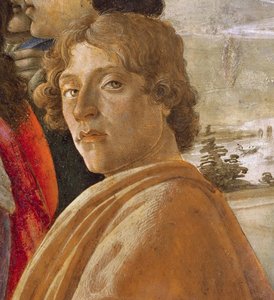
Ontdek Sandro Botticelli (1445-1510), meester van 'De Geboorte van Venus' & 'Primavera'. Bewonder zijn elegante stijl, mythologische thema’s en blijvende invloed op de kunstgeschiedenis!
§ 3Commentary
A Testament to Divine Justice: Sandro Botticelli’s “The Punishment of Korah”
Sandro Botticelli, a Florentine painter whose legacy endured beyond his lifetime, stands as one of the most celebrated figures of the Early Renaissance. Initially overshadowed by later artistic developments, Botticelli's oeuvre experienced a resurgence in the late 19th century thanks to the fervent enthusiasm of the Pre-Raphaelites, prompting a critical reconsideration of his profound contribution to Western art history.
“The Punishment of Korah,” also known as “La Caduta di Kori e della sua Compagnia,” is a monumental tempera panel painting executed around 1482-1490. Commissioned for the Cappella Sistina in Vatican City—a building conceived by Filippo Brunelleschi and completed between 1419 and 1427—this artwork depicts a pivotal episode from the Book of Numbers: God’s retribution against Korah, Aaron, Dathan, and Eliakim for their audacious challenge to Moses' authority. Botticelli masterfully captures this dramatic narrative with an unparalleled blend of stylistic elegance and psychological depth.
Composition and Technique – A Diagonal Dance of Chaos
The painting’s visual impact stems from its dynamic diagonal composition. On the left side, we witness a horrifying spectacle—the earth violently swallowing up Korah and his followers, symbolizing divine judgment and the ultimate consequence of disobedience. The figures are rendered with meticulous detail, conveying palpable fear and despair through expressive gestures and facial expressions. Simultaneously, Moses and Aaron stand calmly amidst this upheaval, representing faith and obedience—observing God’s wrath with solemn dignity.
Botticelli's technique is characterized by a restrained palette of earthy tones – ochre, umber, and crimson – which imbues the scene with an atmosphere of somber contemplation. The artist skillfully employs linear perspective to create depth and realism, while simultaneously adhering to the stylistic conventions of Late Gothic art—a deliberate choice that underscores Botticelli’s connection to artistic traditions preceding his own time.
Symbolism: Earthly Decay Versus Heavenly Order
Beyond its narrative depiction, “The Punishment of Korah” is laden with symbolic significance. The earth consuming the rebels embodies the destructive power of God's wrath and serves as a stark reminder of mortality. Conversely, Moses and Aaron’s unwavering faith represent divine grace and righteousness—a visual counterpoint to the earthly devastation unfolding before them.
Furthermore, Botticelli’s use of color contributes significantly to the painting’s emotional resonance. The muted hues heighten the sense of drama and underscore the solemnity of the biblical tale. The careful rendering of textures – particularly in the depiction of the earth—adds to the painting's realism and reinforces its visual impact.
A Legacy Enduring Through Reproduction
"The Punishment of Korah" continues to captivate audiences today, inspiring artists and designers alike. Its timeless beauty resides not only in its masterful execution but also in its profound exploration of themes concerning faith, obedience, and divine justice. A high-quality reproduction allows admirers to experience Botticelli’s artistic genius firsthand—bringing the grandeur of Renaissance art into any interior space.
Veelgestelde vragen
Kan ik "De Straf van Korah" door Sandro Botticelli bekijken voordat ik bestel?
Om een reproductie van "De Straf van Korah" door Sandro Botticelli te bekijken, opent u de Voorvertoning pagina van het kunstwerk.
Hoe komen medium en beweging samen in "De Straf van Korah"?
"De Straf van Korah" door Sandro Botticelli combineert de Acryl op canvas-techniek met de Early Renaissance-stijl. Techniek en stroming beschrijven de vervaardiging en de stijl van het werk.
Welke nationale herkomst ligt ten grondslag aan de Early Renaissance van "De Straf van Korah"?
"De Straf van Korah" werd gecreëerd door Sandro Botticelli, geboren in Italië, binnen de Early Renaissance-stroming. De herkomst van de kunstenaar verbindt het werk met Early Renaissance, zoals beoefend door kunstenaars uit Italië.


 Schakel over naar print


 Voor kunstwerken of reproducties die aan één zijde groter zijn dan 105 cm (ongeveer 41 inch), wordt de lijst als een losse set verzonden. Deze methode garandeert een veilige levering en voorkomt schade tijdens het transport.


