Geld-terug-garantie · 100 dagen Gratis wereldwijde verzending
449.587kunstwerken 30.613kunstenaars 4.660musea 32talen
Valuta
    Taal
      Atelier · Sinds 2015 · Parijs, Frankrijk
      AllPaintingsStore
      allpaintingsstore.com
      Catalogue entry

      Angel

      1522. Oil On Canvas, 79.0 x 65.0 cm.

      Fig. 1. Tiziano Vecellio, Angel, 1522. Shown as the reproduction you are specifying: , .

      § 1Catalogue data

      § 2Abstract

      Beschrijving verzamelobject

      Experience the serene beauty of Titian’s ‘Angel,’ a High Renaissance masterpiece showcasing flowing hair and contemplative eyes. This stunning oil painting captures divine grace and offers a timeless piece to adorn your space.

      Biografie kunstenaar

      Tiziano Vecellio (1490-1576): De grootste Venetiaanse schilder, beroemd om zijn kleurgebruik, portretten en invloedrijke werken uit de Renaissance.

      § 3Commentary

      A Serene Vision: Tiziano Vecellio's 'Angel'

      Tiziano Vecellio’s ‘Angel,’ painted in 1522, is more than just a depiction of a celestial being; it’s a profound meditation on serenity, contemplation, and the enduring power of Renaissance ideals. Measuring a modest 79 x 65 cm, this oil-on-wood masterpiece immediately draws the viewer into its world of luminous color and carefully considered form. Executed in the style characteristic of the High Renaissance, ‘Angel’ exemplifies Titian's mastery of light, shadow, and human emotion – qualities that secured his place as one of history’s most influential artists.

      • Subject & Composition: The central figure, an angel rendered with a grace that transcends mere representation, dominates the canvas. Long, flowing hair cascades down their back, suggesting both movement and a gentle breeze – a subtle detail that imbues the scene with a sense of ethereal beauty. The angel’s gaze, directed slightly to the side, invites introspection, hinting at a moment of quiet contemplation.
      • Technique & Chiaroscuro: Titian's signature use of chiaroscuro is brilliantly employed here. Deep, dark backgrounds dramatically highlight the figure, creating an almost sculptural effect and intensifying the emotional impact of the scene. The skillful manipulation of light and shadow isn’t merely a technical flourish; it’s integral to conveying the angel’s otherworldly nature.
      • Material & Detail: The fabric draped around the angel appears soft and luxurious, likely silk or a similar material, further enhancing the sense of ethereal beauty. Noticeable attention is paid to detail – from the individual strands of hair to the folds in the garment – demonstrating Titian’s meticulous approach and commitment to realism within a stylized framework.

      The Venetian Renaissance & Titian's Legacy

      ‘Angel’ stands as a testament to the flourishing artistic environment of Venice during the High Renaissance. The city, a vibrant hub of commerce and culture, was home to an extraordinary concentration of talent, and Titian was undoubtedly its most celebrated figure. His work reflects the humanist ideals of the era – a renewed interest in classical antiquity, a focus on human emotion, and a celebration of beauty. Titian’s influence extended far beyond Venice; his innovative techniques and bold use of color profoundly impacted generations of artists across Europe. Works like ‘Christ Carrying the Cross,’ which shares similar compositional elements and masterful use of light, demonstrate the breadth of Titian's artistic vision.

      Symbolism & Spiritual Resonance

      While undeniably beautiful, ‘Angel’ carries significant symbolic weight within its Renaissance context. The angel itself represents divine grace, compassion, and spiritual guidance – themes central to Christian iconography. The scroll held in the angel’s hand, though partially obscured, likely contains sacred text, reinforcing this message. The overall composition speaks to a desire for transcendence, inviting viewers to contemplate their own place within the grand scheme of things. This piece exemplifies the Renaissance's ambition to blend religious devotion with intellectual and artistic exploration.

      A Timeless Masterpiece – Recreated

      This meticulously crafted reproduction captures not only the visual essence of Titian’s ‘Angel’ but also the emotional depth and historical significance of this iconic work. Each hand-painted reproduction offers a unique opportunity to bring a touch of Renaissance brilliance into your home or office. With dimensions of 79 x 65 cm, it's a piece that commands attention while fostering contemplation – a true testament to Titian’s enduring legacy and the power of art to inspire.

      Veelgestelde vragen

      Hoe bekend is "Angel" van Tiziano Vecellio?

      Het populariteitsniveau van "Angel" door Tiziano Vecellio is Iconic.

      Welke afmeting voor de reproductie wordt aanbevolen voor "Angel" door Tiziano Vecellio?

      Voor "Angel" wordt een afdrukformaat van Large aanbevolen. Andere formaten zijn beschikbaar met dezelfde verhoudingen.

      Waar kan ik de afbeelding van "Angel" door Tiziano Vecellio downloaden?

      Er is een download beschikbaar voor "Angel": de Downloaden pagina van het kunstwerk biedt de mogelijkheid om een digitale afbeelding in hoge resolutie om te downloaden.
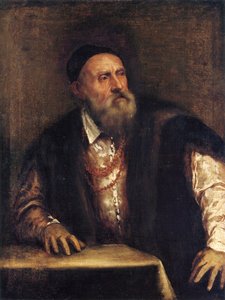
      § 4The artist

      Tiziano Vecellio

      Tiziano Vecellio

      1490 - 1576, Italië

      Quick facts about Tiziano Vecellio

      • Artistic Movement Or Style: Venetiaanse schilderkunst
      • Artists Or Movements Influenced By This Artist: ['Late Italiaanse Renaissance']
      • Artists Who Influenced This Artist:
        • Giovanni Bellini
        • Giorgione
      • Date Of Birth: c. 1490
      • Date Of Death: 1576
      • Full Name: Tiziano Vecellio
      • Nationality: Italiaans
      • Notable Artworks:
        • Een man met een geborduurde mouw
        • De bezoeking van Maria en Elisabeth
      • Place Of Birth: Pieve di Cadore, Italië

      Biografie kunstenaar

      The Venetian Titan: A Life in Color and Canvas

      Tiziano Vecellio, even more famously known as Titian, stands as a monumental figure of the Italian Renaissance—perhaps its most celebrated colorist and a master who fundamentally reshaped the possibilities of oil painting. Born around 1490 in Pieve di Cadore, nestled amidst the dramatic landscapes of the Venetian Alps, his journey from humble beginnings to international acclaim is a testament to prodigious talent and an unwavering dedication to artistic innovation. The details surrounding Titian’s early life remain somewhat shrouded in mystery, but we know he was one of several children born to Gregorio Vecellio, a military man, and Lucia. Recognizing their sons' potential, the family arranged for young Tiziano and his brother Francesco to apprentice with an artist in Venice—a decision that would irrevocably alter the course of art history.

      Venice at the turn of the 16th century was a vibrant hub of commerce, culture, and artistic ferment. Titian’s initial training took place within the workshop of Sebastiano Zuccato, a mosaicist, followed by brief periods under the tutelage of Gentile Bellini and, crucially, his brother Giovanni. However, it was his association with Giorgione—a fellow Venetian painter whose work possessed an ethereal poetic quality—that proved most formative. The two artists collaborated on several projects, including the exterior frescoes for the Fondaco dei Tedeschi, a bustling trading post for German merchants. Even in these early works, Titian’s exceptional skill was evident, earning him recognition among his contemporaries and foreshadowing the brilliance that would soon blossom.

      A Master's Evolving Style

      Titian’s artistic development can be characterized by a remarkable versatility and an ongoing exploration of painterly techniques. His early works, heavily influenced by Giorgione, exhibit a delicate lyricism and a masterful use of color to create atmospheric effects. Paintings like *A Man with a Quilted Sleeve* (circa 1509) demonstrate his emerging talent for portraiture, capturing not only the physical likeness of his subjects but also their inner character. He favored soft, diffused light and subtle gradations of tone, mirroring Giorgione’s approach. As he matured, Titian began to move away from Giorgione’s delicate subtlety and embrace a bolder, more dramatic approach to color. *The Visitation of Mary and Elizabeth* (now in the Accademia, Venice) exemplifies this shift, showcasing his growing confidence in handling complex compositions and vibrant hues. He experimented with layering colors—often applying thin glazes over dried underpaintings—to achieve luminous effects and intense saturation.

      Throughout his long career, Titian consistently pushed the boundaries of artistic expression. He explored a vast range of subjects – mythological scenes, religious narratives, portraits of nobility, and even genre paintings depicting everyday life. He wasn’t afraid to break with convention, often employing unconventional compositions and dramatic lighting. His portraits became renowned for their psychological depth and realistic portrayal of textures and fabrics; he meticulously rendered the sheen of silk, the weight of velvet, and the warmth of skin tones. Simultaneously, he excelled in mythological and religious subjects, imbuing them with a sensuality and dramatic intensity that captivated audiences. A prime example is *Venus of Urbino*, a masterpiece that redefined the depiction of the female nude and established Titian as a leading figure in Venetian painting.

      Patronage, Prestige, and Lasting Influence

      Titian’s talent attracted the attention of powerful patrons from across Europe. He served as court painter to Emperor Charles V, King Philip II of Spain, and Pope Paul III, among others. This patronage not only provided him with financial security but also allowed him to create monumental works that showcased his artistic prowess on a grand scale. His ability to adapt his style to the tastes of different courts while maintaining his own distinctive voice is a testament to his exceptional skill and diplomatic finesse. He was known for his lavish use of gold leaf, particularly in portraits commissioned by royalty, further enhancing their prestige.

      Titian’s influence on subsequent generations of artists was profound. From Peter Paul Rubens and Rembrandt to Eugène Delacroix and Édouard Manet, countless painters drew inspiration from his masterpieces. His innovative use of color, his loose brushwork, and his emphasis on capturing the emotional essence of his subjects profoundly influenced their artistic approaches. He is considered a pivotal figure in the transition from the High Renaissance to the Baroque period, paving the way for new artistic styles and techniques.

      A Legacy Enduring Through Centuries

      Titian passed away in Venice in 1576, leaving behind an extraordinary body of work that continues to inspire awe and admiration. His paintings can be found in museums around the world, including the Galleria Palatina in Florence, the Prado Museum in Madrid, and the National Gallery in London. To experience a Titian is to encounter a master craftsman at the peak of his powers—a painter who possessed an unparalleled ability to capture the beauty, drama, and complexity of the human condition.

      Exploring Further

      • Museums & Collections: Discover Titian’s works at the Scuola del Santo in Padua and San Salvador in Venice, both showcasing his breathtaking frescoes.
      • Related Artists: Explore the influence of Giorgione on Titian's early style and the later impact of Titian on artists like Rubens and Delacroix.
      • Historical Context: Immerse yourself in the world of the Italian Renaissance and Venetian painting to fully appreciate Titian’s artistic achievements.

      § 5Comparanda

      § 6Questions

      Snelle feiten

      • Subject or theme: Religious/Allegorical
      • Movement: High Renaissance
      • Influences: Renaissance
      • Medium: Oil on wood
      • Location: Museo del Prado
      • Notable elements: Chiaroscuro, drapery

      § 7Cite this entry

      AllPaintingsStore.com, “Tiziano Vecellio, Angel (1522)”, https://allpaintingsstore.com/nl/art/titian-angel-8XZ38K-en/ArtistReproduction/ (accessed 2 oktober 2026).

      § 8The reproduction

      Handgemaakte olieverfreproductie

      Met de hand geschilderd in olieverf op canvas in uw gewenste maat en lijst, op bestelling gemaakt door onze kunstenaars. ( Schakel over naar print Schakel over naar digitale afbeeldingen)

      It is specified on the order sheet in the margin; the present state of that sheet reads as follows.

      Angel

      Druktechniek

      Afmetingen reproductie

      -

      Geselecteerde topkunstenaars

      Meer detail, verfijning en extra productietijd

      -

      Lijst voor reproductie

      -

      -

      Voor kunstwerken of reproducties die aan één zijde groter zijn dan 105 cm (ongeveer 41 inch), wordt de lijst als een losse set verzonden. Deze methode garandeert een veilige levering en voorkomt schade tijdens het transport.

      Professionele montage vereist - dit is geen doe-het-zelfproduct.
      De set moet worden gemonteerd en het canvas moet worden gespannen door een ervaren professionele lijstenmaker, met gebruik van houtlijm (niet inbegrepen), een doekspanter en klemmen om de sponningen recht te houden terwijl de lijm droogt. Onjuiste montage of een ongelijkmatige spanning op het canvas kan het kunstwerk permanent beschadigen en wordt niet gedekt door onze garantie.

      • Alle massief houten onderdelen zijn inbegrepen, nauwkeurig op maat gesneden voor montage.

      • Te monteren met de meegeleverde schroeven, plus houtlijm voor de hoekverbindingen, die niet wordt meegeleverd en door uw lijstenmaker moet worden aangeschaft.

      • Professioneel gereedschap is vereist en niet inbegrepen: een spanner voor canvas en klemmen om de latten recht te houden terwijl de lijm droogt.

      Belangrijk:
      De hoekverbindingen vereisen houtlijm, de latten moeten met lijmklemmen worden vastgehouden tot de lijm volledig is opgedroogd, en het spannen van het canvas op het samengestelde frame vereist een doekspanter. Geen van deze artikelen is inbegrepen in de set. Wij adviseren u om een ervaren professionele lijstenmaker te raadplegen voordat u deze maat bestelt.

      Naamplaatje

      -

      -

      Beschermende vernislaag

      Glanzende vernis (versterkt de kleuren en biedt bescherming tegen licht en vocht)

      -

      Mijn kunstwerk aanpassen

      Voorbeelden van aanpassingen: vervang het gezicht door een eigen foto; voeg een huisdier toe (bijv. vervang de kat door een hond); verwerk een verborgen boodschap in de achtergrond; wijzig het landschap of andere elementen op de achtergrond.

      -

      Spoedlevering

      Wereldwijde levering () binnen 3 tot 4 weken in plaats van de standaard 5 weken. (30 oktober). Geen concessies aan de kwaliteit.

      -

      Spoedlevering

      Wereldwijde levering naar binnen 5 weken. (6 november).

      Inbegrepen

      Eindtotaal

      € 229

      Included with every order

      • Gratis wereldwijde expressverzending
      • Hoogwaardig linnen canvas
      • Volledige verzendverzekering
      • Garantie op terugbetaling van invoerrechten
      • Garantie op exacte kleurweergave
      • Retourbeleid van 100 dagen (alleen bij defecten)
      • 100% Geld-terug-garantie
      • Korting bij meerdere afnames
      Order sheet