Geld-terug-garantie · 100 dagen Gratis wereldwijde verzending
449.587kunstwerken 30.613kunstenaars 4.660musea 32talen
Catalogue entry

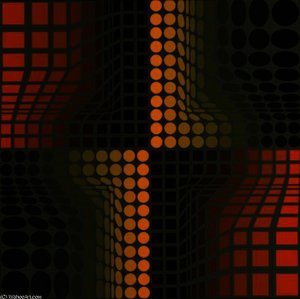
Abstract composition 8

Oil On Canvas.

Fig. 1. Victor Vasarely, Abstract composition 8. Shown as the reproduction you are specifying: , .

§ 1Catalogue data

§ 2Abstract

Beschrijving verzamelobject

Experience Abstract Composition 8 – a captivating Op-Art piece by Victor Vasarely. Explore geometric patterns & optical illusions in this hand-painted reproduction.

Biografie kunstenaar

Ontdek Victor Vasarely (1906-1997), de pionier van Op Art! Bewonder zijn geometrische abstracties, optische illusies & een blijvende invloed op moderne kunst en design.

§ 3Commentary

A Dance of Perception: Exploring Victor Vasarely’s “Abstract Composition 8”

Victor Vasarely's "Abstract Composition 8" is more than just a painting; it’s an invitation to question the very nature of visual reality. Executed in oil on canvas with meticulous attention to detail, this work embodies the core tenets of Op Art – Optical Art – a movement that emerged in the mid-20th century and continues to captivate viewers with its mastery of illusion and pattern. Born in 1906 in Pécs, Croatia (then part of Austria-Hungary), Vasarely’s artistic trajectory began unexpectedly, initially driven by an interest in medicine before he was drawn to the expressive possibilities of color and form. His journey reflects a profound engagement with geometric abstraction, influenced heavily by the Bauhaus movement's emphasis on functionality and design, and nurtured within the rigorous environment of Sándor Bortnyik’s “Műhely” workshop.

  • Subject Matter: The painting presents a carefully constructed arrangement of four distinct sections. A dominant circle commands attention in the left quadrant, while a smaller circle offers a counterpoint in the center. The right side explodes with a dynamic pattern of lines, and the bottom section culminates in a mesmerizing spiral or swirl – a recurring motif in Vasarely’s oeuvre.
  • Style & Technique: Vasarely's signature Op Art style is immediately recognizable through its precise geometric forms and vibrant color palette. The oil on canvas technique allows for rich texture and depth, enhancing the illusionistic effects. He skillfully manipulates perspective and scale to create a sense of movement and dynamism, drawing the viewer into the artwork’s intricate visual field.

The Genesis of Op Art: Historical Context

“Abstract Composition 8” emerged from a pivotal moment in art history – the post-World War II era. The rise of mass media, particularly advertising and graphic design, profoundly influenced artistic thinking. Artists like Vasarely responded to this shift by exploring new ways to engage with visual perception through abstraction. Op Art, as it became known, sought to directly stimulate the viewer’s optic nerve, creating an almost physical experience of color and form. This was a deliberate rejection of traditional representational art, embracing instead the power of pure geometric abstraction to evoke emotion and challenge our understanding of space.

Symbolism & Emotional Impact

While ostensibly abstract, Vasarely’s work is imbued with symbolic meaning. The circles, often interpreted as representing wholeness and unity, are juxtaposed against the dynamic lines and spirals – symbols of movement, energy, and transformation. The overall effect is one of controlled chaos, inviting contemplation on the relationship between order and disorder, perception and reality. “Abstract Composition 8” isn’t simply a visual puzzle; it's an emotional experience, designed to provoke a sense of wonder and intrigue.

A Legacy of Innovation

Victor Vasarely’s influence extends far beyond the realm of Op Art. His pioneering work paved the way for subsequent developments in kinetic art, digital art, and even contemporary graphic design. “Abstract Composition 8” stands as a testament to his genius – a timeless masterpiece that continues to inspire artists and captivate audiences with its innovative approach to visual perception. A hand-painted reproduction of this artwork offers an unparalleled opportunity to bring this iconic piece into your home or office, allowing you to experience the captivating power of Vasarely’s vision firsthand.

Veelgestelde vragen

Bij welke kunststroming behoort "Abstract composition 8" door Victor Vasarely?

"Abstract composition 8" door Victor Vasarely behoort tot de Op Art-stroming. Deze stroming biedt de stilistische context van het werk.

Is "Abstract composition 8" door Victor Vasarely een schilderij, een tekening of een prent?

"Abstract composition 8" is een WallArt-werk.

Met welke techniek is "Abstract composition 8" gemaakt?

"Abstract composition 8" is uitgevoerd in Oil On Canvas.

§ 4The artist

Victor Vasarely

Victor Vasarely

1906 - 1997, Kroatië

Quick facts about Victor Vasarely

  • Artistic Movement Or Style: Op Art, Kinetic Art
  • Artists Or Movements Influenced By This Artist:
    • Graphic design
    • Interieurdesign
  • Artists Who Influenced This Artist:
    • Piet Mondrian
    • Kazimir Malevich
  • Date Of Birth: 9 april 1906
  • Date Of Death: 15 maart 1997
  • Full Name: Victor Vasarely
  • Nationality: Hongaars-Frans
  • Notable Artworks:
    • Blue Study
    • Green Study
    • Zebra
  • Place Of Birth: Pécs, Kroatië

Biografie kunstenaar

A Life Forged in Geometry: The World of Victor Vasarely

Victor Vasarely’s journey to becoming a pioneer of Op Art and kinetic art was anything but predetermined. Born Károly Vaszary in 1906 in Pécs, a city then nestled within Austria-Hungary (now Croatia), his early life hinted at a path far removed from the canvas. Initially pursuing medical studies at Eötvös Loránd University in Budapest, he abruptly abandoned this ambition for the world of painting in 1927, enrolling at the Podolini-Volkmann Academy. This decision wasn’t merely a career shift; it represented a lifelong dedication to exploring the fundamental principles governing perception and form – a quest rooted in logic and precision. A pivotal moment arrived with his enrollment in Sándor Bortnyik’s workshop – Műhely – a school deeply influenced by the Bauhaus movement. Here, Vasarely absorbed the tenets of functional design and geometric abstraction, seeds that would blossom into his signature style. These formative years weren't simply about acquiring technique; they were about dismantling traditional artistic conventions and embracing a new visual language, one designed to actively engage the viewer’s perception.

From Early Abstraction to the Dawn of Op Art

The late 1920s and early 1930s witnessed Vasarely's gradual departure from representational art, as he delved deeper into the realm of geometric abstraction. Works like “Blue Study” and “Green Study,” created in 1929, exemplify this transition – a deliberate shedding of narrative content in favor of pure form and color relationships. He was profoundly influenced by masters such as Piet Mondrian and Kazimir Malevich, yet he wasn’t content to simply emulate their styles. Vasarely sought to transcend the static compositions of his predecessors, aiming for a dynamism that would actively engage the viewer's perception. This quest led him to Paris in 1930, where he established himself as a graphic designer and advertising artist, honing his skills while continuing to develop his unique artistic vision. It was during this period that he began experimenting with techniques that would later become hallmarks of Op Art – manipulating shapes and colors to create illusions of movement and depth. The seeds were sown for a revolution in visual experience.

The Systematic Illusion: Defining a Movement

By the 1960s, Victor Vasarely had fully emerged as a leading figure in the burgeoning Op Art movement. Unlike many artists who relied on intuition and spontaneous expression, Vasarely approached his work with a distinctly systematic methodology. He employed grids and mathematical principles to generate patterns that created powerful optical illusions – visual vibrations, swirling effects, and sensations of depth where none physically existed. This wasn’t about trickery; it was about revealing the inherent dynamism within perception itself. He believed in reproducibility and mass appeal, aiming to democratize art by making it accessible beyond the confines of galleries and museums. His work challenged viewers to question their own visual experience, forcing them to actively participate in the creation of meaning. This deliberate engagement with perception set Op Art apart and cemented Vasarely’s place at its forefront. He wasn't merely painting pictures; he was constructing experiences.

Historical Significance

Vasarely’s contribution to art history is multifaceted. He moved beyond traditional painting techniques to create works that actively engage the viewer’s perception. His systematic approach challenged conventional notions of artistic creativity and paved the way for computer-generated art and digital design. By embracing reproducibility and commercial applications, Vasarely blurred the boundaries between fine art and popular culture, leaving an enduring mark on both. He wasn't simply creating aesthetically pleasing objects; he was conducting visual experiments that revealed fundamental truths about how we see the world. His work continues to resonate today, reminding us of the power of abstraction, the beauty of geometry, and the endless possibilities of human creativity.

Beyond the Canvas: Kinetic Exploration and a Lasting Legacy

Vasarely’s artistic exploration didn't stop at static illusions. He increasingly ventured into kinetic art, creating works that incorporated actual movement or appeared to move through carefully orchestrated visual effects. “Georges Pompidou” (1976), a large kinematic object installed at the Centre Pompidou in Paris, stands as a testament to this ambition – an integration of art with architecture and urban design on a grand scale. He also demonstrated remarkable innovation by applying his designs to commercial products, most notably through his collaboration with Rosenthal porcelain, resulting in the iconic “Suomi” tableware series. This willingness to blur the boundaries between fine art and functional objects further underscored his belief in art’s potential to permeate everyday life. The establishment of the Fondation Vasarely in Aix-en-Provence ensured the preservation and promotion of his extensive body of work, while a remarkable event – the inclusion of serigraphs aboard the French-Soviet spacecraft Salyut 7 in 1982 – symbolized the global recognition of his art and its connection to the broader human endeavor of exploration. Victor Vasarely’s legacy extends far beyond the realm of painting; he profoundly influenced graphic design, fashion, interior design, and even early computer graphics, inspiring generations with his innovative vision and unwavering commitment to exploring the possibilities of perception. He remains a pivotal figure in modern art history, a true visionary who dared to challenge our understanding of what art could be.

§ 5Comparanda

§ 6Questions

Snelle feiten

  • Influences:
    • Bauhaus
    • Functional design
  • Notable elements: Geometric shapes
  • Artist: Victor Vasarely
  • Artistic style: Kinetic, Abstract

§ 7Cite this entry

AllPaintingsStore.com, “Victor Vasarely, Abstract composition 8”, https://allpaintingsstore.com/nl/art/victor-vasarely-abstract-composition-8-8EWRQ4-en/ArtistReproduction/ (accessed 4 oktober 2026).

§ 8The reproduction

Handgemaakte olieverfreproductie

Met de hand geschilderd in olieverf op canvas in uw gewenste maat en lijst, op bestelling gemaakt door onze kunstenaars. ( Schakel over naar print Schakel over naar digitale afbeeldingen)

It is specified on the order sheet in the margin; the present state of that sheet reads as follows.

Abstract composition 8

Druktechniek

Afmetingen reproductie

-

Geselecteerde topkunstenaars

Meer detail, verfijning en extra productietijd

-

Lijst voor reproductie

-

-

Voor kunstwerken of reproducties die aan één zijde groter zijn dan 105 cm (ongeveer 41 inch), wordt de lijst als een losse set verzonden. Deze methode garandeert een veilige levering en voorkomt schade tijdens het transport.

Professionele montage vereist - dit is geen doe-het-zelfproduct.
De set moet worden gemonteerd en het canvas moet worden gespannen door een ervaren professionele lijstenmaker, met gebruik van houtlijm (niet inbegrepen), een doekspanter en klemmen om de sponningen recht te houden terwijl de lijm droogt. Onjuiste montage of een ongelijkmatige spanning op het canvas kan het kunstwerk permanent beschadigen en wordt niet gedekt door onze garantie.

  • Alle massief houten onderdelen zijn inbegrepen, nauwkeurig op maat gesneden voor montage.

  • Te monteren met de meegeleverde schroeven, plus houtlijm voor de hoekverbindingen, die niet wordt meegeleverd en door uw lijstenmaker moet worden aangeschaft.

  • Professioneel gereedschap is vereist en niet inbegrepen: een spanner voor canvas en klemmen om de latten recht te houden terwijl de lijm droogt.

Belangrijk:
De hoekverbindingen vereisen houtlijm, de latten moeten met lijmklemmen worden vastgehouden tot de lijm volledig is opgedroogd, en het spannen van het canvas op het samengestelde frame vereist een doekspanter. Geen van deze artikelen is inbegrepen in de set. Wij adviseren u om een ervaren professionele lijstenmaker te raadplegen voordat u deze maat bestelt.

Naamplaatje

-

-

Beschermende vernislaag

Glanzende vernis (versterkt de kleuren en biedt bescherming tegen licht en vocht)

-

Mijn kunstwerk aanpassen

Voorbeelden van aanpassingen: vervang het gezicht door een eigen foto; voeg een huisdier toe (bijv. vervang de kat door een hond); verwerk een verborgen boodschap in de achtergrond; wijzig het landschap of andere elementen op de achtergrond.

-

Spoedlevering

Wereldwijde levering () binnen 3 tot 4 weken in plaats van de standaard 5 weken. (1 november). Geen concessies aan de kwaliteit.

-

Spoedlevering

Wereldwijde levering naar binnen 5 weken. (8 november).

Inbegrepen

Eindtotaal

€ 229

Included with every order

  • Gratis wereldwijde expressverzending
  • Hoogwaardig linnen canvas
  • Volledige verzendverzekering
  • Garantie op terugbetaling van invoerrechten
  • Garantie op exacte kleurweergave
  • Retourbeleid van 100 dagen (alleen bij defecten)
  • 100% Geld-terug-garantie
  • Korting bij meerdere afnames
Order sheet