Geld-terug-garantie · 100 dagen Gratis wereldwijde verzending
449.564kunstwerken 30.613kunstenaars 4.660musea 32talen
Catalogusvermelding

Sende C

Acrylic On Canvas.

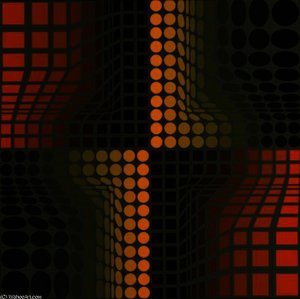
Afb. 1. Victor Vasarely, Sende C. Weergegeven als de reproductie die u specificeert: , .

§ 1Catalogusgegevens

§ 2Abstract

Beschrijving verzamelobject

Experience Victor Vasarely’s iconic Op Art masterpiece, Sende C, featuring a mesmerizing array of blue and green dots creating an illusion of depth and movement. A captivating geometric abstraction from 1960, perfect for art lovers.

Biografie kunstenaar

Ontdek Victor Vasarely (1906-1997), de pionier van Op Art! Bewonder zijn geometrische abstracties, optische illusies & een blijvende invloed op moderne kunst en design.

§ 3Toelichting

A Symphony of Perception: Unveiling Victor Vasarely’s *Sende C*

Victor Vasarely's *Sende C*, a captivating close-up study of vibrant blue and green, is more than just an image; it’s an invitation to explore the very nature of perception. This Op Art masterpiece, created by the Hungarian pioneer, embodies the core tenets of kinetic art – the manipulation of visual experience through geometric forms. The painting's deceptively simple composition immediately draws the eye into a dynamic interplay of color and shape, creating an illusion of movement and depth that shifts with every glance. Vasarely’s meticulous approach to translating mathematical principles onto canvas resulted in a work that is both intellectually stimulating and profoundly visually arresting.

The Genesis of Op Art: Vasarely's Bauhaus Roots

Born in 1906 in Pécs, Croatia, Károly Vaszary – later Victor Vasarely – initially pursued a medical career before embracing his artistic destiny. His formative years were deeply influenced by the Bauhaus movement and Sándor Bortnyik’s “Műhely” workshop, where he absorbed the principles of functional design and geometric abstraction. This training instilled in him a rigorous approach to composition, utilizing precise mathematical ratios and optical illusions to generate his signature style. *Sende C* exemplifies this legacy – a direct descendant of the Bauhaus emphasis on clarity, order, and the exploration of visual phenomena.

Decoding the Visual Language: Technique and Style

*Sende C* showcases Vasarely’s mastery of “stabék,” a technique he developed to create precisely defined, isolated shapes. The painting is constructed from numerous small, overlapping circles in varying shades of blue and green, meticulously arranged to generate an illusion of three-dimensionality. This method, combined with the deliberate use of contrasting colors, amplifies the visual impact and creates a mesmerizing sense of movement. The seemingly random distribution of dots actually adheres to a carefully calculated system, reflecting Vasarely’s belief that art could be both aesthetically pleasing and scientifically grounded.

Symbolism and Emotional Resonance

While ostensibly abstract, *Sende C* resonates with deeper symbolic meanings related to the exploration of consciousness and perception. Vasarely sought to represent the subjective experience of reality – how our brains actively construct our understanding of the world. The dynamic interplay of color and form evokes a sense of excitement, disorientation, and ultimately, wonder. This piece invites viewers to question their own perceptions and consider the complex relationship between art and the human mind. Its enduring appeal lies in its ability to tap into fundamental aspects of our visual experience.

Veelgestelde vragen

Voor welke kamer wordt "Sende C" door Victor Vasarely aanbevolen?

"Sende C" door Victor Vasarely wordt aanbevolen voor een Living Room. Deze suggestie is gebaseerd op het onderwerp, de kleuren en de sfeer van het werk.

Welke nationale herkomst ligt ten grondslag aan de Op Art van "Sende C"?

"Sende C" werd gecreëerd door Victor Vasarely, geboren in Kroatië, binnen de Op Art-stroming. De herkomst van de kunstenaar verbindt het werk met Op Art, zoals beoefend door kunstenaars uit Kroatië.

Hoeveel mensen bekijken "Sende C"?

Er bestaat een Statistieken-pagina voor "Sende C". Deze brengt de maandelijkse bezoeken aan het kunstwerk en andere werken van de kunstenaar in kaart, met uitsplitsingen naar land en taal.

§ 4De kunstenaar

Victor Vasarely

Victor Vasarely

1906 - 1997, Kroatië

Snelle feiten over Victor Vasarely

  • Artistic Movement Or Style: Op Art, Kinetic Art
  • Artists Or Movements Influenced By This Artist:
    • Graphic design
    • Interieurdesign
  • Artists Who Influenced This Artist:
    • Piet Mondrian
    • Kazimir Malevich
  • Date Of Birth: 9 april 1906
  • Date Of Death: 15 maart 1997
  • Full Name: Victor Vasarely
  • Nationality: Hongaars-Frans
  • Notable Artworks:
    • Blue Study
    • Green Study
    • Zebra
  • Place Of Birth: Pécs, Kroatië

Biografie kunstenaar

A Life Forged in Geometry: The World of Victor Vasarely

Victor Vasarely’s journey to becoming a pioneer of Op Art and kinetic art was anything but predetermined. Born Károly Vaszary in 1906 in Pécs, a city then nestled within Austria-Hungary (now Croatia), his early life hinted at a path far removed from the canvas. Initially pursuing medical studies at Eötvös Loránd University in Budapest, he abruptly abandoned this ambition for the world of painting in 1927, enrolling at the Podolini-Volkmann Academy. This decision wasn’t merely a career shift; it represented a lifelong dedication to exploring the fundamental principles governing perception and form – a quest rooted in logic and precision. A pivotal moment arrived with his enrollment in Sándor Bortnyik’s workshop – Műhely – a school deeply influenced by the Bauhaus movement. Here, Vasarely absorbed the tenets of functional design and geometric abstraction, seeds that would blossom into his signature style. These formative years weren't simply about acquiring technique; they were about dismantling traditional artistic conventions and embracing a new visual language, one designed to actively engage the viewer’s perception.

From Early Abstraction to the Dawn of Op Art

The late 1920s and early 1930s witnessed Vasarely's gradual departure from representational art, as he delved deeper into the realm of geometric abstraction. Works like “Blue Study” and “Green Study,” created in 1929, exemplify this transition – a deliberate shedding of narrative content in favor of pure form and color relationships. He was profoundly influenced by masters such as Piet Mondrian and Kazimir Malevich, yet he wasn’t content to simply emulate their styles. Vasarely sought to transcend the static compositions of his predecessors, aiming for a dynamism that would actively engage the viewer's perception. This quest led him to Paris in 1930, where he established himself as a graphic designer and advertising artist, honing his skills while continuing to develop his unique artistic vision. It was during this period that he began experimenting with techniques that would later become hallmarks of Op Art – manipulating shapes and colors to create illusions of movement and depth. The seeds were sown for a revolution in visual experience.

The Systematic Illusion: Defining a Movement

By the 1960s, Victor Vasarely had fully emerged as a leading figure in the burgeoning Op Art movement. Unlike many artists who relied on intuition and spontaneous expression, Vasarely approached his work with a distinctly systematic methodology. He employed grids and mathematical principles to generate patterns that created powerful optical illusions – visual vibrations, swirling effects, and sensations of depth where none physically existed. This wasn’t about trickery; it was about revealing the inherent dynamism within perception itself. He believed in reproducibility and mass appeal, aiming to democratize art by making it accessible beyond the confines of galleries and museums. His work challenged viewers to question their own visual experience, forcing them to actively participate in the creation of meaning. This deliberate engagement with perception set Op Art apart and cemented Vasarely’s place at its forefront. He wasn't merely painting pictures; he was constructing experiences.

Historical Significance

Vasarely’s contribution to art history is multifaceted. He moved beyond traditional painting techniques to create works that actively engage the viewer’s perception. His systematic approach challenged conventional notions of artistic creativity and paved the way for computer-generated art and digital design. By embracing reproducibility and commercial applications, Vasarely blurred the boundaries between fine art and popular culture, leaving an enduring mark on both. He wasn't simply creating aesthetically pleasing objects; he was conducting visual experiments that revealed fundamental truths about how we see the world. His work continues to resonate today, reminding us of the power of abstraction, the beauty of geometry, and the endless possibilities of human creativity.

Beyond the Canvas: Kinetic Exploration and a Lasting Legacy

Vasarely’s artistic exploration didn't stop at static illusions. He increasingly ventured into kinetic art, creating works that incorporated actual movement or appeared to move through carefully orchestrated visual effects. “Georges Pompidou” (1976), a large kinematic object installed at the Centre Pompidou in Paris, stands as a testament to this ambition – an integration of art with architecture and urban design on a grand scale. He also demonstrated remarkable innovation by applying his designs to commercial products, most notably through his collaboration with Rosenthal porcelain, resulting in the iconic “Suomi” tableware series. This willingness to blur the boundaries between fine art and functional objects further underscored his belief in art’s potential to permeate everyday life. The establishment of the Fondation Vasarely in Aix-en-Provence ensured the preservation and promotion of his extensive body of work, while a remarkable event – the inclusion of serigraphs aboard the French-Soviet spacecraft Salyut 7 in 1982 – symbolized the global recognition of his art and its connection to the broader human endeavor of exploration. Victor Vasarely’s legacy extends far beyond the realm of painting; he profoundly influenced graphic design, fashion, interior design, and even early computer graphics, inspiring generations with his innovative vision and unwavering commitment to exploring the possibilities of perception. He remains a pivotal figure in modern art history, a true visionary who dared to challenge our understanding of what art could be.

§ 5Vergelijkbare werken

§ 6Vragen

Snelle feiten

  • Title: Sende C
  • Influences:
    • Bauhaus
    • Kinetic Art
  • Year: 1968
  • Location: Private Collection
  • Medium: Acrylic on canvas

§ 7Citeer dit artikel

AllPaintingsStore.com, “Victor Vasarely, Sende C”, https://allpaintingsstore.com/nl/art/victor-vasarely-sende-c-8EWS3C-en/ArtistReproduction/ (geraadpleegd op 10 oktober 2026).

§ 8De reproductie

Handgemaakte olieverfreproductie

Met de hand geschilderd in olieverf op canvas in uw gewenste maat en lijst, op bestelling gemaakt door onze kunstenaars. ( Schakel over naar print Schakel over naar digitale afbeeldingen)

Dit staat in de marge van het bestelformulier vermeld; de huidige stand van zaken op dat formulier luidt als volgt.

Sende C

Druktechniek

Afmetingen reproductie

-

Geselecteerde topkunstenaars

Meer detail, verfijning en extra productietijd

-

Lijst voor reproductie

-

-

Voor kunstwerken of reproducties die aan één zijde groter zijn dan 105 cm (ongeveer 41 inch), wordt de lijst als een losse set verzonden. Deze methode garandeert een veilige levering en voorkomt schade tijdens het transport.

Professionele montage vereist - dit is geen doe-het-zelfproduct.
De set moet worden gemonteerd en het canvas moet worden gespannen door een ervaren professionele lijstenmaker, met gebruik van houtlijm (niet inbegrepen), een doekspanter en klemmen om de sponningen recht te houden terwijl de lijm droogt. Onjuiste montage of een ongelijkmatige spanning op het canvas kan het kunstwerk permanent beschadigen en wordt niet gedekt door onze garantie.

  • Alle massief houten onderdelen zijn inbegrepen, nauwkeurig op maat gesneden voor montage.

  • Te monteren met de meegeleverde schroeven, plus houtlijm voor de hoekverbindingen, die niet wordt meegeleverd en door uw lijstenmaker moet worden aangeschaft.

  • Professioneel gereedschap is vereist en niet inbegrepen: een spanner voor canvas en klemmen om de latten recht te houden terwijl de lijm droogt.

Belangrijk:
De hoekverbindingen vereisen houtlijm, de latten moeten met lijmklemmen worden vastgehouden tot de lijm volledig is opgedroogd, en het spannen van het canvas op het samengestelde frame vereist een doekspanter. Geen van deze artikelen is inbegrepen in de set. Wij adviseren u om een ervaren professionele lijstenmaker te raadplegen voordat u deze maat bestelt.

Naamplaatje

-

-

Beschermende vernislaag

Glanzende vernis (versterkt de kleuren en biedt bescherming tegen licht en vocht)

-

Mijn kunstwerk aanpassen

Voorbeelden van aanpassingen: vervang het gezicht door een eigen foto; voeg een huisdier toe (bijv. vervang de kat door een hond); verwerk een verborgen boodschap in de achtergrond; wijzig het landschap of andere elementen op de achtergrond.

-

Spoedlevering

Wereldwijde levering () binnen 3 tot 4 weken in plaats van de standaard 5 weken. (7 november). Geen concessies aan de kwaliteit.

-

Spoedlevering

Wereldwijde levering naar binnen 5 weken. (14 november).

Inbegrepen

Eindtotaal

€ 230

Inbegrepen bij elke bestelling

  • Gratis wereldwijde expressverzending
  • Hoogwaardig linnen canvas
  • Volledige verzendverzekering
  • Garantie op terugbetaling van invoerrechten
  • Garantie op exacte kleurweergave
  • Retourbeleid van 100 dagen (alleen bij defecten)
  • 100% Geld-terug-garantie
  • Korting bij meerdere afnames
Bestelformulier