


 Voorvertoning
 Verstuur
 Delen
Delen
 Details bekijken

 Download
 Vergelijkbare items
 Röntgenonderzoek
 Diavoorstelling
Nebuchadnezzar
 Aquatint
- WallArt
- Romanticism
 1795
1795- Early Modern
 446.0 x 620.0 cm
 Tate Britain
 Lees meer
Koop een digitale afbeelding in hoge resolutie met verbeterde kwaliteit, die veel superieur is aan de online voorvertoning.
Elk bestand wordt met uiterste precisie voorbereid door onze interne specialisten, met behulp van geavanceerde tools en deskundige handmatige retouche. Wij garanderen dat elke afbeelding een uitzonderlijke helderheid, nauwkeurige kleurweergave en verfijnde details bezit.
Het uiteindelijke bestand wordt binnen 72 uur per e-mail geleverd, geoptimaliseerd voor direct gebruik in professionele, redactionele en printomgevingen. Dit is dezelfde kwaliteit waarop vooraanstaande designstudio's, uitgevers en galerieën vertrouwen.
Digitale afbeeldingen
Download een bestand met hoge resolutie voor persoonlijke weergave, afdrukken en creatieve projecten. ( Bestel print Bestel handgeschilderde reproductie)
Inbegrepen bij elke bestelling van een digitale afbeelding
Professionele digitale levering, gegarandeerd
Wanneer u kiest voor AllPaintingsStore.com, ontvangt u niet alleen een afbeelding – u krijgt een professioneel verbeterd digitaal kunstwerk, met precisie vervaardigd en voorzien van een tevredenheidsgarantie. Dit is alles wat automatisch bij uw bestelling is inbegrepen:

Snelle levering per e-mail
Uw hoogwaardige digitale afbeeldingsbestand wordt binnen 72 uur na bestelling naar u gemaild – klaar voor direct gebruik.

AI-verbeterd digitaal bestand
Uw kunstwerk wordt professioneel geoptimaliseerd met behulp van geavanceerde AI-tools en handmatige bewerkingen, waardoor maximale details, helderheid en kleurnauwkeurigheid worden gegarandeerd.

Gratis levenslange herlevering van digitale afbeeldingen
Je bestand per ongeluk verwijderd of kwijtgeraakt? Geen zorgen – we sturen het u op elk gewenst moment gratis opnieuw toe.

Geen invoerkosten – nooit
Geniet direct van uw kunstwerk zonder invoerrechten, belastingen of verzendkosten – digitale downloads zijn altijd belastingvrij.

Garantie op kleurgetrouwheid
Met behulp van professionele hulpmiddelen en kleurbeheer zorgen wij ervoor dat uw digitale afbeelding de originele kleuren zo nauwkeurig mogelijk weergeeft.

60 dagen tevredenheidsgarantie
Als u niet tevreden bent met uw digitale afbeelding, passen wij deze aan of storten wij 100% terug binnen 60 dagen – zonder vragen gesteld.

100% Geld-terug-garantie
Niet tevreden? Ontvang binnen 60 dagen na ontvangst van uw digitale bestand uw volledige aankoopbedrag terug – zonder vragen te stellen.

Korting bij grote bestellingen
Koop 3 afbeeldingen, bespaar 10% - Koop 5, bespaar 15% - Koop 10+, bespaar 20%. Ideaal voor creatieve projecten, galerieën en bureaus.
Beschrijving verzamelobject
A Portrait of Spiritual Struggle: Exploring William Blake’s Nebuchadnezzar
William Blake's "Nebuchadnezzar," completed in 1795, stands as a haunting testament to the artist’s profound engagement with biblical prophecy and his deeply personal exploration of faith and doubt. More than just a depiction of a man kneeling in prayer—though that posture undeniably dominates the composition—the painting delves into layers of psychological complexity and symbolic resonance, cementing its place among Blake's most iconic works.- Subject Matter & Composition: The central figure embodies Nebuchadnezzar II, King of Babylon, a biblical monarch renowned for his defiance of divine authority. Blake portrays him in an agonizing position—kneeling on the ground with hands outstretched—a gesture that speaks to vulnerability and supplication. Surrounding him are two smaller figures, presumably representing angels or messengers, positioned above and to the left, emphasizing the disparity between earthly suffering and celestial grace.
- Style & Technique: Blake’s distinctive Romantic style is immediately recognizable through his masterful use of etching and aquatint—a technique he pioneered—allowing for incredible tonal gradation and textural detail. The artist meticulously rendered the cave-like setting, utilizing subtle shading to convey a sense of claustrophobia and isolation. This meticulous attention to detail underscores Blake's commitment to capturing not merely visual appearances but also emotional states.
Historical Context: Prophecy and Doubt in Enlightenment England
“Nebuchadnezzar” emerged during a period of significant intellectual ferment—the Enlightenment—where reason and scientific inquiry challenged traditional religious dogma. Blake’s work reflects this tension, grappling with questions of faith versus skepticism. The biblical narrative itself served as inspiration for Blake's contemplation on the nature of divine judgment and human responsibility. He wasn’t simply illustrating scripture; he was wrestling with its implications for his own spiritual beliefs.- Symbolism: The cave symbolizes the inner turmoil experienced by Nebuchadnezzar, mirroring Blake's own anxieties about reconciling faith and reason. The angels represent divine compassion and offer solace amidst despair—a recurring motif in Blake’s oeuvre. Furthermore, the posture of kneeling signifies humility before God, yet simultaneously conveys a palpable sense of anguish.
- Emotional Impact: “Nebuchadnezzar” powerfully communicates feelings of sorrow, vulnerability, and spiritual struggle. Blake's expressive use of line and tonal variation captures the psychological drama unfolding within the scene—drawing viewers into Nebuchadnezzar’s tormented state of mind. It is a portrait not just of a biblical king but also of the human condition itself.
Blake’s Revolutionary Printmaking Approach
Blake's innovative use of etching and aquatint represents a pivotal moment in printmaking history. Unlike conventional engraving, which relies on incising lines into metal plates, aquatint employs powdered resin applied to the plate surface before polishing it. This process creates tonal variations—gradations of light and dark—that surpass anything achievable with engraving alone. Blake’s mastery of this technique allowed him to produce images imbued with breathtaking subtlety and nuance, elevating printmaking to an art form in its own right.- Legacy: “Nebuchadnezzar” continues to resonate with audiences today as a symbol of spiritual introspection and artistic courage. Its enduring appeal lies in Blake’s ability to distill complex theological ideas into a visually arresting composition—a testament to his genius as both poet and painter.
Vergelijkbare kunstwerken


Kunstenaarsbiografie
A Visionary’s Journey: The Life and Art of William Blake
William Blake, born in London on November 28, 1757, was a figure perpetually out of step with his time, yet destined to become one of the most celebrated artists and poets of the Romantic Age. His life unfolded against the backdrop of a rapidly changing England—a world grappling with industrialization, political upheaval, and shifting spiritual beliefs. From humble beginnings as the son of a hosier, Blake’s early years were marked by an intensely vivid imagination and a propensity for visionary experiences that would profoundly shape his artistic trajectory. Though largely self-taught in formal academics, he received drawing instruction at a young age, quickly revealing a talent that hinted at the extraordinary path ahead. His apprenticeship with engraver James Basire proved pivotal, providing him not only with technical mastery but also an understanding of printmaking techniques he would later revolutionize. These early influences—the Gothic grandeur of Westminster Abbey, the classical forms of Raphael and Michelangelo—served as foundational elements in his developing aesthetic, though Blake was never one to remain bound by convention.The Illuminated World: Technique and Innovation
Blake’s artistic innovation wasn't merely about subject matter; it resided fundamentally in *how* he created. Dissatisfied with conventional engraving methods, he developed a unique process known as “illuminated printing.” This involved etching both text and illustrations onto copper plates, then hand-coloring the resulting prints—a laborious but deeply personal approach that allowed for complete artistic control. This wasn’t simply illustration accompanying poetry; it was an integrated art form where image and verse were inextricably linked, each enhancing the meaning of the other. His relief etching technique, born from a claimed visionary experience following his brother's death, further distinguished his work, granting it- A distinctive textural quality
- Greater artistic freedom than traditional methods
Themes of Innocence, Experience, and Rebellion
The core of Blake’s artistic output lies in its exploration of profound themes: the duality of innocence and experience, the constraints of reason versus the liberating power of imagination, and a fierce critique of societal norms.- Songs of Innocence and of Experience (1794), perhaps his most accessible work, presents a contrasting vision of childhood—one idyllic and untainted, the other marked by hardship and corruption.
- The Marriage of Heaven & Hell (1793) is a provocative prose poem that challenges conventional morality, celebrating energy, desire, and rebellion against restrictive doctrines.
- His illustrations for Dante’s *Divine Comedy* showcase his dramatic vision and ability to translate complex narratives into powerful visual imagery.
A Legacy Rediscovered: Blake's Enduring Influence
During his lifetime, William Blake remained largely marginalized, misunderstood by many of his contemporaries. His work was often dismissed as eccentric or even mad. He struggled financially throughout much of his life, relying on commissions and the support of a small circle of patrons like Thomas Butts. However, in the decades following his death on August 12, 1827, Blake’s reputation began to grow steadily. The Pre-Raphaelites, captivated by his visionary style and symbolic imagery, embraced him as a kindred spirit. Later movements—Symbolism and Modernism—found resonance in his emphasis on imagination, subjective experience, and spiritual themes. Blake's influence extends far beyond the realm of art; he inspired writers like Dylan Thomas and poets such as Ted Hughes. Today, William Blake is recognized as a pivotal figure in the Romantic movement, an artist whose work continues to provoke contemplation and inspire creativity—a testament to the enduring power of visionary imagination in confronting societal conventions and exploring the deepest recesses of human consciousness. His unwavering commitment to artistic freedom cemented his place as one of the most original voices of his era.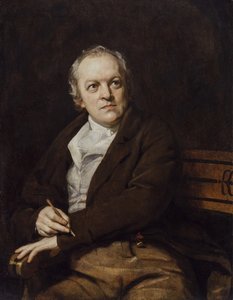
William Blake
1757 - 1827 , Verenigd Koninkrijk
Belangrijkste feiten
- Artistic Movement Or Style: Romantiek
- Artists Who Influenced This Artist:
- Raphael
- Michelangelo
- Date Of Birth: November 28, 1757
- Date Of Death: August 12, 1827
- Full Name: William Blake
- Nationality: Britse kunstenaar
- Notable Artworks:
- Songs of Innocence & Exp.
- The Tyger
- Jerusalem
- Place Of Birth: London, UK



