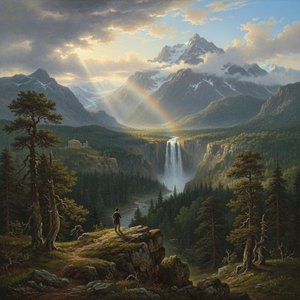
James Peel: A Painter of Northern Light
Born in Newcastle upon Tyne in 1811, James Peel’s life and artistic journey were inextricably linked to the rugged beauty of northern England – specifically, Northumberland, Yorkshire, and Wales. His early years, steeped in the industrial heritage of his father's woollen drapery business, provided a grounding in observation and an appreciation for the changing landscapes around him. Unlike many artists of his era who sought grand, idealized vistas, Peel’s work possessed a remarkable intimacy, capturing not just the scenery but also the subtle textures, atmospheric conditions, and quiet rhythms of rural life. His artistic development was nurtured by Alexander Dalziel, a skilled wood engraver, who recognized Peel's innate talent for drawing and encouraged his pursuit of painting.
Peel’s formal training began at Bruce’s School in Newcastle, where he honed his skills alongside notable figures like Sir Charles Mark Palmer and John Collingwood Bruce. However, it was a move to London in 1840 that truly propelled his career forward. Initially drawn to portraiture – producing striking copies of works by Wilkie Collins, including ‘Blind Fiddler’ and ‘The Village Festival,’ both housed within the National Gallery – Peel soon gravitated towards landscape painting. This shift reflected a deeper connection with the natural world, an impulse he would consistently pursue throughout his career.
A Palette of Northern Moods
Peel's artistic style is characterized by a remarkable sensitivity to light and atmosphere. He wasn’t interested in dramatic sunsets or sweeping vistas; instead, he meticulously rendered the subtle shifts in color and tone that defined the northern skies – the bruised purples of impending rain, the hazy greys of misty mornings, and the golden hues of late afternoon. His brushwork was precise yet fluid, conveying a sense of immediacy and spontaneity. He frequently depicted scenes of everyday rural life: shepherds tending their flocks, farmers working in their fields, and villagers engaged in their routines. These weren’t romanticized depictions; they were honest portrayals of a hardworking people living in harmony with the land.
A key element of Peel's technique was his masterful rendering of trees – an obsession that became almost synonymous with his name. He possessed an extraordinary ability to capture their intricate forms, the play of light and shadow on their bark, and the way they stood sentinel against the sky. Works like ‘A Lane in Berwickshire’ and ‘Cotherstone, Yorkshire,’ now residing in the Laing Art Gallery in Newcastle, exemplify this skill, showcasing a deep understanding of tree structure and an almost tactile quality to his brushstrokes.
Royal Recognition and Artistic Circles
Peel's dedication and talent quickly gained him recognition within the established art world. He began exhibiting at the Royal Academy in 1843 and subsequently joined the Royal Society of British Artists, a prestigious organization that championed English landscape painting. His work was consistently praised for its sincerity, technical skill, and evocative portrayal of northern landscapes. He wasn’t merely documenting scenery; he was conveying a feeling – a sense of quiet contemplation, rustic charm, and deep connection to the land.
Peel's artistic circle extended beyond the Royal Academy. He actively participated in “free” exhibitions organized by figures like Ford Madox Brown and William Bell Scott, challenging the established norms of the art market and advocating for greater accessibility to art. These initiatives demonstrated his commitment to fostering a vibrant and inclusive artistic community.
Legacy and Enduring Appeal
James Peel died in Reading in 1906, leaving behind a substantial body of work that continues to resonate with viewers today. His paintings are not grand statements but intimate glimpses into the heart of northern England – a region he loved deeply and captured with remarkable honesty and skill. His influence can be seen in subsequent generations of landscape artists who sought to emulate his sensitivity to light, his meticulous technique, and his profound appreciation for the beauty of the natural world.
Peel’s legacy extends beyond his artistic achievements. He represents a pivotal moment in British art history – a time when landscape painting moved away from idealized representations and embraced a more direct and personal approach. His work serves as a reminder that true artistry lies not just in technical skill but also in the ability to capture the essence of a place and its people.
Vraag en antwoord
Hoeveel kunstwerken van James Peel zijn beschikbaar om te bekijken?
U kunt 41 kunstwerken werken van James Peel bekijken op de Alle kunstwerken-pagina.
Waar kan ik de kunstwerken van James Peel bekijken, gesorteerd op sfeer?
De werken van James Peel kunnen per stemming worden bekeken op de Sfeercollectie pagina van de kunstenaar, waar de kunstwerken zijn gerangschikt op basis van hun vastgelegde stemmingen.
Waar kan ik de kunstwerken van James Peel ontdekken, ingedeeld op onderwerp?
De Onderwerpsindex-pagina brengt de kunstwerken van James Peel in kaart op basis van onderwerp.