The Versatile Hand of Nicolas Henri Jacob
Born in Paris, France, Nicolas Henri Jacob emerged as a remarkably multifaceted figure within the nineteenth-century art world. A true Renaissance man of his era, he navigated the boundaries between fine art and scientific precision with unparalleled grace. His creative identity was not confined to a single medium; rather, he flourished as a painter, designer, furniture maker, and scientific lithographer. This unique breadth of skill allowed him to leave an indelible mark on both the aesthetic elegance of domestic objects and the rigorous documentation of human anatomy.
The foundations of his artistic journey were laid under the tutelage of some of the most significant masters of the age. Jacob studied painting under the legendary Jacques-Louis David, as well as Antoine Dupasquier and Jean-Jacques Morgan. His education was equally diverse, as he pursued the intricate craft of cabinetmaking under Georges Jacob. This dual training in the lofty realms of Neoclassical painting and the tactile discipline of craftsmanship would later define his unique ability to blend decorative beauty with structural accuracy.
From Courtly Elegance to Scientific Precision
Early in his career, Jacob’s talent earned him prestigious recognition and high-profile patronage. His first presentation at the Paris Salon in 1802 was a pivotal moment, leading to the support of Eugene Rose de Beauharnais, the adopted son of Napoleon Bonaparte. Between 1805 and 1814, Jacob served as the court draughtsman to Eugène Beauharnais during his tenure as Viceroy of Italy. This period of courtly service likely refined his ability to capture the dignity of portraiture and the grandeur of official life.
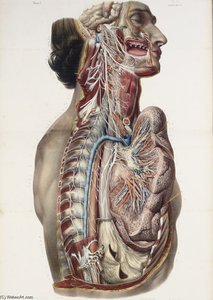
As his career progressed, a fascinating shift occurred toward the intersection of art and science. Following his time in Milan, Jacob served as a drawing teacher at the National Veterinary School of Alfort from 1818 to 1830. It was within this academic environment that his interest in anatomy blossomed. He became a pioneer of the emerging lithographic technique, utilizing its potential for incredible detail. His most monumental achievement in this field was his contribution to Jean-Marc Bourgery's Traité complet de l'anatomie de l'homme, where he executed an astounding 725 lithograph plates that remain celebrated for their stunning accuracy and meticulous chalk technique.
A Legacy of Design and Illustration
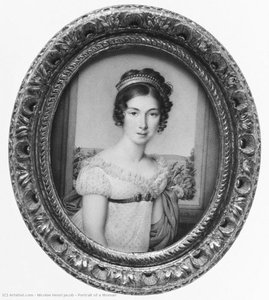
Beyond the anatomical atlas, Jacob’s creative spirit was deeply embedded in the material culture of France. His expertise in furniture design allowed him to create exquisite pieces for notable figures, such as the extraordinary crystal dressing table designed for the Duchess of Berry, which is now held in the Louvre Museum. Whether he was working on a delicate pencil portrait, such as his serene study of Madame Bourgeois Girod and her dog, or executing complex medical illustrations like Tendon Transection For The Treatment Of Muscle Spasm In The Thigh, his work always maintained a standard of profound technical mastery.
The historical significance of Nicolas Henri Jacob lies in his ability to bridge disparate worlds. He moved seamlessly from the decorative splendor of furniture and Neoclassical portraiture to the rigorous, life-saving clarity required by medical publishing. His legacy is found in the delicate lines of his lithographs and the enduring precision of his anatomical studies, marking him as an artist who saw no boundary between the beauty of form and the truth of science.
Vraag en antwoord
Waar komt Nicolas Henri Jacob vandaan?
Nicolas Henri Jacob werd geboren in France.
Kan ik de kunstwerken van Nicolas Henri Jacob sorteren op kleur?
De Sorteren op kleur van Nicolas Henri Jacob biedt een overzicht van de kunstwerken van de kunstenaar, georganiseerd op kleur.
Is er een virtuele 3D-rondleiding door de werken van Nicolas Henri Jacob?
De kunstwerken van Nicolas Henri Jacob zijn te bewonderen in een 3D-galerie op de 3D-galerie-pagina van de kunstenaar.