A Bohemian Visionary: The Life and Legacy of Václav Jansa
Václav Jansa (1859–1913) remains a pivotal figure in the tapestry of Czech landscape painting, a master whose brush captured not just the scenery of his homeland, but its very soul. Born in the small village of Slatinice, Jansa’s early years were marked by a unique intersection of humble origins and aristocratic exposure. While his parents served as staff for Count Herberstein, the young artist was immersed in an environment of refined culture that would later inform the elegance of his compositions. This early life, transitioning from a merchant's apprenticeship to the prestigious halls of the Academy of Fine Arts in Prague, set the stage for a career defined by both meticulous precision and grand, sweeping ambition.
His formal education was a journey through the heart of European artistic excellence. After studying under Antonín Lhota in Prague, Jansa sought further refinement at the Academy of Fine Arts in Vienna. There, he honed his technique under the guidance of luminaries such as Eduard von Lichtenfels and Leopold Carl Müller. This period of intense training allowed him to master the delicate nuances of watercolor, a medium through which he would achieve his greatest renown. His ability to manipulate light and texture enabled him to transform simple landscapes into evocative windows onto the Bohemian spirit, blending the realism of his era with a romantic, almost nostalgic sensibility.
The Architect of Memory: Landscapes and Panoramas
While Jansa is perhaps most beloved for his intimate watercolors of Prague’s Old Town, his artistic reach extended to the monumental. He possessed a rare ability to scale his vision from the minute detail of a cobblestone street to the colossal proportions of historical panoramas. His collaborative spirit was evident in several massive undertakings that sought to immortalize Czech history:
- The Slaughter of the Saxons at Hrubá Skála: A breathtaking achievement measuring 8.5 by 10 meters, this work commemorated a significant 13th-century victory and showcased his ability to handle complex, large-scale narratives.
- The Panorama of Lipany: An immense feat of endurance and artistry, Jansa contributed to this 95-meter-long depiction of the Battle of Lipany, helping to create a cinematic experience of Czech triumph.
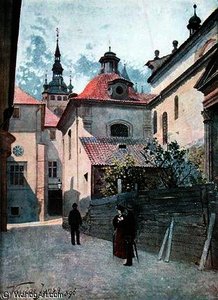
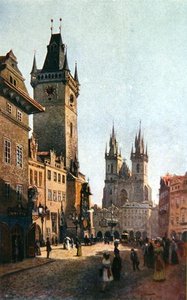
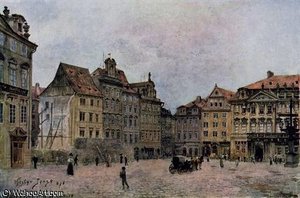
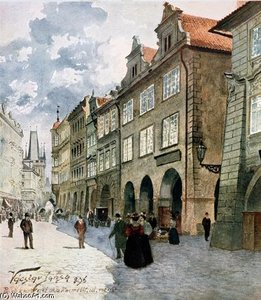
Beyond these grand spectacles, Jansa’s work served a vital historical purpose. As Prague underwent rapid urban redevelopment in the late 19th century, many historic structures were slated for demolition. Recognizing the impending loss of architectural heritage, Jansa undertook a monumental task of documentation. Through over 150 detailed watercolors of the Staré Město and Nové Město, he provided an invaluable visual inventory of a disappearing world, ensuring that the textures, shadows, and character of the old city would endure in the collective memory long after the stones themselves were gone.
A Lasting Impression on Czech Art
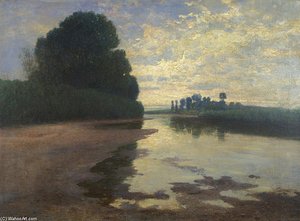
The significance of Václav Jansa lies in his dual role as both an artist and a chronicler. His illustrations for renowned publications like Zlatá Praha and Světozor brought his exquisite talent to the wider public, making him a household name among those who cherished the beauty of the Bohemian landscape. Whether he was capturing the sun-drenched leisure of a seaside scene in Koupání V Zátoce or the somber, sepia-toned tranquility of a rural vista, his work always maintained a profound connection to the essence of the land.
Jansa’s legacy is one of devotion—devotion to the truth of nature and devotion to the preservation of history. Through his mastery of watercolor and his commitment to documenting the changing face of his nation, he bridged the gap between the fleeting moment and eternal art. Today, his works stand as much more than mere paintings; they are precious fragments of a lost era, inviting modern viewers to wander through the timeless streets of Prague and the verdant valleys of Bohemia through the eyes of a true visionary.
Vraag en antwoord
Waar komt Václav Jansa vandaan?
Václav Jansa werd geboren in Czech Republic.
Kan ik de werken van Václav Jansa bekijken op basis van stemming?
Op de Sfeercollectie pagina van de kunstenaar vindt u de kunstwerken van Václav Jansa, gerangschikt op basis van hun sfeer.
Kan ik de werken van Václav Jansa bekijken op basis van kleurenpalet?
De werken van Václav Jansa kunnen op basis van kleurpalet worden bekeken op de Op kleurpalet pagina van de kunstenaar.