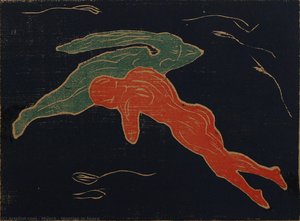
Olje.

§ 1Catalogue data


§ 2Abstract
Beskrivelse av objektet
Utforsk Munchs sans titel (7352): Ett mästerverk av expressionismen som fångar ångest och melankoli genom djärva färger och atmosfär.
 Vis hele teksten
Om kunstneren
Edvard Munch (1863-1944): Pioner innen ekspresjonismen, kjent for malerier som «Skrik». Utforsker angst, sorg og menneskets indre verden med kraftfuld fargebruk og følelser.
§ 3Commentary
A Descent into Melancholy: Exploring Edvard Munch’s “Untitled (7352)”
Edvard Munch's "Untitled (7352)," a cornerstone of the Expressionist movement, isn’t merely a depiction of a solitary figure; it’s an immersion into raw emotion—a visceral portrayal of isolation, anxiety, and the unsettling beauty of twilight. Painted around 1893, this work transcends simple representation, becoming a potent symbol of the human condition grappling with mortality and inner turmoil. Munch, deeply influenced by personal tragedy – the early deaths of his mother and sister from tuberculosis, coupled with a lifelong struggle against mental illness within his family – channeled these profound experiences into his art, forging a style uniquely attuned to capturing the darkest recesses of the psyche. The painting’s power resides not in its precise details but in its evocative atmosphere, achieved through bold brushstrokes, jarring color choices, and a deliberate distortion of form. It's a landscape of the soul, rendered with an unflinching honesty that continues to resonate powerfully over a century later.The Expressionist Palette: Color as Emotion
At the heart of “Untitled (7352)” lies Munch’s masterful manipulation of color – a technique central to the Expressionist movement's core philosophy. The dominant hues are not those of naturalistic representation, but rather shades of deep blues and purples that bleed into an unsettling orange-red horizon. This chromatic dissonance immediately establishes a mood of unease and foreboding. The sky isn’t simply illuminated by sunset; it pulsates with an almost violent energy, mirroring the internal chaos experienced by the figure. Notice how the colors intensify towards the center of the composition, drawing the viewer's eye into the painting’s emotional vortex. Munch deliberately avoided blending his brushstrokes, opting instead for a visible, textured application that further amplifies the sense of urgency and instability. This technique wasn’t intended to mimic reality but to convey the subjective experience—the feeling of being overwhelmed by emotion.A Figure in Isolation: Symbolism and Psychological Depth
The solitary figure standing on the beach is not presented as a heroic adventurer or a contemplative observer; rather, he appears lost, vulnerable, and utterly alone. His posture – slumped shoulders, averted gaze – speaks volumes about his internal state. The figure’s elongated form and distorted features contribute to the overall sense of unease, suggesting a being struggling against an unseen force. Some art historians interpret this figure as Munch himself, grappling with his own demons and anxieties. The painting’s symbolism is rich in references to mortality and psychological torment. The beach itself holds symbolic weight; often associated with transition, liminal spaces, and the passage between life and death. It’s a place where boundaries blur, and the familiar world dissolves into uncertainty. The absence of any other figures reinforces the theme of isolation, emphasizing the individual's struggle within a vast and indifferent universe.Contextualizing Munch: The Birth of Modern Anxiety
“Untitled (7352)” was created during a period of profound social and intellectual upheaval in Europe – the late 19th century, marked by rapid industrialization, urbanization, and growing anxieties about modernity. The rise of psychology, particularly Freud’s exploration of the unconscious mind, profoundly influenced artists like Munch, who sought to depict the hidden realities of human experience. Munch's work reflects this shift towards introspection and a rejection of traditional artistic conventions that prioritized objective representation. He wasn’t interested in portraying what *was* but rather what *felt*. The painting anticipates many of the themes explored by later Expressionist artists – alienation, despair, and the fragmentation of identity—making it a pivotal work in the development of modern art. ## Bringing Munch Home: A High-Quality Reproduction At AllPaintingsStore.com, we are proud to offer meticulously crafted hand-painted reproductions of “Untitled (7352),” capturing the essence and emotional depth of Munch’s original masterpiece. Our skilled artisans utilize traditional oil painting techniques, carefully replicating the artist’s bold brushstrokes, vibrant colors, and distinctive style. Unlike digital prints, our reproductions possess a tactile quality and nuanced color palette that faithfully recreate the artwork’s atmospheric intensity. Owning a AllPaintingsStore reproduction of “Untitled (7352)” is not simply acquiring an image; it’s bringing home a powerful symbol of human emotion—a testament to Munch’s enduring legacy and his profound exploration of the darkest corners of the human soul. Explore our collection today and discover how this iconic work can enrich your space and ignite your imagination.Spørsmål og svar
Kan jeg undersøke "Sans titre (7352)" mer detaljert?
Røntgenstråling-siden til "Sans titre (7352)" av Edvard Munch er en interaktiv visning som lar deg bla gjennom elleve optiske lag av kunstverket, inkludert en visning i røntgenstil.
Hvem har skapt "Sans titre (7352)", og hvilken stil er det i?
Edvard Munch skapte "Sans titre (7352)" innenfor Expressionist-bevegelsen.
Hva er anbefalt trykkstørrelse for "Sans titre (7352)" av Edvard Munch?
"Sans titre (7352)" anbefales i en trykkstørrelse på Standard størrelse. Andre størrelser er tilgjengelige med de samme proporsjonene.


 Bytt til trykk


 For kunstverk eller reproduksjoner som er større enn 105 cm (ca. 41 tommer) på noen side, vil rammen bli sendt som et sett som må monteres. Denne metoden sikrer trygg levering og forhindrer skader under transport.