

.

§ 1Katalogdata

Dette kunstverket er beskyttet av opphavsrett
Kunstverket som vises på denne siden er beskyttet av opphavsretten, noe som betyr at vi ikke har juridisk tillatelse til å lage eller selge identiske reproduksjoner. Denne beskyttelsen håndheves i henhold til internasjonale avtaler som for eksempel Bernerkonvensjonen og av nasjonale lover, inkludert de som er fastsatt i Amerikansk lov om opphavsrett – Tittel 17.
Som et respektfullt og lovlig alternativ tilbyr vi skreddersydde, håndmalte kunstverk inspirert av originalen. Våre dyktige og profesjonelle kunstnere studerer nøye originalens stil, stemning og kunstneriske essens for å skape et nytt og unikt verk som vekker den samme følelsen – samtidig som det forblir en original skapelse i seg selv.
Denne metoden er i fullt samsvar med opphavsrettslige regler, da den ikke innebærer kopiering eller duplisering av det beskyttede kunstverket. I stedet er det snakk om en kreativ nytolkning – et nytt maleri som er inspirert av originalen, men ikke identisk med den.
 Les mer om dette
§ 2Abstrakt
Beskrivelse av objektet
Experience tenderness and care in Henry Moore's 'Lullaby Sleeping Head.' This evocative drawing captures a peaceful moment between a man and child, showcasing Moore’s signature abstract style. Explore the iconic British sculptor's legacy.
Om kunstneren
Utforsk Henry Moores ikoniske skulpturer! Kjennskap til abstrakte former – liggende figurer og mødre-og-barn temaer. Oppdag hans arv over hele verden.
§ 3Kommentarer
A Tender Moment Captured: Henry Moore's "Lullaby Sleeping Head"
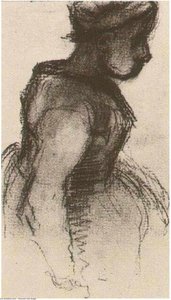
This evocative black and white drawing, “Lullaby Sleeping Head,” offers a poignant glimpse into the intimate bond between a parent and child. Created by the renowned British sculptor Henry Moore, this work transcends mere depiction; it’s an exploration of comfort, protection, and the profound tenderness inherent in nurturing relationships. While primarily known for his monumental sculptures, this drawing reveals another facet of Moore's artistic genius – his ability to distill complex emotions into deceptively simple forms. The image portrays a man gently cradling a sleeping child, their figures intertwined in a posture of serene repose. The man’s robe-like garment envelops both figures, creating a sense of warmth and security. The detail afforded to the man's face—his eyes and mouth—suggests quiet contemplation and unwavering care, while the partially obscured face of the sleeping child amplifies the feeling of vulnerability and trust.Style & Technique: A Sculptor’s Perspective
Moore’s artistic style is immediately recognizable even in this two-dimensional medium. Though he's celebrated for his three-dimensional works, here we see a direct translation of his sculptural principles. The drawing exhibits the hallmarks of Moore’s approach to form – simplification and abstraction. He doesn't strive for photographic realism; instead, he focuses on capturing the essence of the figures through carefully rendered lines and shading. This technique, rooted in direct carving—a method he championed—allows him to convey volume and weight despite the absence of physical depth. The use of black and white enhances the drawing’s emotional intensity, stripping away color distractions and focusing attention on the interplay of light and shadow that defines the forms. It's a testament to Moore’s mastery that he can evoke such powerful emotion with such economical means.Historical Context & Recurring Themes
“Lullaby Sleeping Head” was created during Moore’s prolific career, which spanned from the 1920s until his death in 1986. His work is deeply embedded within the context of Modernism, reacting against traditional representational art while simultaneously exploring universal human themes. Moore frequently depicted the mother-and-child motif throughout his oeuvre, recognizing its symbolic power as a representation of primal connection and enduring love. This drawing aligns with that recurring theme, but offers a unique perspective by portraying the father’s role in nurturing—a shift reflecting evolving societal roles during the mid-20th century. The post-war period saw a renewed emphasis on family and domesticity, and Moore's work often reflected these changing values.Symbolism & Emotional Impact
Beyond its literal depiction, “Lullaby Sleeping Head” resonates with profound symbolic meaning. The act of cradling—the protective embrace—represents security, vulnerability, and unconditional love. The sleeping child symbolizes innocence and trust, while the man embodies strength and guardianship. The absence of a detailed background further emphasizes the intimacy of the moment, drawing the viewer’s attention solely to the relationship between these two figures. The overall emotional impact is one of quiet serenity and profound tenderness—a universal expression of parental love that transcends cultural boundaries. This piece invites contemplation on the enduring power of human connection and the beauty found in simple, everyday moments.Spørsmål og svar
Hvilken stilart tilhører "Lullaby Sleeping Head"?
Kunstretningen knyttet til "Lullaby Sleeping Head" av Henry Moore er Modernism. Denne klassifiseringen plasserer verket sammen med relaterte kunstnere og kunstverk.
Er Henry Moore, skaperen av "Lullaby Sleeping Head", kjent under andre navn?
Andre navn registrert for Henry Moore, skaperen av "Lullaby Sleeping Head", inkluderer Henry Spencer Moore, Henry Lee Moore.
Finnes det et faktablad om "Lullaby Sleeping Head" av Henry Moore for studenter?
Guiden til "Lullaby Sleeping Head" er kunstverkets Faktablad for studenter-side – et utskrivbart faktablad som viser kunstverket med bildetekst, kreditering og informasjonstabell (kunstner, datoer, medium, original størrelse, samling).




 Bytt til trykk


 For kunstverk eller reproduksjoner som er større enn 105 cm (ca. 41 tommer) på noen side, vil rammen bli sendt som et sett som må monteres. Denne metoden sikrer trygg levering og forhindrer skader under transport.




