


 Se i rommet
 Del som digitalt kort
 Del
Del
 Detaljer
 Studentguide

 Last ned
 Liknende objekter
 Røntgen
 Lysbildefremvisning
 Besøksstatistikk
Café Man Ray


 Les mer
Kunstverket som vises på denne siden er beskyttet av opphavsretten, noe som betyr at vi ikke har juridisk tillatelse til å lage eller selge identiske reproduksjoner. Denne beskyttelsen håndheves i henhold til internasjonale avtaler som for eksempel Bernerkonvensjonen og av nasjonale lover, inkludert de som er fastsatt i Amerikansk opphavsrettslov – Tittel 17.
Denne metoden er i fullt samsvar med opphavsrettslige regler, da den ikke innebærer kopiering eller duplisering av det beskyttede kunstverket. I stedet er det snakk om en kreativ nytolkning – et nytt maleri som er inspirert av originalen, men ikke identisk med den.
Giclée / Kunsttrykk
Giclée- eller lerretsprint av museumskvalitet med rask produksjon og fleksible valgmuligheter for etterbehandling. ( Bestill håndmalt reproduksjon Gå til digitalt bilde)




P118B Nkr10

P118H Nkr10

P118W Nkr10

P438Z Nkr10

P508JH Nkr12

P508YH Nkr12

P805H Nkr10

P805Z Nkr10

P919BZ Nkr10

P919G Nkr10

P919XJ Nkr10

P959ZH Nkr10

P968JZ Nkr12

W106C Nkr8

W218G Nkr10

W218JH Nkr8

W218Y Nkr10

W307PJ Nkr10

W316G Nkr10

W316PJ Nkr8

W316Y Nkr10

W398PJ Nkr8

W4111J Nkr10

W500HY Nkr15

W500JH Nkr15

W692G Nkr12

W849H Nkr8

W940BG Nkr15

W953PJ Nkr8




Velg mellom våre forhåndsdefinerte størrelser som bevarer kunstverkets opprinnelige proporsjoner.

Skriv inn bredden og høyden du trenger, slik at den passer til din ramme eller vegg. Et trykk kan kun beskjæres, aldri gjøres større enn bildet, så et format med en annen form vil miste en del av motivet. Vi sender deg en digital mockup for godkjenning før vi trykker noe som helst. Bildet som vises på denne siden viser ikke den faktiske beskjæringen — det er kun mockuppen som gjør det.
Verdensomspennende levering () på 2 uker i stedet for standard 4/5 uker. (23 October)

Gratis ekspressfrakt over hele verden

Lerretsduk av høykvalitets lin

Full transportforsikring

Garanti for refusjon av toll og importavgifter

Garantert fargeekthet

100 dagers returrett ved fabrikasjonsfeil

100% pengene tilbake-garanti

Mengderabatt
 Glassalternativet er kun tilgjengelig i størrelser under 110 cm

Café Man Ray
Giclée / Kunsttrykk
Format på reproduksjon
-


Totalpris
Nkr 608
Café Man Ray: A Surrealist Reverie Revisited
The American artist Man Ray (1890-1976) fundamentally reshaped the perception of photography, elevating it from mere documentation to an expressive art form. His artistic journey commenced in New York with paintings—bold explorations of abstraction and symbolism—but a pivotal encounter with Dadaism, spearheaded by Marcel Duchamp in 1915, propelled his conceptual horizons far beyond conventional boundaries. Embracing the ready-made aesthetic championed by Duchamp, Man Ray’s groundbreaking sculptures exemplify this paradigm shift; perhaps most notably, “The Gift,” featuring a flattened iron affixed with tacks (1921), stands as an emblem of artistic innovation. Returning to Paris after World War I, he immersed himself in diverse creative pursuits—portraiture, fashion photography, and filmmaking—activities that solidified his position within the Surrealist movement and cemented his reputation as a visionary innovator.- Subject Matter: The artwork presents a meticulously crafted still life centered around a weathered shovel resting against a richly textured wooden panel. This seemingly unassuming composition belies a profound narrative of time, labor, and perhaps even nostalgia—themes that resonate deeply within the Surrealist tradition.
- Style: Man Ray’s approach leans toward realism infused with stylistic elements characteristic of Surrealism. The deliberate juxtaposition of textures—the rough surface of the shovel contrasted against the smooth grain of the wood—creates visual tension and invites contemplation about materiality and perception.
Technique & Materials: An Impressionistic Dialogue
The artwork’s execution employs oil paint or mixed media, demonstrating a masterful blending of techniques. Layers of pigment are applied with careful consideration to capture the nuances of light and shadow—a hallmark of Impressionism—while simultaneously incorporating textural elements that heighten visual interest. The artist’s meticulous attention to detail—evident in the rendering of the shovel’s contours and the subtle shading on the wooden panel—underscores his commitment to capturing a moment in time with unwavering accuracy.- Color Palette: Dominant hues consist of deep browns and blacks, punctuated by warm tones derived from the wood grain. This color scheme evokes feelings of warmth, solidity, and understated elegance—a stylistic choice consistent with Surrealist sensibilities.
- Composition: The artwork adopts a centered composition with a slight offset to the right, positioning the shovel slightly off-center to create visual balance. Text – ‘cafe’ and ‘Man Ray 1940’ – are seamlessly integrated into the design in a calligraphic style—a deliberate gesture that emphasizes both subject matter and artistic authorship.
Historical Context & Symbolism: Echoes of Dada & Surrealist Ideals
Born Emmanuel Radnitzky, Man Ray’s artistic trajectory mirrored the turbulent intellectual landscape of the early 20th century—a period marked by radical experimentation and a rejection of traditional conventions. Influenced by Dada’s embrace of chance and absurdity, he sought to challenge established norms and provoke viewers into questioning their assumptions about reality. The shovel itself serves as a potent symbol—representing labor, resilience, and perhaps even the cyclical nature of existence—reflecting core tenets of Surrealist thought.- Lighting: Directional lighting casts shadows that accentuate the shovel’s form and illuminate the intricate details of the wooden surface—a technique reminiscent of Impressionistic painting and contributing to the artwork's overall atmosphere of quiet contemplation.
Emotional Impact & Artistic Legacy
Ultimately, “Café Man Ray” transcends mere visual representation; it evokes a profound emotional response—one characterized by nostalgia for simpler times and an appreciation for the beauty of understated craftsmanship. Man Ray’s enduring legacy resides in his pioneering spirit—his unwavering dedication to artistic innovation—and his ability to capture fleeting moments of experience with remarkable sensitivity.Spørsmål og svar
Er "Café Man Ray" tilgjengelig som et kunsttrykk?
"Café Man Ray" er tilgjengelig som et kunsttrykk på bomullslerret eller arkivbestandig lerretspapir. Bestillinger legges inn på siden for Kunsttrykk i høy kvalitet, i den størrelsen du selv velger.
Hvilken følelse formidler "Café Man Ray" av Man Ray?
I "Café Man Ray" ledsages en Calm stemning av en Reflective følelse.
Hvordan laster jeg ned bildet av "Café Man Ray" av Man Ray?
Bildet av "Café Man Ray" av Man Ray kan lastes ned fra verkets Last ned-side: nedlasting av et digitalt bilde i høy oppløsning.
Relaterte kunstverk


Kunstnerbiografi
A Life Illuminated by Shadows
Emmanuel Radnitzky, a name forever intertwined with the enigmatic “Man Ray,” was born in Philadelphia in 1890 to Russian Jewish immigrant parents. His early life, steeped in the vibrant energy of New York City, proved formative, exposing him to both the raw realism of the Ashcan School and the revolutionary currents of European modernism – a potent blend that would subtly shape his artistic vision. From a young age, he displayed an innate talent for drawing and design, skills honed during his studies at the Ferrer Centre, where anarchist ideals fostered a spirit of experimentation and radical self-expression. This environment instilled in him a lifelong commitment to challenging conventional norms and pushing the boundaries of artistic possibility. The shift from “Manny” Radnitzky to Man Ray wasn’t merely a stylistic choice; it was an assertion of identity—a deliberate rejection of societal expectations and a declaration of independence within the art world.Dada, Surrealism, and the Birth of a New Vision
Man Ray's artistic trajectory took a dramatic turn with his encounter with Marcel Duchamp in New York around 1915. This meeting ignited a shared fascination with dismantling traditional notions of art, leading them both into the heart of the Dada movement—a defiant protest against the horrors and disillusionment of World War I. Dada artists sought to dismantle established values, embracing chance, absurdity, and anti-art principles. Man Ray quickly became a key figure in this movement, collaborating with Duchamp on “ready-mades”—ordinary manufactured objects elevated to the status of art—and contributing to the publication of *New York Dada*, a groundbreaking attempt to establish Dada’s presence in America. This rebellious spirit propelled him beyond Dada and into the embrace of Surrealism, a movement that sought to unlock the power of the unconscious mind. He found kinship with André Breton and other leading Surrealists, exploring themes of dreams, desire, and the irrational through his art. His work during this period is characterized by a dreamlike quality—a deliberate blurring of reality and illusion, inviting viewers into a world of hidden meanings and subconscious associations.The Alchemy of Light: Rayographs and Photographic Innovation
Perhaps Man Ray’s most enduring contribution to the art world lies in his invention of the “rayograph”—a revolutionary photographic technique that emerged almost serendipitously in 1922. Frustrated with the limitations of traditional photography, he began experimenting with placing objects directly onto light-sensitive paper and exposing them to light—effectively bypassing the camera lens altogether. The resulting images were ethereal, ghostly, and utterly unlike anything previously seen in photography. These weren’t representations *of* things; they were direct imprints *from* them, imbued with a sense of mystery and otherworldliness. He dubbed these creations “rayographs,” a clever blend of his own name and the word "photograph." Beyond rayographs, Man Ray relentlessly explored the possibilities of photography, mastering techniques like solarization—a process that created dramatic reversals of tone—and experimenting with multiple exposures to achieve complex layered effects. His portraits, particularly those of fellow artists like Lee Miller, are renowned for their psychological depth and striking compositions, capturing a sense of vulnerability and intrigue.Beyond Stillness: Film and a Lasting Legacy
Man Ray’s artistic curiosity didn't end with still photography; he ventured into the realm of filmmaking, producing a series of experimental films that challenged conventional narrative structures and embraced surreal imagery. Films like *Le Retour à la Raison* (1923) and *L'Étoile de Mer* (1928) were not stories told in a linear fashion; they were visual poems— explorations of form, rhythm, and the subconscious. He employed innovative techniques such as stop-motion animation and superimposition to create disorienting and dreamlike effects, pushing the boundaries of cinematic expression. While his filmography remained relatively small, it was profoundly influential on subsequent generations of avant-garde filmmakers. Throughout his long career, Man Ray consistently defied categorization, refusing to be confined by labels or expectations. He died in Paris in 1976, leaving behind a body of work that continues to inspire and provoke—a true pioneer who forever altered our perception of art and reality.A Continuing Influence
Man Ray’s legacy extends far beyond his own lifetime, continuing to resonate with artists and audiences today. His willingness to experiment, his rejection of convention, and his unwavering commitment to artistic freedom serve as a powerful inspiration for those who seek to push the boundaries of creative expression. His influence can be seen across various disciplines:- Photography: Man Ray’s techniques, particularly rayography and solarization, continue to be explored by contemporary photographers.
- Surrealism: His contributions solidified the movement's visual language and inspired countless artists across disciplines.
- Experimental Film: His pioneering work in film laid the groundwork for future generations of avant-garde filmmakers.
- Fashion Photography: Ray’s innovative approach to portraiture and composition influenced the development of modern fashion photography.

Man Ray
1890 - 1976 , USA
Kort om kunstneren
- Artistic Movement Or Style: Dada, Surrealisme
- Artists Or Movements Influenced By This Artist: ['Surrealistbevegelsen']
- Artists Who Influenced This Artist: ['Marcel Duchamp']
- Date Of Birth: 27. august 1890
- Date Of Death: 18. november 1976
- Full Name: Emmanuel Radnitzky
- Nationality: Amerikansk
- Notable Artworks:
- Rayographs
- Film
- Place Of Birth: Philadelphia, USA
Relaterte artikler
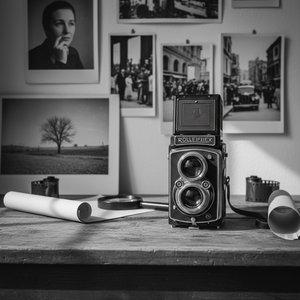
Monochrome Visions: Exploring the Aesthetic & Historical Significance of Black & White Photography
Explore the rich history & artistic power of black and white photography. From early techniques to iconic masters like Ansel Adams, discover why monochrome continues to captivate art lovers today. Expert insights for collectors.

The Lens of Truth: A Comprehensive History and Legacy of Documentary Photography
Explore the profound history of documentary photography. From early daguerreotypes to social reform movements, discover how the lens captures truth, preserves vanishing cultures, and shapes our global visual narrative through an expert art-historical lens.

Beyond the Lens: Photography's Enduring Influence on Modern & Contemporary Art
Explore photography's pivotal role in shaping modern & contemporary art. Discover key movements, influential artists like Stieglitz, and expert collecting advice from AllPaintingsStore.

The Enduring Legacy of Oil on Canvas: Technique, History & Aesthetic Impact
Explore the rich history & techniques of oil painting – from Renaissance masters to Impressionism. Discover pigments, layering methods, and why this timeless medium endures. Expert insights for artists & art enthusiasts.

Pictorialism: A Search for Artistic Photography's Soul – Aesthetics, Techniques & Legacy
Explore the captivating world of Pictorialism – a pivotal movement that transformed photography into fine art. Discover key artists like Stieglitz & Käsebier, techniques, and collecting tips from experts.


