

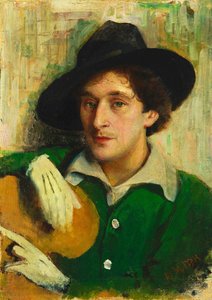
1914. Oil On Canvas.

§ 1Katalogdata


Dette kunstverket er beskyttet av opphavsrett
Kunstverket som vises på denne siden er beskyttet av opphavsretten, noe som betyr at vi ikke har juridisk tillatelse til å lage eller selge identiske reproduksjoner. Denne beskyttelsen håndheves i henhold til internasjonale avtaler som for eksempel Bernerkonvensjonen og av nasjonale lover, inkludert de som er fastsatt i Amerikansk lov om opphavsrett – Tittel 17.
Som et respektfullt og lovlig alternativ tilbyr vi skreddersydde, håndmalte kunstverk inspirert av originalen. Våre dyktige og profesjonelle kunstnere studerer nøye originalens stil, stemning og kunstneriske essens for å skape et nytt og unikt verk som vekker den samme følelsen – samtidig som det forblir en original skapelse i seg selv.
Denne metoden er i fullt samsvar med opphavsrettslige regler, da den ikke innebærer kopiering eller duplisering av det beskyttede kunstverket. I stedet er det snakk om en kreativ nytolkning – et nytt maleri som er inspirert av originalen, men ikke identisk med den.
 Les mer om dette
§ 2Abstrakt
Beskrivelse av objektet
Experience Marc Chagall's 'The Fiddler,' a vibrant Cubist masterpiece depicting a musician and his audience. Explore its surreal imagery, folklore-inspired style, and artistic significance.
Om kunstneren
Opplev Marc Chagall (1887-1985), en russisk-fransk kunstner kjent for sine drømmende malerier, jødiske temaer og fantastiske glasskunstverk. Utforsk hans arv!
§ 3Kommentarer
A Portrait of Rural Reverie: Marc Chagall’s “The Fiddler”
Marc Chagall's "The Fiddler," painted in 1914 during his formative years in Paris, isn’t merely a depiction of a man playing an instrument; it’s a shimmering portal into a world steeped in folklore, memory, and the quiet beauty of rural life. This oil on canvas, currently residing within the Kunstsammlung Nordrhein-Westfalen in Düsseldorf, embodies the artist's unique synthesis of influences – a potent blend of Cubism’s fractured perspectives, the vibrant hues of Fauvism, and the deeply personal symbolism rooted in his Jewish heritage.
The scene unfolds with an immediate sense of dreamlike tranquility. A solitary fiddler, rendered with bold, almost childlike strokes, stands before a modest dwelling, its snow-dusted roof hinting at a harsh winter landscape. His face, etched with a gentle melancholy and framed by a flowing red coat, is instantly recognizable – a figure both familiar and profoundly enigmatic. Around him, the composition isn’t concerned with strict realism; instead, Chagall employs Cubist principles to deconstruct forms into geometric shapes, layering planes and creating an intriguing sense of spatial ambiguity. The figures observing from afar are rendered in muted tones, almost dissolving into the background, suggesting a community witnessing this solitary moment.
The Language of Cubism and Jewish Folklore
Chagall’s embrace of Cubism is evident not as a rigid adherence to its tenets but rather as a means to express his inner vision. The fragmented forms, tilted perspectives, and overlapping planes aren't simply stylistic choices; they mirror the artist’s desire to capture fleeting memories and emotional states. Crucially, however, “The Fiddler” transcends mere Cubist experimentation. It’s deeply intertwined with Chagall’s personal iconography – a vocabulary of symbols drawn from his childhood in Vitebsk, Belarus, a region where Jewish culture thrived alongside Orthodox Christianity.
The fiddle itself is a potent symbol, representing not just music but also storytelling, tradition, and the preservation of cultural memory. The red coat, a recurring motif in Chagall’s work, often signifies passion, vitality, or even sacrifice. The presence of the boy – presumably the fiddler's son – adds another layer of meaning, evoking themes of lineage, continuity, and the passing down of heritage. Furthermore, the snow-covered house suggests both hardship and resilience—a testament to the enduring spirit of a rural community.
A Window into Chagall’s Artistic Evolution
Painted in the wake of World War I, “The Fiddler” reflects a period of profound artistic upheaval. Chagall was grappling with new ideas and experimenting with different styles, seeking to forge his own distinct voice amidst the revolutionary currents sweeping through the art world. This work demonstrates his early exploration of abstraction while retaining a strong connection to representational imagery and deeply personal symbolism. It’s a pivotal piece in understanding his artistic trajectory – a bridge between his formative years in Vitebsk and his later, more overtly expressive works.
The influence of artists like Pablo Picasso and Henri Matisse is undeniable, yet Chagall skillfully integrates these influences into his own unique style. His use of bold colors—particularly the vibrant red against the muted blues and whites—creates a dynamic visual impact, drawing the viewer’s eye through the composition. The painting's emotional resonance stems from its ability to evoke a sense of nostalgia, solitude, and the quiet dignity of everyday life. It is a testament to Chagall’s extraordinary talent for transforming personal memories into universal symbols.
Reproductions and Experiencing Chagall’s Vision
Art enthusiasts now have the opportunity to bring the magic of “The Fiddler” into their homes through meticulously crafted oil painting reproductions offered by AllPaintingsStore.com and similar platforms. These reproductions strive to capture not only the visual details of the original but also its emotional essence – the dreamlike quality, the vibrant colors, and the profound sense of human connection. By owning a reproduction of “The Fiddler,” one gains access to a timeless masterpiece that continues to resonate with viewers across generations.
For further exploration into Marc Chagall’s life and work, we encourage you to visit AllPaintingsStore.com or the Stedel museum for a deeper understanding of this extraordinary artist.
Spørsmål og svar
Hvilket trykkformat og orientering anbefales for "The Fiddler" av Marc Chagall?
Det anbefales å trykke "The Fiddler" av Marc Chagall i størrelsen Medium med Portrait orientering.
Hvor stor er kontrasten i "The Fiddler" av Marc Chagall?
Lys-mørke-kontrasten i "The Fiddler" er registrert som Statement. Kontrast beskriver hvor sterkt lyse og mørke områder skiller seg fra hverandre.
Bruker "The Fiddler" av Marc Chagall sterke kontraster eller myke harmonier?
Fargekomposisjonen i "The Fiddler" av Marc Chagall forener en Statement kontrast med en Discordant Palette harmoni.


 Bytt til trykk


 For kunstverk eller reproduksjoner som er større enn 105 cm (ca. 41 tommer) på noen side, vil rammen bli sendt som et sett som må monteres. Denne metoden sikrer trygg levering og forhindrer skader under transport.


