

Wedding
1918. Oil On Canvas, 100.0 x 119.0 cm.

§ 1Catalogue data
 Oil On Canvas
- WallArt
- Symbolic Expressionism
 1918
1918- Modern
 100.0 x 119.0 cm
Dette kunstverket er beskyttet av opphavsrett
Kunstverket som vises på denne siden er beskyttet av opphavsretten, noe som betyr at vi ikke har juridisk tillatelse til å lage eller selge identiske reproduksjoner. Denne beskyttelsen håndheves i henhold til internasjonale avtaler som for eksempel Bernerkonvensjonen og av nasjonale lover, inkludert de som er fastsatt i Amerikansk lov om opphavsrett – Tittel 17.
Som et respektfullt og lovlig alternativ tilbyr vi skreddersydde, håndmalte kunstverk inspirert av originalen. Våre dyktige og profesjonelle kunstnere studerer nøye originalens stil, stemning og kunstneriske essens for å skape et nytt og unikt verk som vekker den samme følelsen – samtidig som det forblir en original skapelse i seg selv.
Denne metoden er i fullt samsvar med opphavsrettslige regler, da den ikke innebærer kopiering eller duplisering av det beskyttede kunstverket. I stedet er det snakk om en kreativ nytolkning – et nytt maleri som er inspirert av originalen, men ikke identisk med den.
 Les mer om dette
§ 2Abstract
Beskrivelse av objektet
Marc Chagall’s ethereal Wedding captures a poignant moment of familial love amidst angelic figures and symbolic elements—a dreamlike depiction from 1918 reflecting Vitebsk's cultural heritage, inviting you to explore this timeless masterpiece.
Om kunstneren
Opplev Marc Chagall (1887-1985), en russisk-fransk kunstner kjent for sine drømmende malerier, jødiske temaer og fantastiske glasskunstverk. Utforsk hans arv!
§ 3Commentary
A Symphony of Memory and Dream: Exploring Marc Chagall’s “Wedding”
In the quiet, monochrome depths of Marc Chagall’s 1918 masterpiece, “Wedding,” we find ourselves transported into a realm where the boundaries between reality and folklore dissolve. This is not merely a depiction of a matrimonial union; it is a profound exploration of emotion and symbolism, serving as a testament to the artist's enduring fascination with his Jewish heritage and the ethereal landscapes of his youth. Measuring 10 and 119 cm, the painting immediately draws the viewer into a scene brimming with fantastical figures set against a backdrop that whispers of Chagall’s beloved Vitebsk. Through a delicate interplay of light and shadow, the work captures a sense of timelessness, inviting us to witness a moment that feels simultaneously like a cherished personal memory and a universal myth.
The visual narrative is masterfully constructed through a style that blends elements of realism with the burgeoning surrealism of the early 20th century. Chagall employs a distinctive technique characterized by flattened perspectives and distorted proportions, prioritizing expressive gesture over meticulous anatomical detail. At the heart of the composition, a man embraces his wife while gazing tenderly upon their child, creating an intimate nucleus of affection amidst a swirling expanse of sky and earth. This central trio is flanked by celestial observers—angels that drift into the frame, lending a divine benediction to the earthly union. The artist’s skillful use of hatching and cross-hatching builds tonal variations that provide texture and depth, proving that even in the absence of his signature vibrant palette, Chagall can command an immense emotional range through grayscale alone.
Symbolism and the Anchors of Time
Beyond the central figures, the painting is peppered with recurring motifs that serve as anchors to memory and tradition. A violin rests near the top right corner, a poignant symbol of the music and soul of Jewish life, while a clock hangs suspended, reminding us of the inexorable passage of time and the fleeting nature of joy. These elements are not merely decorative; they are the threads that weave Chagall’s personal recollections into the broader tapestry of cultural identity. For collectors and enthusiasts, these symbols offer a rich layer of contemplation, making the piece an intellectually stimulating addition to any curated collection. The way these objects float within the composition mirrors the weightlessness of a dream, encouraging the viewer to abandon the constraints of gravity and enter a world where the soul takes flight.
For interior designers and lovers of fine art, "Wedding" offers a unique opportunity to introduce a sense of narrative depth and historical gravity into a space. The monochrome palette provides a sophisticated, understated elegance that complements both modern minimalist settings and more traditional, classical interiors. It acts as a window into the tumultuous era of 1918—a period of significant upheaval in Europe following World War I. By bringing a high-quality reproduction of this work into a home or gallery, one does not just display a painting; one invites the spirit of Vitebsk and the poetic resilience of Chagall’s vision to reside within the walls, creating an atmosphere of profound peace, love, and enduring togetherness.
Spørsmål og svar
Hva forestiller "Wedding" av Marc Chagall, og hvilken stemning formidler det?
"Wedding" viser marriage, family, angel, love, faith, dreams, biblical, og den formidlede stemningen er Mystical.
Hvilke proporsjoner har "Wedding" av Marc Chagall, og hva er målene?
"Wedding" av Marc Chagall har proporsjonene til et Landscape-verk på 100 x 119 cm.
Hvilken kunstner kan "Wedding" tilskrives?
Kunstneren bak "Wedding" er Marc Chagall. Verket er katalogisert under Marc Chagall sitt navn.
§ 4The artist
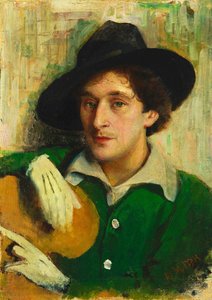
Marc Chagall
1887 - 1985, Belarus
Kort om kunstneren
- Artistic Movement Or Style: Modernism, Kubism
- Artists Or Movements Influenced By This Artist:
- Surrealism
- Modern konst
- Artists Who Influenced This Artist:
- Bakst
- Delaunay
- Borovikovsky
- Date Of Birth: 7 juli 1887
- Date Of Death: 28 mars 1985
- Full Name: Marc Chagall
- Nationality: Russisk, senare fransk
- Notable Artworks:
- I och byen
- Vitbesk
- Vitkrifixion
- Place Of Birth: Liozna, Belarus
Om kunstneren
A Life Painted in Dreams: The World of Marc Chagall
Marc Chagall, born Moishe Shagal in 1887 in the small Belarussian town of Liozna near Vitebsk, wasn’t merely a painter; he was a poet of color, a weaver of dreams, and a chronicler of memory. His life, spanning nearly a century, mirrored the tumultuous currents of the 20th century, yet his art remained steadfastly rooted in a deeply personal vision—one infused with the folklore of his Hasidic Jewish upbringing and an unwavering belief in the power of imagination. Vitebsk itself was more than just a birthplace; it became the emotional core of his artistic universe, a recurring motif populated by flying figures, whimsical animals, and the vibrant hues of remembered landscapes. The town’s unique blend of cultures—Russian Orthodox churches alongside bustling Jewish marketplaces—forged an aesthetic sensibility that would defy easy categorization throughout his long career. Though he sought formal training first with a local sign painter and later in St. Petersburg under Léon Bakst, and then in Paris at the Académie de la Grande Chaumière, Chagall never fully embraced any single artistic movement. He absorbed elements of Cubism, Symbolism, and Fauvism, but always filtered them through his own intensely personal lens, creating a style that was uniquely, unmistakably Chagall.Early Influences and Artistic Beginnings
Chagall’s formative years were marked by the traditions of Vitebsk’s Jewish community—a world steeped in ritual, storytelling, and vibrant visual culture. These influences would permeate his artistic vision throughout his life. His initial training was modest, focusing on practical skills as a sign painter, but he quickly developed an aptitude for drawing and painting, driven by an innate desire to capture the beauty of the natural world and the complexities of human emotion. St. Petersburg provided him with access to influential teachers like Léon Bakst, who encouraged him to experiment with theatrical design and introduced him to the principles of Cubism—a movement that would profoundly impact his artistic style. However, Chagall resisted rigid stylistic conventions, prioritizing instead a deeply expressive approach rooted in observation and imagination. His early canvases already hinted at the distinctive language he would develop – paintings like *I and the Village* (1911) are not simply depictions of place; they are explorations of identity, memory, and the relationship between the individual and community. The village isn’t rendered realistically but as a fragmented collection of recollections, imbued with symbolic meaning. This ability to transmute personal experience into universal themes became a hallmark of his art.The Symbolism of Flight and Memory
Chagall's artistic style quickly distinguished itself through its characteristic use of color and imagery—particularly the motif of flight. Figures soar across canvases in fantastical landscapes, defying gravity and logic, creating a dreamlike atmosphere that invites viewers into his inner world. This stylistic choice wasn’t accidental; it stemmed from a desire to move beyond mere imitation of reality and capture the essence of feeling, the weight of memory, and the power of folklore. Recurring symbols—such as apples, birds, and biblical figures—appear throughout his oeuvre, conveying profound emotional resonance and hinting at deeper spiritual concerns. His palette was bold and expressive, often employing vibrant, non-naturalistic colors to convey emotion rather than literal representation. This approach solidified his reputation as a visionary artist who dared to explore the subconscious mind and express ideas beyond conventional boundaries.From Vitebsk to Paris: Artistic Transformation
The Russian Revolution dramatically altered Chagall’s life trajectory, bringing him back to Vitebsk where he became involved in cultural initiatives, establishing an art school that briefly flourished before succumbing to the restrictions imposed by the new regime. This period was marked by both creative energy and political disillusionment, a tension that would continue to shape his artistic trajectory. He embraced Surrealism, influenced by André Breton and fellow artists, experimenting with dreamlike imagery and irrational juxtapositions—a stylistic shift that reflected the anxieties and uncertainties of the time. The outbreak of World War II forced him to flee occupied France for the United States, where he spent seven years in New York City. This period was marked by profound emotional upheaval and artistic experimentation. He found solace in his art, creating powerful works that reflected the traumas of war and displacement—particularly *White Crucifixion* (1938), a haunting depiction of suffering and persecution.Legacy and Recognition
After the war, Chagall returned to France, where he continued to paint and create until his death in 1985 at the age of 97. He received numerous prestigious commissions, including the ceiling of the Paris Opera (1964), a breathtaking explosion of color and form that celebrated musical masterpieces, and stunning stained glass windows for the Hadassah Hebrew University Medical Center synagogue in Jerusalem. These large-scale projects allowed him to translate his artistic vision into architectural spaces, creating immersive environments that continue to inspire awe and wonder. Chagall’s influence on subsequent generations of artists is undeniable. His lyrical quality, emotional depth, and imaginative power resonated with Surrealists and other movements that embraced fantasy and symbolism. He bridged the gap between European modernism and Jewish cultural identity, becoming known as “the quintessential Jewish artist of the twentieth century.” His ability to synthesize personal experience, folklore, and universal themes continues to resonate with audiences worldwide. Marc Chagall’s legacy extends beyond his paintings and stained glass; it resides in the enduring power of his vision—a vision that celebrates love, memory, and the boundless possibilities of the human imagination.§ 5Comparanda
Lignende kunstverk


§ 6Questions
§ 7Further reading
Relaterte artikler

Bryllupsminner som Ikke Er Kjedelige: Løft Innredningen med Skreddersydd Kunst
Forvandle bryllupsminner til unike kunstverk! Få skreddersydd maleri fra foto, med ekspertveiledning og høy kvalitet. Skap et personlig hjem du vil elske – bestill nå!

Giclée Prints: Archival Quality & Aesthetic Nuances for the Discerning Collector
Explore the world of giclée prints with AllPaintingsStore. Learn about archival quality, aesthetic nuances & investment potential. Expert guidance for discerning art collectors seeking museum-quality reproductions and lasting value.

Svart Kunst: Topp 10 Maler som Definerer Skyggenes Skjønnhet | AllPaintingsStore.no
Utforsk 10 ikoniske malerier dominert av svart – fra Rembrandts skygger til Munchs ekspresjonisme. Oppdag historiene bak mesterverkene og finn kunsttrykk for ditt hjem på AllPaintingsStore.no. Utforsk hele samlingen online!

De 10 mest ikoniske malerier dominert av hvitt – Kunsthistorie og interiørinspirasjon
Utforsk de 10 mest ikoniske maleriene dominert av hvitt – fra Monet til Van Gogh. Lær historien bak disse mesterverkene og finn inspirasjon for ditt hjem. Museumskvalitet kunsttrykk på AllPaintingsStore.com! Oppdag hele samlingen online.

Kjærlighet på lerret: 7 romantiske stiler å velge for ditt bryllupsportrett
Finn den perfekte stilen for ditt bryllupsportrett! Ekspertguide til romantiske kunststiler og personlig tilpasning. Skap et tidløst minne med .
Cite this entry
AllPaintingsStore.com, “Marc Chagall, Wedding (1918)”, https://allpaintingsstore.com/no/art/marc-chagall-wedding-8XYGNM-en/ArtistReproduction/ (accessed 1 October 2026).
§ 8The reproduction
Håndlaget oljereproduksjon
Håndmalt olje på lerret i din valgte størrelse og ramme, laget på bestilling av våre kunstnere. ( Bytt til trykk Bytt til digitalt bilde)
It is specified on the order sheet in the margin; the present state of that sheet reads as follows.

Wedding
Trykkmetode
Størrelse på reproduksjon
-

Utvalgte mesterkunstnere
Mer detaljrikdom, finesse og ekstra produksjonstid
-

Innramming av reproduksjon
-
-
For kunstverk eller reproduksjoner som er større enn 105 cm (ca. 41 tommer) på noen side, vil rammen bli sendt som et sett som må monteres. Denne metoden sikrer trygg levering og forhindrer skader under transport.
Krever profesjonell montering – dette er ikke et DIY-produkt.
Settet må monteres og lerretet strammes av en erfaren profesjonell rammelegger, ved bruk av trelim (følger ikke med), en lerretstang og klemmer for å holde rammelisten vinkelrett mens limet tørker. Feilaktig montering eller ujevn stramming av lerretet kan påføre kunstverket permanente skader og er
 For kunstverk eller reproduksjoner som er større enn 105 cm (ca. 41 tommer) på noen side, vil rammen bli sendt som et sett som må monteres. Denne metoden sikrer trygg levering og forhindrer skader under transport.
Alle massive trelister er inkludert, presist tilpasset i størrelse.
Monteres med de medfølgende skruene, samt trelim til hjørnene, som ikke er inkludert og må anskaffes av din rammehandler.
Profesjonelt verktøy er nødvendig og er ikke inkludert: en lerretstang (strammer) og klemmer for å holde rammene vinkelrette mens limet tørker.
Viktig:
Hjørnene krever trelim, listene må holdes på plass med tvinger til limet er helt tørt, og stramming av lerretet på den ferdige rammen krever en lerretstang. Ingen av disse produktene er inkludert i settet. Vennligst sørg for tilgang til en erfaren profesjonell rammehandler før du bestiller denne størrelsen.

Navneskilt
-
-

Beskyttende ferniss
Blank lakk (forsterker farger, beskytter mot lys og fuktighet)
-

Tilpass mitt kunstverk
Eksempler på hva som kan endres: Erstatt ansikt med bilde av kunden; Legg til kjæledyr (f.eks. bytt ut katt med hund); Inkluder en skjult melding i bakgrunnen; Endre bakgrunnslandskap eller elementer.
-

Ekspresslevering
Verdensomspennende levering () på 3–4 uker i stedet for standard 5 uker. (29 October). Ingen kompromisser med kvaliteten.
-
Ekspresslevering
Verdensomspennende levering til innen 5 uker. (5 November).
Inkludert frakt
Totalpris for valgte alternativer
Nkr 2480
Included with every order
- Gratis ekspressfrakt over hele verden
- Lerretsduk av lin av høy kvalitet
- Full transportforsikring
- Garanti for refusjon av toll og importavgifter
- Garantert fargegjengivelse
- 100 dagers returrett ved fabrikasjonsfeil
- 100% pengene tilbake-garanti
- Rabatt ved flere kjøp


