Pengene tilbake-garanti · 100 dager Gratis levering over hele verden
449587kunstverk 30613kunstnere 4660museer 32språk
Valuta
    Språk
      Atelier · Etablert 2015 · Paris, Frankrike
      AllPaintingsStore
      allpaintingsstore.com
      Catalogue entry

      Apolinère Enameled

      Assemblage.

      Fig. 1. Marcel Duchamp, Apolinère Enameled. Shown as the reproduction you are specifying: , .

      § 1Catalogue data

      § 2Abstract

      Beskrivelse av objektet

      Marcel Duchamp’s ‘Apolinère Enameled’ is a Dadaist assemblage featuring a girl on a bed adorned with vibrant enamel paint, challenging artistic conventions and sparking dialogue through its provocative use of industrial advertising.

      Om kunstneren

      Marcel Duchamp var en fransk kunstner som revolusjonerte kunstens verden ved å stille spørsmål om hva kunst er og hvordan vi oppfatter den. Utforsk hans ikoniske verk og filosofiske innvirkning!

      § 3Commentary

      A Provocative Dialogue with Tradition

      In the annals of modern art, few works possess the disruptive power of Marcel Duchamp’s "Apolinère Enameled." Created between 1916 and 1917, this masterpiece serves as a cornerstone of the Dadaist movement, acting less as a mere painting and more as a profound interrogation of what it means to create. At first glance, the viewer is met with a deceptively serene tableau: a young girl seated upon a bed, surrounded by the vibrant, almost playful hues of an industrial advertisement. Yet, beneath this tranquil surface lies a calculated rebellion against the very foundations of aesthetic beauty. Duchamp does not merely depict a scene; he deconstructs the act of seeing itself, inviting collectors and enthusiasts to look past the pigment and into the conceptual heart of the twentieth century's most radical era.

      The artwork’s soul resides in its origin as an "assisted readymade." Duchamp took a mundane, commercial tin sign promoting Sapolin enamel—a product intended for industrial beautification—and intervened with pencil sketches and cardboard to subtly fracture the original's intent. This technique represents a seismic shift in art history, where the artist’s hand moves from the role of a craftsman to that of a philosopher. For the discerning interior designer or art lover, this piece offers a sophisticated tension; it brings the raw, intellectual energy of the Dadaist revolt into a space, challenging the viewer to find meaning within the intersection of mass production and individual expression.

      The Architecture of Illusion and Language

      Beyond its physical assemblage, "Apolinère Enameled" is a linguistic puzzle, a play on words that mirrors the fractured reality of a world at war. The title itself is a brilliant pun, referencing Duchamp’s close friend, the poet Guillaume Apollinaire. By manipulating language through this phonetic nod, Duchamp mirrors his manipulation of the physical object, suggesting that neither word nor image can be taken at face value. This layer of intellectual depth makes the piece an extraordinary conversational centerpiece, perfect for those who appreciate art that rewards deep contemplation and rewards the inquisitive mind.

      Visually, the work is a masterclass in subtle expression and geometric intrigue. The color palette, though derived from commercial enamel, possesses a luminous quality that draws the eye toward the central figure. There is a haunting, almost surrealist quality to the composition, particularly in the way the bed frame presents conflicting perspective lines. This creates what many scholars call an "impossible object," a precursor to the optical illusions that would later define Surrealism. The interplay of the bright, primary-adjacent colors against the more muted, sketched elements creates a rhythmic visual experience that is both stimulating and intellectually grounding.

      A Timeless Addition to the Modern Collection

      For those seeking to curate a collection defined by innovation, "Apolinère Enameled" offers an unparalleled opportunity. As a high-quality reproduction, it brings the historical weight of the Philadelphia Museum of Art into the private home or gallery. It is a piece that transcends simple decoration; it is an invitation to participate in a century-old debate about the nature of creativity. Whether placed in a minimalist contemporary setting where its bold lines can stand alone, or within a more eclectic, curated space where its historical narrative can breathe, this artwork provides a sense of intellectual prestige and avant-garde elegance.

      Owning a piece that embodies the spirit of Duchamp is to possess a fragment of the revolution that redefined modernity. It serves as a reminder that art need not be purely "retinal"—merely pleasing to the eye—but can instead be a profound, transformative experience that challenges our perceptions of reality, commerce, and the very essence of the human imagination.

      Spørsmål og svar

      Kan "Apolinère Enameled" forhåndsvises i utvidet virkelighet (AR)?

      "Apolinère Enameled" har en forhåndsvisning med utvidet virkelighet: Se i AR-siden til kunstverket viser det i ditt eget rom på en kompatibel enhet.

      Er "Apolinère Enameled" av Marcel Duchamp et portrett, landskap eller en kvadratisk komposisjon?

      "Apolinère Enameled" av Marcel Duchamp har et Landscape-format. Formatet beskriver komposisjonens proporsjoner.

      Hvilken farge dominerer i "Apolinère Enameled"?

      Den dominerende fargen i "Apolinère Enameled" av Marcel Duchamp er Quinacridone Magenta (#795944).
      § 4The artist

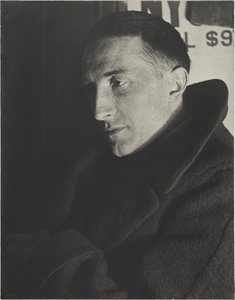
      Marcel Duchamp

      Marcel Duchamp

      1887 - 1968, Frankrike

      Quick facts about Marcel Duchamp

      • Artistic Movement Or Style:
        • Kubisme
        • Dadaisme
        • Konseptuell kunst
      • Artists Or Movements Influenced By This Artist:
        • Kubisme
        • Popkunst
        • Minimalisme
      • Date Of Birth: 28 juli 1887
      • Date Of Death: 2 oktober 1968
      • Full Name: Marcel Duchamp Henri-Robert-Marcel
      • Nationality: Fransk-Amerikansk
      • Notable Artworks:
        • Fontane
        • L.H.O.O.Q.
        • Det Store Glas
        • Boîte-en-valise
      • Place Of Birth: Blainville, Frankrike

      Om kunstneren

      A Revolutionary Spirit: The Life and Art of Marcel Duchamp

      Marcel Duchamp, born Henri-Robert-Marcel Duchamp in 1887 in Blainville-Crevon, Normandy, was more than an artist; he was a philosophical provocateur who fundamentally altered the course of modern art. His early life, though seemingly conventional – nurtured within a family that appreciated artistic expression with both brothers pursuing successful careers as artists – hinted at the iconoclasm to come. Duchamp initially pursued formal training, mastering traditional techniques and experimenting with post-impressionist styles. However, this academic foundation served not as an end in itself, but as a springboard for questioning the very nature of art, its purpose, and its definition. He wasn’t content merely to depict the world; he sought to challenge how we perceive it, and what constitutes artistic value. This restless intellectual curiosity would become the defining characteristic of his prolific career.

      Early Artistic Explorations: Cubism and Impressionism

      Duchamp's initial foray into art began with a grounding in traditional techniques—primarily painting—influenced by Impressionist masters like Claude Monet and Pierre-Auguste Renoir. He honed his skills diligently, capturing fleeting moments of light and color with remarkable precision. Yet, even within these aesthetically pleasing compositions, Duchamp harbored doubts about the role of representation itself. Recognizing that art could transcend mere visual imitation, he turned his attention to Cubism, spearheaded by Pablo Picasso and Georges Braque. This movement embraced fragmented forms and multiple perspectives—a radical departure from the single viewpoint demanded by Renaissance painting—and Duchamp skillfully incorporated these principles into works like *Portrait of Chess Players* (1911). The fractured planes and overlapping viewpoints mirrored his own intellectual preoccupation with dismantling established conventions.

      The Dadaist Rebellion: Challenging Artistic Norms

      The horrors of World War I profoundly impacted Duchamp’s worldview, fueling a deep disillusionment with the values of reason and logic that underpinned Western civilization. This discontent propelled him into the embrace of Dadaism—a movement born out of utter rejection of artistic dogma and societal complacency. Dadaists like Tristan Tzara and Hugo Ball sought to dismantle traditional notions of art through absurdity, chance, and anti-rational gestures. Duchamp wholeheartedly embraced this rebellious spirit, producing provocative pieces that defied categorization and challenged viewers’ expectations. His Dadaist output included collages incorporating found objects—such as newspaper clippings and photographs—and performances designed to disrupt artistic rituals. The infamous *Fontaine* (1917)—a porcelain urinal signed “R. Mutt”—became the emblem of Dada’s radical critique of art, sparking controversy and cementing Duchamp's reputation as a revolutionary iconoclast.

      The Birth of Conceptual Art: Beyond Representation

      Duchamp’s most enduring contribution to art history was arguably his pioneering role in establishing Conceptual Art—a movement that prioritized idea over execution. Rejecting the visual arts altogether, Conceptual Artists questioned whether an artwork could exist without tangible form. Duchamp famously declared, “The idea precedes the object,” encapsulating this fundamental shift in artistic thinking. He continued to explore this concept through various mediums, including assemblage and photography. *L.H.O.O.Q.* (1919)—a postcard reproduction of Leonardo da Vinci’s Mona Lisa overlaid with a mustache and goatee—served as a deliberate parody of art history and a commentary on the veneration of artistic genius. Duchamp's intention wasn’t to create a beautiful image; it was to provoke reflection on notions of authorship, originality, and the very definition of art itself.

      Legacy and Enduring Influence

      Marcel Duchamp’s influence extends far beyond his own lifetime, shaping the trajectory of countless artists who followed him. His unwavering commitment to conceptual thought—the primacy of idea over form—established a paradigm that continues to resonate within contemporary artistic practice. Artists across disciplines—from sculpture to performance art to video installation—have drawn inspiration from Duchamp’s challenge to conventional aesthetic standards and his insistence on questioning accepted truths. He remains a central figure in discussions about the role of art in society, prompting us to consider whether beauty is truly paramount or if intellectual engagement—the pursuit of ideas—is equally valuable. His legacy endures as a testament to the transformative power of artistic innovation and the enduring relevance of Duchamp’s revolutionary vision.

      § 5Comparanda

      § 6Questions

      Kort om verket

      • Year: 1916-1917
      • Dimensions: 9 5/8 x 13 3/8 inches (24.4 x 34 cm)
      • Artistic style: Conceptual art
      • Medium: Gouache and graphite on painted tin
      • Title: Apolinère Enameled
      • Subject or theme: Advertising; Critique of painting

      Kunnequiz om kunst

      Det er kun ett riktig svar på hvert spørsmål.

      Spørsmål 1:
      What artistic movement is Marcel Duchamp primarily associated with?
      Spørsmål 2:
      The artwork incorporates a repurposed industrial advertisement. What does this element symbolize in relation to Duchamp’s artistic philosophy?
      Spørsmål 3:
      What is the primary technique employed by Duchamp in creating this piece?
      Spørsmål 4:
      The title 'Apolinère Enameled' references Guillaume Apollinaire, a prominent French writer and critic. What is the significance of this reference?
      Spørsmål 5:
      Where is Apolinère Enameled currently housed?

      § 7Cite this entry

      AllPaintingsStore.com, “Marcel Duchamp, Apolinère Enameled”, https://allpaintingsstore.com/no/art/marcel-duchamp-apolinere-enameled-8EWLEF-en/ArtistReproduction/ (accessed 3 October 2026).

      § 8The reproduction

      Håndlaget oljereproduksjon

      Håndmalt olje på lerret i din valgte størrelse og ramme, laget på bestilling av våre kunstnere. ( Bytt til trykk Bytt til digitalt bilde)

      It is specified on the order sheet in the margin; the present state of that sheet reads as follows.

      Apolinère Enameled

      Trykkmetode

      Størrelse på reproduksjon

      -

      Utvalgte mesterkunstnere

      Mer detaljrikdom, finesse og ekstra produksjonstid

      -

      Innramming av reproduksjon

      -

      -

      For kunstverk eller reproduksjoner som er større enn 105 cm (ca. 41 tommer) på noen side, vil rammen bli sendt som et sett som må monteres. Denne metoden sikrer trygg levering og forhindrer skader under transport.

      Krever profesjonell montering – dette er ikke et DIY-produkt.
      Settet må monteres og lerretet strammes av en erfaren profesjonell rammelegger, ved bruk av trelim (følger ikke med), en lerretstang og klemmer for å holde rammelisten vinkelrett mens limet tørker. Feilaktig montering eller ujevn stramming av lerretet kan påføre kunstverket permanente skader og er ikke dekket av vår garanti.

      • Alle massive trelister er inkludert, presist tilpasset i størrelse.

      • Monteres med de medfølgende skruene, samt trelim til hjørnene, som ikke er inkludert og må anskaffes av din rammehandler.

      • Profesjonelt verktøy er nødvendig og er ikke inkludert: en lerretstang (strammer) og klemmer for å holde rammene vinkelrette mens limet tørker.

      Viktig:
      Hjørnene krever trelim, listene må holdes på plass med tvinger til limet er helt tørt, og stramming av lerretet på den ferdige rammen krever en lerretstang. Ingen av disse produktene er inkludert i settet. Vennligst sørg for tilgang til en erfaren profesjonell rammehandler før du bestiller denne størrelsen.

      Navneskilt

      -

      -

      Beskyttende ferniss

      Blank lakk (forsterker farger, beskytter mot lys og fuktighet)

      -

      Tilpass mitt kunstverk

      Eksempler på hva som kan endres: Erstatt ansikt med bilde av kunden; Legg til kjæledyr (f.eks. bytt ut katt med hund); Inkluder en skjult melding i bakgrunnen; Endre bakgrunnslandskap eller elementer.

      -

      Ekspresslevering

      Verdensomspennende levering () på 3–4 uker i stedet for standard 5 uker. (31 October). Ingen kompromisser med kvaliteten.

      -

      Ekspresslevering

      Verdensomspennende levering til innen 5 uker. (7 November).

      Inkludert frakt

      Totalpris for valgte alternativer

      Nkr 2485

      Included with every order

      • Gratis ekspressfrakt over hele verden
      • Lerretsduk av lin av høy kvalitet
      • Full transportforsikring
      • Garanti for refusjon av toll og importavgifter
      • Garantert fargegjengivelse
      • 100 dagers returrett ved fabrikasjonsfeil
      • 100% pengene tilbake-garanti
      • Rabatt ved flere kjøp
      Order sheet