


 Forhåndsvisning
 Send
Send Del
Del
 Vis detaljer
 Utskriftsvennlig guide

 Last ned bilde
 Liknende objekter
 Røntgenundersøkelse
 Lysbildefremvisning
 Q&A
Q&A Statistikk
Cliff
 Impressionism
 1872
1872 17.0 x 25.0 cm
 Vis hele teksten
Giclée / Kunsttrykk
Giclée- eller lerretsprint av museumskvalitet med rask produksjon og fleksible valgmuligheter for etterbehandling. ( Kjøp håndmalt maleri Bytt til digitalt bilde)




































Velg mellom våre forhåndsdefinerte størrelser som bevarer kunstverkets opprinnelige proporsjoner.

Skriv inn ønsket bredde og høyde for å tilpasse trykket til din ramme eller vegg. Et trykk kan kun beskjæres, aldri skaleres opp utover motivets opprinnelige størrelse, noe som betyr at et format med andre proporsjoner vil føre til tap av deler av bildet. Vi sender deg en digital mockup for godkjenning før vi starter trykkeprosessen. Bildet som vises på denne siden viser ikke den faktiske beskjæringen — det er kun mockuppen som viser dette.
Verdensomspennende levering () på 2 uker i stedet for standard 4/5 uker. (29 October)

Gratis ekspressfrakt over hele verden

Lerretsduk av lin av høy kvalitet

Full transportforsikring

Garanti for refusjon av toll og importavgifter

Garantert fargegjengivelse

100 dagers returrett ved fabrikasjonsfeil

100% pengene tilbake-garanti

Rabatt ved flere kjøp
 Glassalternativet er kun tilgjengelig i størrelser under 110 cm

Cliff
Giclée / Kunsttrykk
Størrelse på reproduksjon
-


Totalpris for valgte alternativer
Nkr 615
Lignende kunstverk


Om kunstneren
The Light of the Macchiaioli
Born into modest circumstances in Verona, Italy, Vincenzo Cabianca emerged as a profound voice within the Macchiaioli movement, a group of Italian painters who sought to capture the raw essence of reality through light and shadow. His artistic journey began with formal training at the Verona Academy under Giovanni Caliari, followed by pivotal studies at the Venice Academy between 1845 and 1847. This classical foundation provided the technical rigor that he would eventually dismantle in favor of a more visceral, patch-based approach to painting.
Cabianca’s life was as much defined by political passion as it was by aesthetic evolution. An admirer of Giuseppe Mazzini, he became deeply entwined with the Young Italy movement. This commitment to his country led him into the crucible of conflict, where he was taken prisoner during the defense of Bologna in 1848. Such turbulent experiences likely informed the emotional depth and social realism that would later characterize his brushwork, grounding his art in the lived realities of the Italian people.
A Mastery of Contrast and Color
As Cabianca moved through Venice and eventually settled into the vibrant artistic circles of Florence, his style underwent a transformative shift. Through his friendships with luminaries such as Telemaco Signorini and Cristiano Banti, he was drawn away from traditional genre paintings toward a bolder, more experimental realism. Traveling to Paris alongside these contemporaries, he embraced the influence of new perspectives that encouraged him to focus on the interplay of light and atmosphere.
His technique became celebrated for its emphasis on powerful value contrasts, often referred to as the macchia or "patch" technique. While many of his peers focused almost exclusively on landscapes, Cabianca maintained a unique connection to historical and literary subjects, blending the ephemeral effects of sunlight with enduring narratives. He was frequently described by his contemporaries as a painter obsessed with the effects of the sun, capable of capturing the way light strikes a surface to create dramatic, uninhibited compositions.
Legacy and Artistic Significance
The works of Vincenzo Cabianca serve as a window into the soul of nineteenth-century Italy. His repertoire is diverse, ranging from evocative coastal scenes like Cliff to intimate depictions of religious life, such as his well-known paintings of nuns. Whether portraying the rugged beauty of a landscape or the quiet dignity of everyday figures, his work remains anchored by a sense of profound realism and an acute sensitivity to the natural world.
Today, his historical significance is cemented by the presence of his masterpieces in prestigious institutions such as the Musee d'Orsay. He remains a vital figure for understanding the development of Italian modernism, representing a bridge between classical tradition and the revolutionary spirit of light-driven realism. His ability to manipulate shadow and sun continues to resonate, marking him as one of the most striking and declared members of the Macchiaioli circle.

Vincenzo Cabianca
1827 - 1902 , Italy
Kort om kunstneren
- Artistic Movement Or Style: Macchiaioli
- Artists Who Influenced This Artist: ['Giovanni Caliari']
- Full Name: Vincenzo Cabianca
- Nationality: Italian
- Notable Artworks:
- Women in Montemurlo
- Cliff
- Rocks in Sestri Levante
- Le monachine
- La Mandriana
- il Porcile al sole
- Place Of Birth: Verona, Italy
- Date Of Birth: 1827
- Date Of Death: 1902
Relaterte artikler
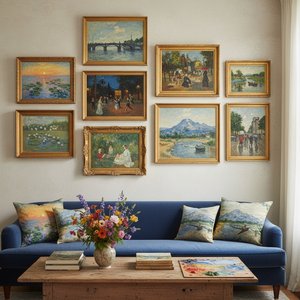
Impressionismens landskapskunst: Topp 10 mesterverk som definerte en epoke | AllPaintingsStore.no
Opplev impressionismens magi! Utforsk 10 ikoniske landskapsmalerier av Monet, Renoir og Van Gogh. Lær om kunsthistorien bak mesterverkene & finn din perfekte veggkunst på AllPaintingsStore.com – museumskvalitet for ditt hjem.

Beyond the Horizon: A Curated Guide to Integrating Post-Impressionist Landscapes into Modern Interiors
Transform your home with the emotive power of Post-Impressionist landscapes. Discover expert tips on selecting hand-painted oil reproductions to create a soulful, vibrant interior that reflects your unique style and connection to nature.

Golden Fields & Sun-Drenched Meadows: Capturing the Soul of Impressionist Landscapes
Immerse yourself in the luminous world of Impressionist landscapes. Discover how masters like Monet and Gauguin captured ephemeral light through plein air painting, and learn to bring the soul of sun-drenched meadows into your home with exquisite, hand-painted oil reproductions.

Capturing the Soul: The Most Emotionally Moving Impressionist and Post-Impressionist Masterpieces
Discover the profound emotional depth of Impressionist and Post-Impressionist masterpieces. Explore how legends like Monet, Van Gogh, and Gauguin captured light and soul through evocative landscapes and vibrant brushwork for a timeless connection to art history.

Impresjonistiske landskap: 10 mesterverk som definerte en kunstbevegelse | AllPaintingsStore.no
Opplev impresjonismens magi! Utforsk 10 ikoniske landskapsmalerier av Monet, Renoir og Degas. Lær historien bak mesterverkene & finn din perfekte kunsttrykk på AllPaintingsStore.com.

