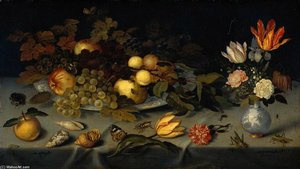
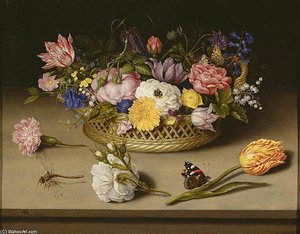
The Legacy of Floral Elegance: The Life of Ambrosius Bosschaert II
In the golden light of the Dutch seventeenth century, a period defined by unparalleled prosperity and artistic refinement, the name Ambrosius Bosschaert II emerged as a master of the ephemeral. Born in 1609 in Arnemuiden, near Middelbard, he was destined to inhabit a world where the delicate beauty of nature was captured with scientific precision and poetic grace. As a member of the illustrious Bosschaert dynasty, his very existence was intertwined with the tradition of floral still life. He did not merely paint flowers; he curated moments of botanical perfection, ensuring that the fleeting bloom of a tulip or the soft curve of a rose would endure long after the physical petals had withered.
The foundations of his artistry were laid within the intimate confines of his family studio. Under the watchful and expert eyes of his father, Ambrosius Bosschaert I, and his uncle, Balthasar van der Ast, the young artist developed an unparalleled command over detail and texture. This immersive upbringing allowed him to inherit a specialized vocabulary of form and color, yet he was far from a mere imitator. While his early training focused on the meticulous botanical accuracy characteristic of his lineage, his later development revealed a sophisticated understanding of atmosphere. He moved beyond simple documentation, infusing his compositions with a sense of depth and drama that spoke to the evolving tastes of the Dutch Golden Age.
Mastery of Light and Botanical Detail
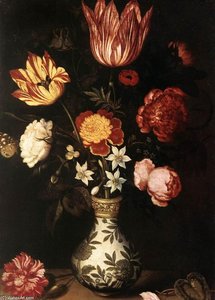
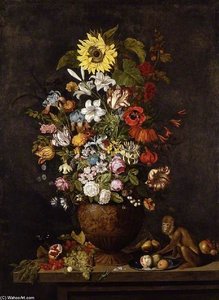
To gaze upon a work by Bosschaert II is to enter a realm where light and shadow perform a silent, captivating dance. His technique was deeply rooted in the Mannerist traditions passed down through his mentors, yet he infused these structures with a unique luminosity. He often utilized compact compositions set against dark, enigmatic backgrounds, a choice that allowed his subjects to emerge with startling clarity. Through the masterful application of chiaroscuro, he sculpted the petals of lilies and the velvety surfaces of tulips, creating a tactile experience for the viewer.
His palette was a study in harmonious contrasts. He frequently employed muted tones—soft grays, earthy browns, and deep blues—to provide a somber stage for the brilliant whites, vibrant yellows, and delicate pinks of his floral subjects. This careful balance prevented the richness of the colors from overwhelming the composition, instead guiding the eye through a carefully orchestrated visual journey. Every brushstroke served a purpose, whether it was to capture the translucent quality of a dewdrop or the subtle decay at the edge of a leaf, reminding the observer of the vanitas theme—the transient nature of life and beauty.
A Lasting Impression on Dutch Still Life
Though his life was tragically short, ending in Utrecht in 1645, the impact of Ambrosius Bosschaert II remains etched in the history of European art. His ability to blend the scientific rigor of botanical illustration with the emotional resonance of fine art helped define the zenith of the Dutch still life genre. He navigated a complex period of artistic transition, bridging the gap between the rigid, structured arrangements of his father's generation and the more fluid, atmospheric styles that would follow.
The historical significance of his work lies in its dual nature: it is both a record of the botanical wonders of his era and a profound meditation on beauty and mortality. His masterpieces, such as Flowers in a Glass Vase, continue to captivate collectors and historians alike, serving as windows into a lost world of elegance. Through his meticulous hand, the ephemeral blossoms of the seventeenth century were granted a permanent, breathtaking immortality.
Spørsmål og svar
Hvilke andre navn eller pseudonymer bruker Ambrosius The Younger Bosschaert?
Ambrosius The Younger Bosschaert er også kjent under navnene Ambrosius Bosschaert The Younger.
Finnes det en kronologisk oversikt over Ambrosius The Younger Bosschaert?
En kronologisk oversikt over Ambrosius The Younger Bosschaert sitt arbeid er tilgjengelig på kunstnerens Karriereløp-side, hvor verkene presenteres i rekkefølge etter når de ble skapt, kapittel for kapittel.
Hva er fødestedet og fødselsåret til Ambrosius The Younger Bosschaert?
Ambrosius The Younger Bosschaert ble født i Arnemuiden i 1609.