A Life Forged in the Crucible of Revolution
The life of Auguste de Forbin (1777–1841) was a dramatic tapestry woven from the threads of nobility, tragedy, and profound political transformation. Born into the aristocratic splendor of Château La Roque-d’Anthéron in Provence, Forbin’s early years were marked by an extraordinary precocity; it is said he possessed the ability to draw before he had even mastered the art of writing. This innate talent was nurtured through a lifelong bond with his contemporary, François Marius Granet, a friendship that would serve as a cornerstone for their shared artistic evolution. However, the tranquility of his noble upbringing was shattered by the violent tremors of the French Revolution. During the Lyon insurrection of 1793, Forbin suffered the devastating loss of both his father, the Marquis de Pont-à-Mousson, and his uncle. This early encounter with mortality and political upheaval left an indelible mark on his psyche, instilling a sensitivity to the ephemeral nature of power and the inevitable decay of even the most grand structures.
Despite the shadows cast by personal loss, Forbin’s ascent within the Parisian art world was nothing short of meteoric. The Directory provided him with the ultimate gateway to prestige: entry into the legendary studio of Jacques-Louis David. Within this neoclassical sanctuary, Forbin absorbed the rigorous discipline and formal precision that defined the era's dominant aesthetic. Collaborating closely with Granet, he refined a technique that balanced the structured ideals of Neoclassicism with an emerging, soulful Romanticism. His journey was not merely one of academic study but a physical pilgrimage through the heart of classical civilization, most notably during his transformative travels to Rome in 1804. In the vibrant, intellectual atmosphere of Roman society, Forbin immersed himself in the grandeur of antiquity, a period that would forever inform the spiritual and historical weight of his later compositions.
The Romantic Vision: Landscapes of Memory and Decay
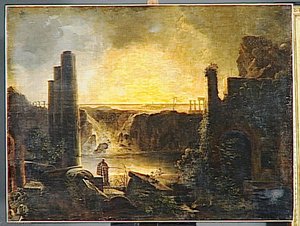
As his style matured, Forbin’s work began to transcend mere topographical representation, moving toward a deeply emotive exploration of the sublime. His canvases became windows into a world where history and nature converged in moments of poignant melancholy. In masterpieces such as “Vue de Cazzafani, dans l'île de Chypre,” Forbin utilized a masterful blend of realism and evocative abstraction to capture the relentless passage of time. These landscapes were rarely just scenery; they were visceral encounters with the ghosts of bygone eras, where crumbling ruins served as metaphors for the fragility of human ambition. His ability to render the texture of decay—the way light falls upon weathered stone or how shadows cling to ancient walls—allowed him to communicate a sense of loss that resonated deeply with the Romantic movement's fascination with the ephemeral.
This preoccupation with historical narrative and spiritual grandeur is perhaps most evident in his depictions of the Levant and the Holy Land. In works like “Vue de Jérusalem, prise de la vallée de Josaphat,” painted in 1825, Forbin constructed meticulously crafted tableaus that sought to capture the sacred weight of the ancient city. Through a sophisticated use of light and composition, he invited viewers to contemplate the intersection of the divine and the earthly. Whether painting the sun-drenched ruins of Ascalon or the quiet cloisters of Aix-en-Provence, Forbin’s brushwork remained deeply informed by his early training under David, yet it was infused with a new, restless energy that sought to find beauty in the wreckage of history.
Legacy of a Curator and Antiquary
Beyond the canvas, Auguste de Forbin occupied a position of immense cultural significance within the French state. His expertise as an antiquary and his profound understanding of classical aesthetics led him to succeed the great Vivant Denon as the curator of the Musée du Louvre and other vital French museums. In this capacity, he was not merely a keeper of objects but a guardian of national heritage, navigating the complex responsibilities of managing one of the world's most significant collections during a period of intense political transition. His career, which intertwined military service, diplomatic missions, and museum administration, reflects the multifaceted nature of an intellectual caught between the pragmatic demands of the Napoleonic era and the idealistic pursuits of the Romantic age.
The historical significance of Forbin lies in his ability to bridge disparate worlds:
- Stylistic Synthesis: He successfully merged the disciplined, linear precision of Davidian Neoclassicism with the emotive, atmospheric depth of Romanticism.
- Cultural Stewardship: As a curator, he played a pivotal role in shaping the public's engagement with classical and historical art within the Louvre.
- Thematic Depth: His oeuvre remains a profound meditation on the themes of memory, the passage of time, and the enduring power of ruins.
Spørsmål og svar
Hvilke andre navn er Auguste de Forbin kjent under?
Auguste de Forbin er også kjent som Louis Nicolas Philippe Auguste, Comte De Forbin.
Hvor kan jeg se Auguste de Forbin sine kunstverk i kronologisk rekkefølge?
Auguste de Forbin sine kunstverk kan ses i kronologisk rekkefølge på kunstnerens Kronologisk oversikt over kunstverk-side.
Hvordan finner jeg verk av Auguste de Forbin innenfor et spesifikt tema?
For å finne verk av Auguste de Forbin innen et spesifikt tema, kan du bruke kunstnerens Søk etter nøkkelord-side, som grupperer kunstverkene etter nøkkelord.