The Atmospheric Vision of Edwin Frederick Holt
Born in the historic enclave of Hampstead, London, in 1830, Edwin Frederick Holt emerged as a defining voice within the British Romantic tradition. His life and work serve as a window into the Victorian era, a period where the tension between industrial progress and the untamed beauty of nature found its most poignant expression through the brush. While often celebrated as a master watercolorist, Holt’s ability to manipulate medium and light allowed him to transcend simple documentation, instead offering viewers an emotional journey through the English countryside. His early years in London provided the foundation for a career that would eventually lead him to settle much of his adult life in Dunstable, where the shifting skies and rolling terrains of the British landscape became his most enduring muses.
The trajectory of Holt’s talent was formally recognized quite early in his professional journey. In 1854, while studying at the prestigious Royal Academy of Art, he was awarded a silver medal, an achievement that signaled his arrival as a formidable force in the London art scene. This academic rigor, however, did not stifle his creative spirit; rather, it provided him with the technical vocabulary to engage with the great masters of his time. He drew profound inspiration from the legacies of J.M.W. Turner and John Constable, adopting their fascination with atmospheric phenomena and the psychological weight of light. Through their influence, Holt learned to treat the sky not merely as a backdrop, but as a living, breathing protagonist capable of conveying grandeur, melancholy, or sudden, dramatic energy.
Mastery of Landscape and Light
Holt’s oeuvre is characterized by a remarkable versatility that allowed him to move seamlessly between the delicate nuances of watercolor and the robust textures of oil painting. His landscapes, particularly those focused on the rugged terrains of Yorkshire and Northumberland, are masterclasses in the use of light and shadow. In works such as "Swallow Falls," one can witness his ability to employ thick impasto and lost-edge techniques to replicate the raw power of cascading water and the mist that clings to stone. There is a palpable sense of movement in his brushwork, where meticulous detail often gives way to expressive strokes that prioritize the feeling of the wind or the dampness of the earth over mere photographic accuracy.
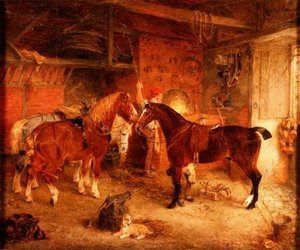
Beyond the wilder reaches of the north, Holt also found profound beauty in the quiet, rustic rhythms of rural life. His painting "The Blacksmith"* stands as a testament to his skill in capturing the drama of human labor within a landscape setting. Here, the interplay of light and shadow creates a sense of intimacy and reverence for the toil of the working class, a common theme in Romanticism that sought to find the sublime in the everyday. This ability to weave together the monumental scale of nature with the humble reality of human existence is what elevates his work from mere scenery to profound narrative art.
A Lasting Artistic Legacy
While Holt was equally adept at portraiture—demonstrated by the formal elegance of works like "A Squadron Sergeant Major"*—it is his contribution to the landscape genre that secures his place in art history. His ability to capture the ephemeral qualities of the British atmosphere helped sustain the Romantic movement well into the late Victorian period. The historical significance of his work lies in its preservation of a specific, emotive connection to the land, captured just as the world was undergoing rapid industrial transformation.
Today, the enduring impact of Edwin Frederick Holt can be felt through the collections that house his treasures. Notable highlights of his legacy include:
- The Champney Collection: Located at the Beverley Art Gallery, this collection offers a vital opportunity to witness his prowess in person.
- Technical Innovation: His use of texture and light to evoke psychological states remains a subject of study for those interested in 19th-century British art.
- Cultural Resonance: His depictions of the English countryside remain iconic representations of the Romantic ideal, celebrating the beauty of the natural world.
Through his disciplined training and his boundless imagination, Holt left behind a body of work that continues to resonate with anyone moved by the quiet majesty of a changing sky or the rugged, timeless strength of the earth.
Spørsmål og svar
Hvor kan jeg se Edwin Frederick Holt sine kunstverk sortert etter stemning?
Edwin Frederick Holt sine verk kan utforskes etter stemning på artistens Kunst etter stemning-side, hvor kunstverkene er organisert etter deres tilhørende stemninger.
I hvilken historisk periode arbeidet Edwin Frederick Holt?
Edwin Frederick Holt var virksom i perioden 19th Century. Denne perioden plasserer kunstnerens virke i en historisk kontekst.
Hva er fødestedet og fødselsåret til Edwin Frederick Holt?
Edwin Frederick Holt ble født i Hampstead i 1830.
Hvor mange kunstverk av Edwin Frederick Holt er tilgjengelige å bla gjennom?
Du kan bla gjennom 10 kunstverk verk av Edwin Frederick Holt på siden Alle kunstverk.