A Tranquil Vision of Roman Landscapes
Jacob de Heusch stands as a singular figure in the golden age of Dutch Baroque landscape painting, renowned primarily for his exquisitely rendered depictions of Italian harbors and sun-drenched towns. While history often reserves its brightest spotlights for contemporaries like Rembrandt or Vermeer, De Heusch’s work possesses a quiet elegance and a masterful observation of light that continues to captivate art historians and collectors alike. His artistic lineage was deeply rooted in the traditions of Utrecht; he was the nephew of the celebrated painter Willem de Heusch, and he adopted a similar monogrammatic signature, subtly substituting a ‘J’ for his uncle’s ‘G’. This familial connection provided him with a foundational strength, yet it was his own wanderlust that would ultimately define his creative soul.
The trajectory of De Heusch’s life changed forever in 1675 when he embarked upon a transformative journey to Rome. This period of Italian immersion served as the crucible for his mature style, allowing him to cultivate vital connections with influential patrons and fellow artists. Within the vibrant artistic community of Rome, he found himself part of the Bentvueghels, a group of much-loved Northern artists, where he earned the nickname 'Afdruk' or 'Copia'. It was during these years that his brushwork began to absorb the classical ideals of the Mediterranean, blending the meticulous detail of his Dutch training with the atmospheric grandeur of the Italian landscape.
The Influence of the Arcadian Ideal
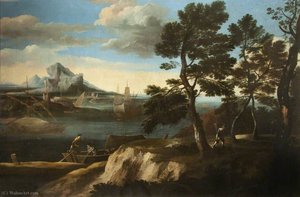
De Heusch’s artistic development was profoundly shaped by the masters who preceded and traveled alongside him. He became an ardent imitator of Jan Both, whose luminous, expansive landscapes provided a blueprint for De Heusch’s own approach to light and space. Much like Both, De Heusch sought to capture the "Arcadian" essence—a nostalgic, idealized vision of nature where rocky formations, lofty thin-leaved trees, and wide expanses of country meet the soft glow of an approaching evening. His work often echoes the dramatic, rugged sensibilities of Salvator Rosa, yet he frequently steered his compositions toward a more serene and harmonious atmosphere.
His technical prowess is most evident in his specialized focus on Italian harbor views. In these works, one can observe a delicate balance between the structural permanence of architecture—such as towers and ancient walls—and the fluid, transient nature of water and maritime life. Through his use of color and light, he was able to evoke the specific warmth of the Roman sun, creating scenes that feel less like mere documentation and more like poetic meditations on the beauty of the classical world. His ability to render the subtle shifts in atmosphere, from the clarity of midday to the hazy, golden hues of twilight, remains his most enduring technical achievement.
A Legacy Carved in Light and Shadow
Despite a life that was tragically curtailed by a sudden accident, De Heusch left behind a body of work that serves as a vital bridge between Dutch precision and Italian romanticism. After years spent abroad, he returned to Utrecht, living alongside his brother, the postmaster. Though he did not achieve the prolific output of some of his more famous peers, his dedication to his craft remained steadfast, with much of his output destined for discerning Italian clients who craved the charm of his Mediterranean vistas. His travels were not limited to Italy; his excursions to Venice and even Berlin allowed him to weave a diverse tapestry of European scenery into his repertoire.
The end of De Heusch’s life was as sudden as it was poignant. During a final journey to Amsterdam to visit fellow artists, a carriage mishap resulted in injuries that led to his untimely death at the age of forty-eight. Yet, the scarcity of his surviving canvases only adds to their mystique and value. Today, his masterpieces reside in some of the world's most prestigious institutions, including:
- The Louvre in Paris, showcasing his mastery of classical composition.
- The Belvedere in Vienna, housing his breathtaking depictions of harbors and mountains.
- The British Museum, preserving the historical context of his era.
- The Hermitage in St. Petersburg, where his light-filled landscapes continue to inspire awe.
Ultimately, Jacob de Heusch remains a master of the atmospheric landscape, an artist who successfully translated the spirit of Italy through a Dutch lens, leaving behind a legacy of tranquil, enduring beauty.
Spørsmål og svar
Hvor kan jeg se alle kunstverk av Jacob de Heusch?
Utforsk alle verk av Jacob de Heusch på denne nettsiden via kunstnerens Alle kunstverk-side.
Hvilke kunstverk av Jacob de Heusch har flest visninger?
Statistikk om Jacob de Heusch sine verk er tilgjengelig på kunstnerens Besøksstatistikk-side.
Hvilke stemninger uttrykker kunstverkene til Jacob de Heusch?
Kunstnerens Kunst etter stemning-side viser Jacob de Heusch sine kunstverk sortert etter stemning.