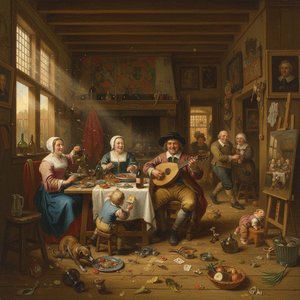
Jan Gossaert (c. 1478-1532): Bridging Renaissance Italy and Northern European Tradition
Jan Gossaert, also known as Jan Mabuse or Jennyn van Hennegouwe, stands as a pivotal figure in the early Netherlandish Renaissance, marking a crucial juncture between Italian artistic innovation and established northern European conventions. Born around 1478 in Maubeuge, France, he embarked on an extraordinary artistic journey that propelled him to prominence as one of the foremost painters of his era—a pioneer who courageously embraced Romanism, injecting its stylistic fervor into the Low Countries.Early Life and Artistic Training
Information regarding Gossaert’s formative years remains scarce, shrouded in historical obscurity. However, scholarly consensus suggests he honed his skills at Maubeuge Abbey, absorbing foundational artistic principles within a devout ecclesiastical environment. His formal training culminated in membership of the Antwerp Guild of Saint Luke in 1503—a pivotal step that connected him to a vibrant artistic community brimming with luminaries like Albrecht Dürer and Lucas van Leyden. Notably, Gossaert’s linguistic heritage leaned heavily towards French, reflecting the cultural landscape of his time and informing the documentation surrounding his career.A Synthesis of Styles: Romanism Takes Root
Gossaert's artistic brilliance lay in his unparalleled ability to synthesize disparate stylistic influences—primarily Italian Renaissance grandeur and Northern European realism. This distinctive approach quickly established him as a leader of the Romanism movement, characterized by an ardent admiration for classical ideals and techniques. Unlike many of his contemporaries who adhered strictly to one tradition, Gossaert deliberately blended elements from both worlds, resulting in artworks that possessed a captivating dynamism and intellectual depth. He recognized the transformative potential of Italian artistic principles—particularly fresco painting and illusionistic perspective—and skillfully integrated them into his compositions.Notable Works and Patronage
Gossaert’s oeuvre encompasses a remarkable array of masterpieces, reflecting his versatility as an artist and his responsiveness to diverse commissions. Among his most celebrated creations are “The Mocking of Christ,” a dramatic depiction imbued with meticulous detail and masterful use of color—a testament to his command of Italian artistic conventions. Equally impressive is “Virgin and Child,” a poignant portrait capturing the intimacy and tenderness inherent in maternal devotion, showcasing Gossaert’s exceptional skill in portraying human emotion. Furthermore, he produced striking portraits of prominent figures, including nobility and civic leaders, demonstrating his ability to convey character and status with remarkable precision. Perhaps most enduringly remembered is “The Descent from the Cross,” an ambitious altarpiece commissioned by Philip and Adolf of Burgundy—a monumental undertaking that captivated Albrecht Dürer himself before suffering irreparable damage from a devastating lightning strike. This artwork exemplifies Gossaert’s ambition to engage in grand narrative storytelling, blending religious symbolism with innovative compositional techniques. His influence extended beyond his own immediate circle, shaping the artistic sensibilities of subsequent generations of painters like Jan van Scorel and Jan Mertens the Younger—artists who embraced Gossaert's distinctive style as they pursued their own creative endeavors.Legacy and Historical Significance
Jan Gossaert’s contribution to art history transcends mere stylistic innovation; he fundamentally reshaped the artistic landscape of the Low Countries, ushering in a new era of artistic experimentation and intellectual engagement. His pioneering embrace of Romanism irrevocably altered prevailing aesthetic standards, fostering a dialogue between Italian and Northern European traditions that continues to resonate today. As a result, Gossaert’s legacy persists as a cornerstone of early Netherlandish art—a testament to his enduring influence on the trajectory of Western painting and an emblem of artistic courage in confronting established conventions.Spørsmål og svar
Hvor finner jeg Jan Gossaert (Jean Gossart) sine kunstverk gruppert etter teknikk?
Jan Gossaert (Jean Gossart) sine verk kan utforskes etter medium på Jan Gossaert (Jean Gossart) sin Alle medier-side.
Hvilken by og hvilket land er Jan Gossaert (Jean Gossart) født i?
Jan Gossaert (Jean Gossart) ble født i Maubeuge i France.
Hvor mange kunstverk av Jan Gossaert (Jean Gossart) er tilgjengelige å bla gjennom?
Du kan bla gjennom 1 kunstverk verk av Jan Gossaert (Jean Gossart) på siden Alle kunstverk.