A Life of Design and Color
Léon Cauvy began his formal training at the École Nationale des Beaux-Arts de Montpellier, but the pull of the larger art world led him to Paris in 1895. There, he studied under the painter Albert Maignan, absorbing techniques that would later inform both his decorative and fine art pursuits. Upon returning to Montpellier, his hands were busy with more than just a brush; he became deeply involved in the creation of Art Nouveau furniture and interior designs.
His early career was marked by a remarkable ability to blend utility with ornament. Between 1896 and 1906, his work for furniture and interiors earned him twelve prizes featured in Paul Arnavielhe's Art et Décoration magazine. He often worked alongside the cabinet-maker Paul Arnavielhe, where Cauvy was responsible for the intricate designs and leatherwork that gave their collaborative pieces a distinct character.
From Interiors to the Algerian Landscape
In 1898, Cauvy took on a significant commission for Emmanuel Laurens to decorate the interior of a house in Agde, Hérault, known as Château Laurens. This period saw him producing various decorative elements, including screens with leather decoration and display cases with leather panels. His talent for creating cohesive environments extended to wallpaper designs and decorative panels that appeared in the salons of the Société des Artistes Français starting in 1901.
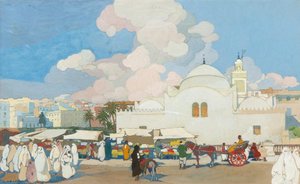
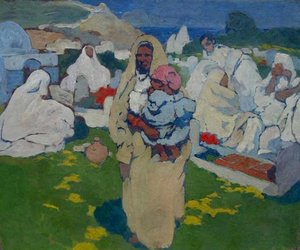
A major shift occurred in 1907 when Cauvy traveled to Algiers to stay at the Villa Abd-el-Tif, a colony for European artists. This move led him to settle in Algeria permanently. As his life in North Africa took root, his artistic focus shifted away from the decorative arts and toward Orientalist painting and printmaking. His deep connection to the region eventually led him to serve as the director of the École Nationale des Beaux-Arts d'Alger.
A Lasting Presence
Even as his focus moved toward painting, Cauvy continued to contribute to the decorative landscape of major international events. In 1925, he decorated the interior of the Pavillon de l'Algérie for the Exposition International des Arts Décoratifs et Industriels Modernes in Paris. This specific work was later moved to the governor's Summer Palace in Algiers, linking his early decorative roots with his later life in North Africa.
Though documentation of his life remains sparse, the physical remnants of his collaborations—such as the bedroom suite designed for the Laurens commission—provide a window into his skill. His work exists in two distinct worlds: the structured, ornamental elegance of French Art Nouveau and the observational depth of his later Algerian works.
Spørsmål og svar
Hvordan finner jeg verk av Léon Cauvy innenfor et spesifikt tema?
Utforsk Léon Cauvy sine verk via nøkkelord på kunstnerens Søk etter nøkkelord-side. Hvert nøkkelord grupperer de tilhørende kunstverkene.
Hvor finner jeg Léon Cauvy sine kunstverk gruppert etter kunstretning?
Se kunstretningene Léon Cauvy arbeidet innen på kunstnerens Alle kunstretninger-side, hvor verkene er gruppert etter stilretning.
Hvor mange kunstverk av Léon Cauvy er tilgjengelige å bla gjennom?
Du kan bla gjennom 17 kunstverk verk av Léon Cauvy på siden Alle kunstverk.
Hvilke stemninger uttrykker kunstverkene til Léon Cauvy?
Léon Cauvy sine verk kan utforskes etter stemning på artistens Kunst etter stemning-side, hvor kunstverkene er organisert etter deres tilhørende stemninger.