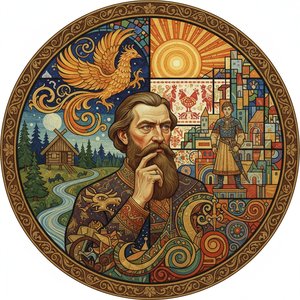
Nikolai Vasilievich Nevrev: A Visionary of Russian Romantic Realism
Nikolai Vasilievich Nevrev (1891 – 1967) stands as a pivotal figure in the landscape of late 19th and early 20th-century Russian art, embodying the spirit of Romantic realism—a movement that sought to reconcile emotional intensity with meticulous observation. Born into an aristocratic family steeped in artistic tradition, Nevrev’s formative years were marked by exposure to influential artists like Ilya Repin and Vasily Surikov, whose mastery of narrative painting profoundly shaped his own aesthetic sensibilities. This early influence instilled a dedication to portraying human experience with unflinching honesty and capturing the grandeur of Russian history and folklore.- Early Life & Artistic Training: Nevrev’s formal artistic education commenced at Saint Petersburg Imperial Academy of Arts, where he honed his skills under Konstantin Dmitrievich Korovin, a staunch advocate for realism and tonal painting. Korovin's teachings emphasized the importance of capturing atmospheric conditions and conveying psychological depth—principles that would become cornerstones of Nevrev’s distinctive style.
- Style & Technique: Nevrev’s artistic approach distinguished itself through its masterful use of tonal painting, prioritizing subtle gradations of color to evoke mood and atmosphere. He favored thick impasto brushstrokes, layering paint onto the canvas with deliberate physicality—a technique that lent his canvases a palpable sense of texture and dynamism. This stylistic choice reflected not only an aesthetic preference but also a deep engagement with the expressive potential of materiality.
Notable Works & Artistic Themes
Nevrev’s oeuvre comprises numerous paintings exploring themes of spirituality, morality, and social commentary—often interwoven within dramatic historical narratives. Among his most celebrated compositions are “The Last Moments of Metropolitan Philipp,” a poignant depiction of the Orthodox Patriarch's final hours reflecting on faith and mortality; "The Jester," portraying a solemn figure contemplating judgment; and “The Embroideress,” capturing the quiet dignity of a nun’s devotion amidst austere surroundings. These works exemplify Nevrev’s ability to infuse historical subjects with psychological nuance, conveying profound emotions through carefully crafted visual language.- “The Last Moments of Metropolitan Philipp”: This monumental canvas captures the solemnity and pathos of the Patriarch's passing, utilizing muted colors and textured brushstrokes to convey a sense of spiritual contemplation. Nevrev’s meticulous attention to detail—particularly in portraying the facial expressions and gestures of the figures—underscores his commitment to psychological realism.
- “The Jester”: The painting depicts a solitary jester contemplating a crucifix, symbolizing introspection and moral reckoning. Nevrev's masterful use of tonal shading creates an atmosphere of solemn contemplation, highlighting the jester’s inner turmoil.
Historical Significance & Legacy
Nevrev’s artistic contributions solidified his place within the broader context of Russian Romantic Realism—a movement that reacted against the idealized conventions of academic art and championed a more truthful representation of human experience. His paintings served as powerful vehicles for conveying moral values and exploring existential questions, resonating deeply with audiences during his lifetime and continuing to inspire admiration among scholars and collectors today. Nevrev’s enduring legacy resides in his unwavering dedication to artistic integrity—a testament to the transformative power of observation and emotional expression.Spørsmål og svar
Hvor kan jeg se Nikolai Vasilevich Nevrev sine kunstverk sortert etter stemning?
Kunst etter stemning til Nikolai Vasilevich Nevrev er en side som organiserer kunstnerens verk etter stemning.
Kan jeg utforske verkene til Nikolai Vasilevich Nevrev etter nøkkelord?
Utforsk Nikolai Vasilevich Nevrev sine verk via nøkkelord på kunstnerens Søk etter nøkkelord-side. Hvert nøkkelord grupperer de tilhørende kunstverkene.
Finnes det en oversikt over alle motivene Nikolai Vasilevich Nevrev malte?
Siden Motivatlas kartlegger Nikolai Vasilevich Nevrev sine kunstverk etter motiv.