Prunella Clough: A Life in Art
Early Life and Education
Born on November 11, 1919, in Chelsea, London, Prunella Clough came from an affluent upper-middle-class family. Her father, the poet Eric Taylor, initially provided her with a private education. She later enrolled as a part-time student at the Chelsea School of Art (now Chelsea College of Art and Design) in 1937, and in 1938 took classes with the sculptor Henry Moore. Her aunt was the influential Irish designer Eileen Gray, who undoubtedly impacted her aesthetic sensibilities. Clough remained a London resident throughout her life.
Wartime Service and Early Career
During World War II, Clough served as a cartographer for the Office of War Information, a role that likely honed her observational skills. Following the war, she dedicated herself to painting full-time, supplementing her income with teaching positions at Chelsea (1956–69) and Wimbledon School of Art (1966-97). The Clough-Taylor family’s frequent holidays in Southwold proved significant; her mother purchased Woldside House there in 1945, which became a crucial base for the artist until 1966.
Artistic Development and Influences
Clough's early work was linked with Neo-Romantic artists like John Minton and Michael Ayrton, focusing on closely observed details of the landscape, particularly around Southwold, Lowestof, and Yarmouth. However, she soon moved beyond this style, increasingly drawn to the industrial landscapes of post-war Britain. Key relationships with artists like John Berger, Ghisha Koenig, and David Carr further shaped her artistic vision.
- 1940s - 1950s: Early landscapes, harbor scenes, and figures reflecting Neo-Romantic tendencies.
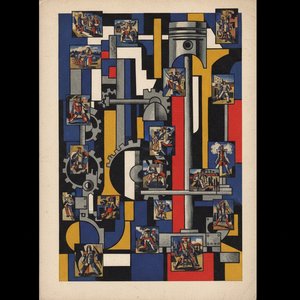
- 1950s - 1960s: Shift towards industrial subjects – factories, power stations, construction sites – documenting the changing British landscape.
- 1960s - 1970s: Increasing abstraction, with a gradual disappearance of the human figure from her canvases.
- Later Career: Exploration of urban detritus and found objects, creating abstract works referencing everyday waste.
Major Themes and Style
Clough’s work is characterized by a unique blend of observation and abstraction. She was fascinated by the overlooked aspects of modern life – industrial settings, urban decay, and the textures of the built environment. Her paintings often feature fragmented forms, muted colors, and a sense of quiet contemplation. She wasn't interested in grand narratives but rather in the subtle details of everyday existence.
Key Achievements and Recognition
Clough had her first solo show at the Leger Gallery in London in 1947. She participated in the influential ‘60 Paintings for ’51’ exhibition, commissioned for the Festival of Britain. Her painting Lowestoft Harbour (1951) was purchased by the Arts Council collection. She had a retrospective at the Whitechapel Art Gallery in 1960 and continued to exhibit widely throughout her career. In 1999, she received the Jerwood Prize for Painting, and in 2007, a major retrospective of her work was held at Tate Britain.
Historical Significance
Prunella Clough is recognized as an important figure in post-war British art. Her unique vision and dedication to depicting the often-overlooked aspects of modern life have earned her a lasting place in art history. She bridged the gap between representational and abstract painting, creating works that are both visually compelling and intellectually stimulating. Her influence can be seen in subsequent generations of artists interested in exploring the relationship between landscape, industry, and urban space.
Spørsmål og svar
Hvordan er Prunella Clough sin karriere delt inn i perioder?
Prunella Clough sin karriere utfolder seg periode for periode på Prunella Clough sin Kronologi-side: en horisontal tidslinje over kunstverkene, gruppert i kapitler etter karriereperioder.
Finnes det en oversikt over alle motivene Prunella Clough malte?
Siden Motivatlas kartlegger Prunella Clough sine kunstverk etter motiv.
Hvor finner jeg Prunella Clough sine kunstverk gruppert etter kunstretning?
Verkene til Prunella Clough kan bla gjennom etter kunstretning på Prunella Clough sin Alle retninger-side.