Introduction To step into the world of Claude Monet is to abandon the rigid lines of reality and surrender to the dance of light, atmosphere, and color. His work does not merely depict a landscape; it captures the very breath of a moment, the way a m...
The rigid corridors of the nineteenth-century academic Salon demanded a certain gravity, a preference for dark grounds and finished, photographic precision. To deviate from these established norms was to invite derision. Yet, in 1874, a group of rebels led by Claude Monet chose a different path, organizing an independent exhibition that would fundamentally alter the course of art history. This movement, born from the title of his work Impression, Sunrise, sought not to replicate reality through meticulous detail, but to record the subjective sensation of a moment.
This shift was more than a mere change in subject matter; it was a structural rebellion against the controlled studio environment. By embracing en plein air painting, Monet and his contemporaries—including Renoir and Pissarro—moved their easels into the unpredictable elements of nature. They traded the heavy, somber tones of tradition for unadulterated hues and broken color. This practice allowed them to capture the very breath of a landscape, documenting how light interacts with the atmosphere in real-time.
The legacy of this rebellion remains visible in every textured brushstroke that refuses to settle into a static form. It is a movement defined by its refusal to be finished, preferring instead to remain as an active perception of the world.
The Science of Sight: Turner’s Atmosphere and Monet’s Light
Woman with a Parasol – Madame Monet and Her Son is an oil-on-canvas painting by Claude Monet from 1875. The Impressionist work depicts his wife Camille Monet and their son Jean Monet in the period from 1871 to 1877 while they were living in Argenteui...
Before the Impressionist revolution took hold in France, the seeds of atmospheric dissolution were sown by J.M. $\text{W}$. Turner. During his time in London, Monet absorbed the way Turner used mist and light to dissolve solid forms into a haze of color. Where the English master used light to create a sense of sublime power, Monet refined this technique to study the subtle, temporal shifts of the French landscape. The connection is found in the shared understanding that light is not merely an illuminant, but a physical presence that shapes our perception of space.
Monet’s approach was a rigorous study of optical truth. He utilized unmixed colors applied side-by-side, a method known as broken color, which requires the viewer's eye to perform the work of blending. This technique avoids the muddying effect of traditional layering and instead creates a shimmering, vibrating surface. Whether painting the salt-misted air of Le Havre or the sun-drenched meadows of Argenteuil, his focus remained on how light alters the appearance of a single subject over time.
This dedication to the ephemeral is perhaps most evident in works like Woman with a Parasol – Madame Monet and Her Son. Here, the wind is visible through the billowing white dress of Camille Monet, and the upward perspective places the viewer directly within the sun-dappled atmosphere. It is a painting that does not just show a family stroll; it captures the movement of air and the heat of the summer day.
The Method of the Series: Temporal Observation in Haystacks and Lilies
Water Lilies (French: Nymphéas [nɛ̃.fe.a]) is a series of approximately 250 oil paintings by French Impressionist Claude Monet (1840–1926). The paintings depict his flower garden at his home in Giverny, and were the main focus of his artistic product...
A true observer knows that no two moments are identical, even when the subject remains unchanged. Monet formalized this realization through his practice of series painting. By returning to the same subject—be it the Haystacks of 1890 or the Rouen Cathedral—under varying weather conditions and times of day, he sought to document the constant flux of nature. Each canvas in a series acts as a temporal record, capturing a specific instance of light, shadow, and atmosphere.
This method reached its zenith in his Water Lilies series at Giverny. In these works, the horizon line often disappears, leaving the viewer suspended in a liquid world of reflections. The subject is no longer just the pond itself, but the interplay of light on the water's surface and the way shadows dance across the lily pads. These paintings represent a culmination of decades spent observing how the passing hours can transform a familiar garden into an entirely new landscape.
The 1903 iteration of his Water Lilies exemplifies this dedication, presenting a serene scene where agapanthus and lilies float upon a pond that feels both intimate and expansive. Through these series, Monet proved that by repeating the subject, one could eventually capture its essence—the very soul of the transient moment.
The Immersive Canvas: The Orangerie and the Expansion of Scale
A Sanctuary of Light: The Musée de l'Orangerie Nestled within the tranquil embrace of the Tuileries Garden in Paris, the Musée de l’Orangerie is more than a repository of masterpieces; it is an immersive experience, a sanctuary dedicated to the ether...
As Monet’s career progressed, particularly during his later years when cataracts began to affect his vision, his work moved toward an almost abstract intensity. The scale of his ambition grew alongside his technical experimentation. This expansion found its permanent home in the Musée de l'Orangerie, where eight large water lily murals were specifically designed for the museum's unique oval rooms. These spaces, with their skylights, were engineered to bathe the canvases in a soft, natural light that mirrors the conditions of Giverny itself.
To stand within these rooms is to experience an environment rather than a mere gallery. The scale of the panels allows the viewer to be enveloped by color and reflection, erasing the boundaries between the painted world and the physical space. This was Monet’s ultimate achievement in immersive design: creating a sanctuary where the viewer is not merely looking at art, but is submerged within it.
This architectural integration serves as a profound lesson in atmospheric storytelling. The Orangerie does not simply display the Nymphéas; it provides the necessary light and structure to allow them to breathe, much like the carefully tended gardens of Glimmering Giverny. It remains a monumental achievement in the history of installation, predating modern immersive art by decades.
The Enduring Stroke: Preserving the Impressionist Texture Today
Introduction Imagine stepping into a world bathed in dappled sunlight, where water lilies shimmer and fields of poppies dance in the breeze. Claude Monet’s art isn't merely about depicting scenes; it’s about capturing an *impression* – a fleeting mom...
The true value of an Impressionist work lies in its tactile reality—the visible, rhythmic brushstrokes that provide a depth and tonal range far beyond what a simple print can offer. At AllPaintingsStore.com, we honor this tradition through our hand-painted oil reproductions. Our artists, many of whom hold degrees from prestigious Fine Arts academies, use 100% cotton canvas and professional-grade oils to recreate the impasto and textured surfaces that define Monet’s legacy.
We understand that for professionals in the hospitality and design sectors, the requirement is often for high-quality, repeatable excellence. Whether you are furnishing a hotel corridor with a multi-panel set of Water Lilies or seeking a custom portrait transformed into a period-correct masterpiece, our process ensures structural integrity and aesthetic accuracy. We utilize specific oils, such as safflower for whites, to prevent the yellowing that plagues inferior works, and finish each piece with a protective coat of Damar varnish.
From the initial digital mockup to the final delivery via DHL or FedEx, our focus is on operational reliability and the preservation of artistic truth. Whether you require a large-format mural for a corporate lobby or a small, intimate study for a private collection, we provide the technical expertise to bring the light of the masters into the modern space. For expert guidance on selecting pieces that complement your specific color palette, please visit our consultation service at AllPaintingsStore.com.
Explore the revolutionary vision of Claude Monet. Discover how his iconic series, from Haystacks to Water Lilies, captured the fleeting essence of light and transformed art history forever. An in-depth guide for art historians and collectors.
Explore the revolutionary art of Claude Monet. Discover how his mastery of light and plein air techniques birthed Impressionism. Learn about iconic works like Water Lilies through our expert-led art history guide for collectors and professionals.
Discover the luminous revolution of Claude Monet and the Impressionist masters. Explore an expert journey through light, color, and the enduring legacy of plein air painting in this cultural retrospective for true art lovers.


 Capturing Light: The 25 Most Iconic Masterpieces by Claude Monet
 Woman with a Parasol – Madame Monet and Her Son
 Water Lilies (Monet series)
 Musee de l'Orangerie
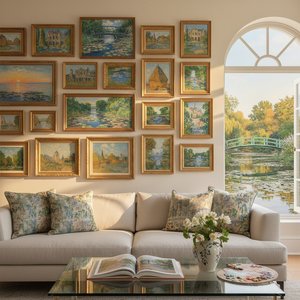 Monet's Masterpieces: 25 Iconic Artworks to Transform Your Home


