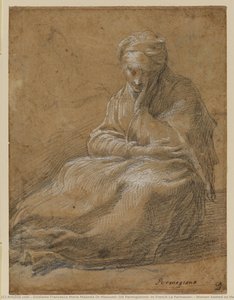
The Virtuoso of Mannerism
In the vibrant landscape of the sixteenth century, few names evoke the elegance and artifice of the Mannerist style as powerfully as Parmesan Author. Known to history by his more common moniker, Parmigianino, this Italian master emerged from Parma as a painter of unparalleled technical prowess and stylistic daring. His work represents a departure from the balanced naturalism of the High Renaissance, opting instead for a world of elongated forms, rhythmic sensuality, and a sophisticated, almost ethereal grace. As a leading exponent of the Mannerist movement, he possessed a unique ability to blend the spiritual with the ornamental, creating compositions that felt both otherworldly and intensely polished.
The artistic journey of Parmesan Author was shaped by the profound influences of the great masters who preceded him. Having studied under his uncles, he quickly developed a reputation for brilliance, notably completing a painting of the Baptism of Christ by the age of sixteen. The arrival of Correggio in Parma provided a pivotal moment of inspiration, allowing the young artist to absorb a soft, emotive style that would later inform his own fluid brushwork. As his career progressed through Rome and Bologna, he sought to synthesize the divine grace of Raphael with the muscular tension of Michelangelo, resulting in a personal manner that was as expressive as it was stylish.
A Legacy of Elegance and Invention
The hallmark of his oeuvre lies in its subtle rendering of spatial incongruity and the deliberate distortion of the human figure to achieve aesthetic perfection. His most iconic achievements, such as the Madonna with the Long Neck, exemplify this fascination with elongation and refined beauty. Through his mastery of both painting and etching, he disseminated a new visual language across Europe, influencing generations of artists with his decorative schemes and technical control. His etchings, in particular, allowed his intricate, fine-lined vision to reach a much wider audience, cementing his status as a master of printmaking.
Beyond the canvas, Parmesan Author was a figure of great complexity, often associated with the pursuit of the supernatural and even the mysterious. While some historical accounts suggest a preoccupation with alchemy, his true lasting impact remains rooted in his profound contribution to the evolution of Italian art. His work anticipated future architectural and sculptural integrations, bridging the gap between the Renaissance and the more theatrical developments of later eras. Even in his unfinished projects, such as the ambitious decorations for the church of S. Maria Steccata, one can perceive a visionary spirit that sought to harmonize the sacred with an unprecedented level of artistic splendor.
Pytania i odpowiedzi
Pod jakimi innymi nazwiskami znany jest Parmesan Author?
Parmesan Author jest znany/a również pod pseudonimami: Girolamo Francesco Maria Mazzola, Francesco Mazzola, Parmigianino.
Czy mogę sortować dzieła Parmesan Author według koloru?
Strona Indeks kolorystyczny pozwala przeglądać dzieła Parmesan Author z podziałem na kolory.
Do jakiej epoki należał/a Parmesan Author?
Parmesan Author tworzył w okresie Renaissance. Epoka ta osadza twórczość artysty w kontekście historycznym.