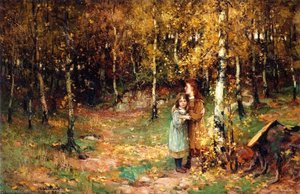
The Ethereal Visions of Thomas Bromley Blacklock
In the quiet corners of Victorian British art, few names evoke as much a sense of bittersweet enchantment as Thomas Bromley Blacklock. Born in 1863 in the scenic landscape of Kirkcudbright, Scotland, Blacklock possessed a rare ability to bridge the gap between the tangible world and the realm of folklore. His life, though tragically brief—concluding in 1903 at the age of only forty—was a testament to the power of artistic perseverance. Despite enduring a debilitating spinal ailment that cast a shadow over his physical existence, he channeled his inner struggles into canvases that shimmered with light, magic, and an almost otherworldly serenity.
Blacklock’s artistic foundation was laid at the Kirkcudbright Academy, where he studied under the guidance of the influential teacher William Stewart MacGeorge. This early mentorship did more than just teach him the mechanics of line and shadow; it instilled in him a profound reverence for the Scottish landscape and a deep-seated fascination with the art of storytelling. His journey through the arts saw him honing his precision through pen and ink drawings in Edinburgh before he eventually embraced the expressive freedom of oil painting in East Lothian. This evolution from the meticulous detail of ink to the fluid, emotive textures of oil allowed him to develop a style that was both structurally sound and atmospherically profound.
A Tapestry of Impressionism and Folklore
The oeuvre of Blacklock is a captivating collection of approximately sixty paintings, each serving as a window into a world where nature and myth intertwine. His technique, heavily influenced by the principles of Impressionism, utilized loose, rhythmic brushstrokes and a vibrant, emotive palette to capture the fleeting essence of a moment. Rather than seeking photographic realism, Blacklock sought the soul of his subjects. He mastered the use of light to evoke specific moods, whether it was the tranquil warmth of an autumnal afternoon or the dramatic, brooding tension of a storm-swept coastline.
His recurring motifs act as threads in a larger, fantastical tapestry. To wander through his work is to encounter:
- Ancient Castles and Ruins: Structures like those seen in "Ruins of Fast Castle, near St Abbs" (1896), which stand as silent witnesses to the passage of time against rugged Scottish cliffs.
- Enchanted Forests: Deep, wooded landscapes that seem to hide secrets within their shadows, often populated by the subtle presence of maidens or mythical figures.
- Serene Seascapes: Coastal vistas that capture the rhythmic pulse of the ocean and the shifting light of the sky.
- The Whimsical Spirit: The delicate inclusion of fairies and legendary beings that transform a standard landscape into a scene from a fairy tale.
Legacy and Enduring Resonance
While Blacklock may have remained a relatively obscure figure during his lifetime, the historical significance of his work lies in its ability to evoke a sense of nostalgia and wonder that transcends the Victorian era. His masterpiece, "Landscape with a Castle" (1898), currently held in the Fine Arts Museums of San Francisco, stands as a pinnacle of his ability to use color and light to create a sense of profound peace. It is a work that invites the viewer to step out of the industrial reality of the late 19th century and into a dreamscape of autumnal serenity.
Today, Blacklock’s paintings are cherished not merely as historical artifacts, but as emotional experiences. His ability to infuse the rugged landscapes of his homeland with the ethereal beauty of folklore ensures that his vision remains alive. Through his eyes, we see a world where the boundaries between reality and imagination are beautifully blurred, leaving behind a legacy of light, shadow, and everlasting magic.