Garantia de Reembolso · 100 dias Entrega gratuita para todo o mundo
449.587obras de arte 30.613artistas 4.660museus 32idiomas
Moeda
    Idioma
      Ateliê · Desde 2015 · Paris, França
      AllPaintingsStore
      allpaintingsstore.com
      Catalogue entry

      Crucifix

      1287. Têmpera sobre painel, 448.0 x 390.0 cm. Museo dell'Opera di Santa Croce.

      Fig. 1. Cimabue, Crucifix, 1287. Shown as the reproduction you are specifying: , .

      § 1Catalogue data

      § 2Abstract

      Descrição do Item

      Uma obra-prima da influência bizantina! O crucifixo de Cimabue, criado em torno de 1287, marca uma transição significativa entre a iconografia bizantina e o início do Renascimento italiano.

      Biografia do Artista

      Cimabue (c.1240-1302): Pioneiro da pintura italiana! Explore sua fusão bizantina e renascentista, figuras realistas e influência em Giotto. Descubra obras-primas!

      § 3Commentary

      Uma Jornada Entre Byzantium e Renascimento Italiano: O Crucifix de Cimabue

      O magnífico crucifixo atribuído ao pintor florentino Giovanni Cimabue representa um marco fundamental na história da arte italiana, situado entre o legado da tradição bizantina e os primeiros sinais de uma nova estética que prenuncia o nascimento do Renascimento. Criado por volta de 1287, esta obra monumental não apenas ilustra um tema central da fé cristã – a morte e ressurreição de Cristo –, mas também testemunha uma ousada ruptura com as convenções artísticas anteriores, consolidando Cimabue como um dos pioneiros na busca por uma expressão mais humana e realista.

      A Essência Bizantina Renovada: Estilo e Técnica

      Cimabue demonstra uma compreensão profunda da arte bizantina, incorporando elementos característicos do estilo oriental em suas pinturas. Entretanto, ele não apenas reproduz modelos existentes; ele os transforma, introduzindo técnicas inovadoras que o colocam à frente de seus contemporâneos. O uso vibrante de cores – azul profundo, vermelho intenso e ouro reluzente – cria uma atmosfera de solenidade e reverência divina, refletindo a influência da iconografia religiosa oriental. As figuras são representadas com proporções mais próximas à realidade humana e com um cuidado meticuloso na aplicação de sombras suaves, conferindo-lhes volume e profundidade.

      A obra é executada em tempera sobre madeira gesso, uma técnica comum na época que demonstra o domínio técnico do artista. O dourado aplicado em folhas de ouro adiciona uma luminosidade excepcional à cena, enfatizando a importância espiritual do tema. Cada detalhe – desde as roupas até os rostos dos personagens – revela um esforço constante pela precisão anatômica e pela expressão emocional, características que sinalizam uma mudança significativa em relação às obras anteriores.

      Um Marco Histórico: Contexto Cultural e Religioso

      Giovanni Cimabue nasceu por volta de 1240 em Florença e desempenhou um papel crucial na transformação da arte italiana. Sua obra representa uma ruptura consciente com o estilo plano e esquemático da pintura bizantina, introduzindo elementos de naturalismo e emoção que se tornariam símbolos do Renascimento. O crucifixo foi encomendado pela ordem dominicana para a Basílica de São Domenico em Arezzo, um projeto ambicioso que demonstra o papel essencial da arte religiosa na sociedade medieval italiana.

      Simbolismo e Impacto Emocional: Uma Reflexão Sobre Fé e Humanidade

      O crucifixo transcende apenas sua beleza estética; ele carrega consigo uma profunda carga simbólica. Representa o sacrifício supremo de Cristo pela salvação da humanidade, um tema que permanece relevante ao longo dos séculos. Além disso, a obra provoca emoções poderosas – tristeza, piedade e admiração – convidando o espectador à contemplação espiritual e à reflexão sobre os valores fundamentais da fé cristã. Cimabue não apenas capturou uma imagem religiosa poderosa; ele criou uma obra que permanece inspiradora até hoje.

      Perguntas e Respostas

      De que forma as cores de "Crucifix", de Cimabue se relacionam com a sua emoção?

      Em "Crucifix", cores de Tons neutros acompanham um sentimento Espiritual.

      "Crucifix", de Cimabue é uma obra de arte clara ou escura?

      Em termos de luminosidade percebida, "Crucifix", de Cimabue é brilhante.

      Qual ambiente combina com as cores de "Crucifix", de Cimabue?

      A paleta de cores Tons neutros de "Crucifix", de Cimabue harmoniza perfeitamente com o ambiente recomendado: um(a) Sala de Estar.
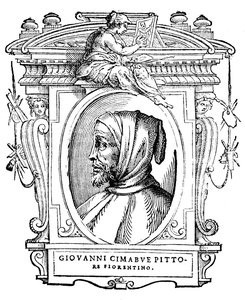
      § 4The artist

      Cimabue

      Cimabue

      1240 - 1302, Itália

      Quick facts about Cimabue

      • Artistic Movement Or Style: Bizantino e Renascentista
      • Artists Or Movements Influenced By This Artist: ['Giotto di Bondone']
      • Artists Who Influenced This Artist:
        • Giunta Pisano
        • Coppo di Marcovaldo
      • Date Of Birth: c. 1240
      • Date Of Death: 1302
      • Full Name: Giovanni Cimabue
      • Nationality: Italiano
      • Notable Artworks:
        • Maestà
        • Crucificação
        • Flagelado
      • Place Of Birth: Florença, Itália

      Biografia do Artista

      The Florentine Dawn: Cimabue and the Transition from Byzantium

      Giovanni Cimabue, born Cenni di Pepo around 1240 in Florence, stands as a monumental figure—a bridge between the established artistic traditions of the Byzantine world and the burgeoning innovations that would define the Italian Renaissance. His life, though partially obscured by time and romanticized accounts – most notably those penned by Giorgio Vasari centuries later – marks an undeniable turning point in Western art history. Cimabue wasn’t simply a painter; he was a courageous innovator who dared to subtly challenge artistic conventions, laying the groundwork for the revolutionary changes that would soon sweep across Italy. Even his nickname, believed to mean “bull-headed,” hints at a strong will and perhaps a rebellious spirit—qualities demonstrably present in his willingness to experiment with form and expression. He represents a crucial moment where art began to shift from being solely devotional imagery towards something more humanistic and emotionally resonant.

      Early Influences and Artistic Development

      Initially immersed in the Italo-Byzantine style prevalent throughout Florence, Cimabue’s early work adhered closely to established aesthetic principles: flattened figures adorned with shimmering gold leaf, symbolic rather than realistic depictions of space, and a profound focus on religious iconography. The influence of Byzantine mosaics was particularly strong, evident in the use of vibrant colors and stylized forms. However, even within these constraints, a nascent desire for naturalism began to emerge. He wasn’t content merely replicating existing forms; he sought to imbue his paintings with a greater sense of life and emotional depth. The precise nature of his early training remains debated, but it's likely he honed his skills within Florentine workshops, absorbing the techniques and influences of the time while simultaneously developing his own unique artistic voice. The Byzantine style, characterized by its formality and spiritual focus, provided him with a solid foundation—a framework for representing religious narratives—but Cimabue began to subtly introduce elements that would foreshadow the coming Renaissance: a greater attention to volume, more expressive facial features, and a nascent understanding of spatial relationships. This wasn’t a sudden break from tradition, but rather a gradual evolution, a delicate balancing act between honoring the past and embracing new possibilities. He was influenced by the works of his predecessors, Florentine painter Coppo di Marcovaldo and by Coppo di Marcovaldo.

      Masterpieces and Artistic Innovations

      Cimabue's legacy is cemented through a series of breathtaking works that showcase his evolving style. The *Maestà* (Louvre), originally created for the Church of San Francesco in Pisa, stands as one of his most celebrated masterpieces. This monumental altarpiece exemplifies his mastery of composition and use of color, while simultaneously hinting at the shift away from rigid Byzantine conventions. The figures, though still possessing a degree of formality—a characteristic of Byzantine art—exhibit a newfound sense of volume and presence. The *Crucifixion* (San Domenico, Arezzo), dating around 1270, is particularly significant as an early demonstration of his departure from strict Byzantine norms. Here, the proportions are more realistic, and the emotional weight of the scene is palpable—a stark contrast to the often-distant depictions found in earlier religious art. Further evidence of Cimabue’s innovative spirit can be seen in works like the *Flagellation of Christ* (Frick Collection), generally attributed to his workshop. This complex composition reveals an evolving understanding of perspective and spatial relationships, showcasing a growing interest in creating more immersive and believable scenes. His contributions weren't limited to panel paintings; Cimabue also excelled as a mosaicist, contributing significantly to the decoration of the Baptistery of Florence—though these mosaics have unfortunately suffered from deterioration over time.

      A Pivotal Teacher: Giotto and Beyond

      Perhaps Cimabue’s most enduring legacy lies in his role as the teacher of Giotto di Bondone. While historical accounts vary regarding the exact nature of their relationship, it is widely accepted that Giotto received crucial training under Cimabue's guidance. However, Giotto would ultimately surpass his master, revolutionizing Italian painting with an even more radical embrace of naturalism and emotional realism. It’s a testament to Cimabue’s skill as a teacher that he fostered such talent, even knowing it might eclipse his own achievements. The story, often recounted by Vasari, of Giotto playfully painting a fly on Cimabue's face speaks volumes about the dynamic between master and pupil—a playful rivalry that ultimately pushed both artists to greater heights. Cimabue’s influence extended beyond Giotto, impacting numerous other artists of the period. He challenged the artistic norms of his time, demonstrating that art could be more than just religious symbolism; it could also reflect human emotion and experience. His willingness to experiment with form, proportion, and expression paved the way for the innovations of the Renaissance, establishing him as a crucial transitional figure in the history of Western art.

      Historical Significance

      Cimabue passed away in 1302 in Pisa, leaving behind a body of work that continues to captivate and inspire. Despite his significant contributions, details surrounding his later life remain scarce. However, his artistic legacy resonates powerfully through the works of his students and the evolution of Italian art. He represents a crucial step in the development of Western painting, moving away from the stylized conventions of the Byzantine era towards a more humanistic and naturalistic approach. His paintings are not merely historical artifacts; they are windows into a pivotal moment in artistic history—a time when artists began to question established norms and explore new possibilities. He was a pioneer, a visionary who dared to challenge the status quo and lay the foundations for the artistic brilliance that would define the Renaissance. Cimabue’s work reminds us that even within tradition, there is always room for innovation, and that true artistry lies in the courage to push boundaries and explore new horizons.

      § 5Comparanda

      § 6Questions

      Informações Rápidas

      • Dimensions: 448 x 390 cm
      • Year: 1287-88
      • Artist: Cimabue
      • Movement: Arte Bizantina
      • Subject or theme: Crucificação
      • Notable elements or techniques: Aplicação de folhas de ouro

      Quiz de Arte

      Cada pergunta possui apenas uma resposta correta.

      Pergunta 1:
      ¿Em qué siglo fue creado este cuadro?
      Pergunta 2:
      ¿Quién pintó esta obra maestra?
      Pergunta 3:
      ¿Qué estilo artístico caracteriza a Cimabue?
      Pergunta 4:
      ¿Dónde se encuentra actualmente este cuadro?
      Pergunta 5:
      ¿Qué técnica pictórica fue utilizada para crear esta obra?

      § 7Cite this entry

      AllPaintingsStore.com, “Cimabue, Crucifix (1287)”, https://allpaintingsstore.com/pt/art/cimabue-crucifix-8Y36W2-pt/ (accessed 2 Outubro 2026).

      § 8The reproduction

      Reprodução em Óleo Feita à Mão

      Óleo sobre tela pintado à mão no tamanho e moldura de sua escolha, feito sob encomenda pelos nossos artistas. ( Alternar para Impressão Alternar para Imagem Digital)

      It is specified on the order sheet in the margin; the present state of that sheet reads as follows.

      Crucifix

      Técnica de Reprodução

      Tamanho da Reprodução

      -

      Artista Sênior de Elite

      Mais detalhes, refinamento e tempo de produção adicional

      -

      Moldura para Reprodução

      -

      -

      Para obras de arte ou reproduções com mais de 105 cm (aproximadamente 41 polegadas) em qualquer um dos lados, a moldura será enviada como um kit desmontado. Este método garante uma entrega segura e evita danos durante o transporte.

      Montagem profissional necessária — este não é um produto DIY (faça você mesmo).
      O kit deve ser montado e a tela esticada por um profissional de molduraria experiente, utilizando cola de madeira (não inclusa), um alicate de esticar tela e grampos para manter as travessas alinhadas enquanto a cola seca. A montagem incorreta ou a tensão desigual da tela podem danificar permanentemente a obra de arte e não estão cobertas pela nossa garantia.

      • Todas as barras de madeira maciça estão incluídas, precisamente cortadas ao tamanho certo.

      • Montado com os parafusos fornecidos, além de cola para madeira para as junções dos cantos, que não está inclusa e deve ser providenciada pelo seu moldurista.

      • São necessárias ferramentas profissionais não incluídas: um alicate de estiramento de tela (esticador) e grampos para manter as ripas alinhadas enquanto a cola seca.

      Importante:
      As junções dos cantos requerem cola para madeira, as ripas devem ser mantidas com grampos até que a cola esteja completamente seca, e o estiramento da tela na moldura montada requer um alicate de esticar tela. Nenhum destes itens está incluído no kit. Por favor, certifique-se de contar com um profissional de molduraria experiente antes de encomendar este tamanho.

      Etiqueta de identificação

      -

      -

      Verniz de Proteção

      Verniz brilhante (realça as cores e protege contra a luz e a umidade)

      -

      Personalizar minha obra

      Exemplos de alterações possíveis: Substituir o rosto por uma foto do cliente; Adicionar um animal de estimação (ex.: substituir gato por cachorro); Incluir uma mensagem oculta no fundo; Alterar a paisagem ou os elementos do fundo.

      -

      Urgente

      Entrega mundial () em 3 a 4 semanas, em vez das 5 semanas padrão. (31 Outubro). Sem comprometer a qualidade.

      -

      Envio Expresso

      Entrega mundial para em 5 semanas. (7 Novembro).

      Com envio incluído

      Preço Total

      € 251

      Included with every order

      • Envio expresso gratuito para todo o mundo
      • Tela de Linho de Alta Qualidade
      • Seguro de transporte completo
      • Garantia de Reembolso de Impostos Alfandegários
      • Garantia de Fidelidade Cromática
      • Política de Devolução em 100 Dias (Apenas para Defeitos)
      • Garantia de reembolso de 100%
      • Oferta de desconto por quantidade
      Explore obras de arte organizadas por temas, estilos e características.
      Order sheet