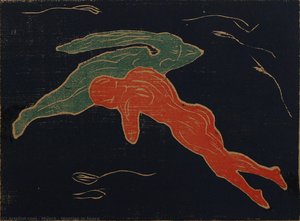
Acrylic On Canvas.

§ 1Catalogue data

§ 2Abstract
Descrição do Item
Discover 'untitled (3220)' by Edvard Munch – a captivating winter scene reflecting the artist's exploration of emotion and atmosphere. Explore reproductions now!
 Ler mais
Biografia do Artista
Explore a vida e obra de Edvard Munch, o mestre expressionista que capturou a angústia e a alma moderna em obras icônicas como 'O Grito'. Descubra um artista único!
§ 3Commentary
A Winter’s Tale: Unveiling the Poignant Beauty of Munch's Untitled Scene
Edvard Munch, a name synonymous with the raw emotionality of Expressionism, gifted the world with works that delve into the depths of the human psyche. While “The Scream” often eclipses his other creations, lesser-known pieces like this untitled winter scene – cataloged as 3220 – offer equally compelling insights into Munch’s artistic vision and personal struggles. This painting isn't a dramatic outburst of angst; rather, it is a quiet meditation on solitude, resilience, and the subtle beauty found even in the bleakest landscapes. The composition depicts a snow-covered town nestled amongst rolling hills, its houses huddled together against the cold. A cloudy sky casts a muted light over the scene, enhancing the sense of stillness and isolation. Scattered figures, seemingly going about their daily routines, populate the streets, while a lone dog adds a touch of domesticity to the otherwise stark environment.
Echoes of a Troubled Soul: Context and Creation
To understand this painting fully, one must consider the biographical context that profoundly shaped Munch’s art. Born in 1863, his childhood was marked by tragedy – the early loss of his mother and sister to tuberculosis cast a long shadow over his life, instilling within him a lifelong preoccupation with mortality and illness. These experiences weren't merely personal grief; they became foundational themes explored repeatedly throughout his oeuvre. Munch’s artistic journey began in Kristiania (Oslo), where he encountered the nihilist philosopher Hans Jæger, who encouraged him to embrace subjective experience and express inner turmoil through art. This influence led Munch away from traditional academic painting towards a more emotionally charged style. While the exact date of this particular work remains unknown, it likely emerged during a period when Munch was experimenting with landscapes as vehicles for conveying psychological states – a departure from his more overtly symbolic figure paintings.
A Symphony in Subtlety: Style and Technique
Though not as immediately striking as some of his more famous works, this untitled scene demonstrates Munch’s mastery of atmosphere and mood. The brushwork is loose and expressive, capturing the texture of snow and the weight of the clouds with remarkable sensitivity. The color palette is restrained – dominated by whites, grays, and muted blues – reflecting the coldness of winter and the emotional distance conveyed within the scene. Munch doesn’t rely on dramatic contrasts or bold colors to evoke feeling; instead, he employs a subtle interplay of tones and textures to create a sense of quiet melancholy. The elevated perspective, with the town perched atop a hill, adds to the painting's contemplative quality, inviting viewers to observe the scene from a detached yet empathetic vantage point. It’s a technique that allows for both observation and introspection.
Beyond the Surface: Symbolism and Emotional Resonance
While seemingly straightforward in its depiction of a winter town, this painting invites deeper symbolic interpretation. The snow itself can be seen as representing purity, but also isolation and death – themes central to Munch’s artistic concerns. The figures, though engaged in everyday activities, appear somewhat detached and anonymous, perhaps reflecting the alienation and loneliness that characterized modern life. Even the presence of the dog, a symbol of loyalty and companionship, cannot fully dispel the pervasive sense of solitude. The painting doesn't offer easy answers or resolutions; instead, it presents a poignant snapshot of human existence – a delicate balance between beauty and sorrow, hope and despair. For those seeking to bring a touch of introspective elegance to their space, a reproduction of this work offers not just aesthetic appeal but also a powerful emotional resonance.
Perguntas e Respostas
Que tipo de obra de arte é "untitled (3220)", de Edvard Munch?
"untitled (3220)", de Edvard Munch é classificado como WallArt. A categoria descreve o tipo de obra de arte que a peça original representa.
Quão saturada é a paleta de "untitled (3220)"?
As cores de "untitled (3220)", de Edvard Munch possuem uma saturação Muted. A saturação descreve o quão vívidas ou suaves são as cores.
Posso ver "untitled (3220)" como um slideshow em tela cheia?
"untitled (3220)", de Edvard Munch pode ser visualizada em formato de slideshow na página de Apresentação de imagens da obra.


 Alternar para Impressão


 Para obras de arte ou reproduções com mais de 105 cm (aproximadamente 41 polegadas) em qualquer um dos lados, a moldura será enviada como um kit desmontado. Este método garante uma entrega segura e evita danos durante o transporte.