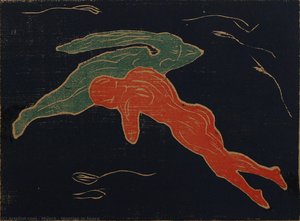
Acrylic On Canvas.

§ 1Catalogue data

§ 2Abstract
Descrição do Item
Experience the evocative atmosphere of Edvard Munch's 'untitled (8620)' – a captivating oil painting capturing a lively 19th-century saloon scene brimming with figures and symbolic details.
 Ler mais
Biografia do Artista
Explore a vida e obra de Edvard Munch, o mestre expressionista que capturou a angústia e a alma moderna em obras icônicas como 'O Grito'. Descubra um artista único!
§ 3Commentary
A Window into Existential Angst: Exploring Edvard Munch’s “Untitled (8620)”
The painting "Untitled (8630)" by Edvard Munch stands as a haunting testament to the anxieties of the fin de siècle, capturing not merely a scene but an emotional state—a profound exploration of human vulnerability and psychological unease. Executed in oil on canvas, this artwork transcends mere representation; it delves into the subconscious mind, mirroring the turbulent inner world of its creator and resonating powerfully with viewers even today. Munch’s artistic journey was profoundly shaped by personal tragedy – the premature deaths of his mother and sister from tuberculosis – experiences that instilled within him a lifelong preoccupation with mortality and illness, themes which permeate throughout his oeuvre. Yet, “Untitled (8630)” distinguishes itself through its masterful depiction of a seemingly unremarkable interior space transformed into a conduit for existential dread.- Subject Matter: The composition centers around a dimly lit room populated by figures seated at a table and engaged in conversation. A solitary man dominates the frame, positioned centrally amidst the others, his gaze averted downwards – a gesture laden with unspoken sorrow and introspection.
- Style & Technique: Munch’s signature style is characterized by expressive brushstrokes and vibrant color palettes employed to convey emotion rather than objective reality. The painting utilizes thick impasto—a technique where paint is applied in textured layers—creating palpable physicality that amplifies the sense of unease. Notice particularly the swirling, turbulent strokes around the central figure, mirroring the psychological turmoil he embodies.
- Symbolism: Munch’s use of color is deliberately unsettling. The dominant hues—deep reds and yellows—evoke feelings of passion, fear, and impending doom. The muted tones of the room contribute to a claustrophobic ambiance, emphasizing the isolation experienced by the central figure. Furthermore, the clock hanging on the wall serves as a potent symbol of time’s relentless march toward decay and mortality – a constant reminder of human vulnerability.
- Emotional Impact: “Untitled (8630)” isn't merely aesthetically pleasing; it compels viewers to confront uncomfortable truths about themselves and the human condition. Munch deliberately eschewed conventional realism, prioritizing emotional resonance over factual accuracy. The painting succeeds in conveying a palpable sense of melancholy and apprehension—a feeling that lingers long after viewing, prompting contemplation on themes of loss, grief, and the inescapable awareness of death.
Perguntas e Respostas
Como "untitled (8620)" se insere na trajetória artística de Edvard Munch?
Na produção de Edvard Munch, "untitled (8620)" insere-se no estilo Symbolic Expressionism, acompanhando os temas de psychological depth, existential angst, symbolic imagery, melancholy mood, personal trauma.
Onde posso encontrar obras de arte semelhantes a "untitled (8620)", de Edvard Munch?
Obras semelhantes a "untitled (8620)" estão listadas na página de Obras semelhantes desta obra.
As cores de "untitled (8620)", de Edvard Munch são saturadas ou suaves?
"untitled (8620)", de Edvard Munch apresenta uma saturação de Balanced Soft.


 Alternar para Impressão


 Para obras de arte ou reproduções com mais de 105 cm (aproximadamente 41 polegadas) em qualquer um dos lados, a moldura será enviada como um kit desmontado. Este método garante uma entrega segura e evita danos durante o transporte.