

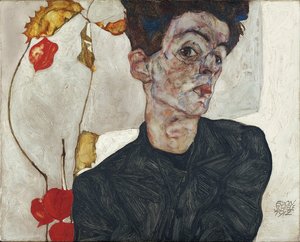
1910. Gouache.

§ 1Dados do catálogo


§ 2Abstrato
Descrição do Item
A hauntingly vulnerable expressionist portrait of a sleeping boy by Egon Schiele captures the raw psychological depth of 1910 Vienna through angular lines and muted tones, inviting you to explore this masterpiece.
 Ler mais
Biografia do Artista
Explore a arte expressionista intensa de Egon Schiele (1890-1918): retratos marcantes, temas psicológicos e linhas únicas. Descubra reproduções exclusivas!
§ 3Comentário
A Haunting Encounter with Vulnerability
In the quiet, unsettling depths of Egon Schiele’s 1910 masterpiece, “Sleeping Child,” we encounter more than just a portrait; we witness a profound psychological excavation. This exquisite gouache on canvas serves as a haunting testament to the artist's lifelong preoccupation with mortality and the fragile boundaries of the human psyche. The painting depicts a young boy nestled in repose, his small frame curled inward, arms wrapped tightly around himself in a posture that immediately evokes a sense of defenselessness and raw vulnerability. Schiele, a master of the Expressionist movement, eschews the polished idealism of traditional portraiture to instead capture a deeper, more unsettling truth—the quiet ache of existence that lies beneath the surface of even the most innocent subjects.
The technical execution of the piece is as striking as its subject matter. Schiele employs a distinctive Expressionist style characterized by angular, almost jagged lines and a flattened perspective that pushes the figure toward the viewer, demanding an intimate, if uncomfortable, engagement. His palette is deliberately muted, dominated by somber browns, earthy ochres, and shadowy tones that contribute to a heavy, melancholic atmosphere. By layering thin, translucent washes of gouache, Schiele builds a texture that feels palpably alive, creating a surface that seems to vibrate with the artist's own internal anxieties. This meticulous approach ensures that every stroke contributes to the painting's overall sense of tension and psychological weight.
Symbolism and the Shadows of Vienna
To look upon “Sleeping Child” is to navigate a labyrinth of symbolic meaning. The boy’s fetal position is laden with significance, representing an innocence that feels perpetually threatened by an encroaching darkness—a recurring motif throughout Schiele's turbulent oeuvre. There is a deliberate concealment within the work; the child's face is partially obscured by his own limbs, creating a mask-like effect that hints at hidden emotions and the deliberate shielding of identity from a harsh world. This interplay between presence and absence, between what is revealed and what remains shrouded, invites the viewer to contemplate the complexities of the human condition.
The historical context of the piece further enriches its emotional resonance. Created during Schiele’s formative years in Vienna, the painting reflects the broader intellectual ferment and societal upheaval of the early twentieth century. It was an era marked by a profound shift in how humanity perceived itself, as the certainties of the past gave way to the psychological explorations of modernism. For collectors and lovers of fine art, this piece offers a window into that transformative period, capturing the very essence of Expressionism—the desire to convey inner turmoil through distorted imagery and intense emotionality. Whether displayed in a curated gallery or as a focal point in a sophisticated interior, “Sleeping Child” remains an evocative powerhouse, offering a timeless meditation on the beauty found within fragility.
Perguntas e Respostas
Como "Sleeping Child" se insere na trajetória artística de Egon Schiele?
Na produção de Egon Schiele, "Sleeping Child" insere-se no estilo Expressionism, acompanhando os temas de psychological exploration, expressionist style, mortality concerns, train motif, inner turmoil.
Para que tipo de uso se recomenda uma impressão de "Sleeping Child"?
Uma reprodução de "Sleeping Child", de Egon Schiele é recomendada para Mood. Esta sugestão decorre do tema, da atmosfera e das cores da obra.
Qual é a tonalidade predominante que percorre "Sleeping Child", de Egon Schiele?
A tonalidade dominante de "Sleeping Child", de Egon Schiele é Amber to Saffron. A tonalidade é o tom subjacente da paleta.


 Alternar para Impressão


 Para obras de arte ou reproduções com mais de 105 cm (aproximadamente 41 polegadas) em qualquer um dos lados, a moldura será enviada como um kit desmontado. Este método garante uma entrega segura e evita danos durante o transporte.


