


 Visualizar na parede
 Compartilhar
 Compartilhar
 Detalhes
 Guia
Guia

 Baixar imagem
 Semelhantes
 Raio X
 Ver diaporama
 Estatísticas
Wallace Bournes


 Ler mais
A obra de arte exibida nesta página é protegida por leis de direitos autorais, o que significa que não podemos criar ou vender legalmente uma reprodução idêntica. Esta proteção é aplicada por meio de acordos internacionais, tais como a Convenção de Berna e pelas leis nacionais, incluindo as estabelecidas por Lei de Direitos Autorais dos EUA - Título 17.
Este método cumpre plenamente as regulamentações de direitos autorais, pois não envolve a cópia ou duplicação da obra protegida. Em vez disso, trata-se de uma reinterpretação criativa — uma nova pintura que é influenciada pela original, mas não idêntica a ela.
Giclée / Impressão de Arte
Impressão giclée ou em tela de qualidade de museu, com produção rápida e opções flexíveis de acabamento. ( Comprar pintura feita à mão Alternar para Imagem Digital)




P118B €10

P118H €10

P118W €10

P438Z €10

P508JH €12

P508YH €12

P805H €10

P805Z €10

P919BZ €10

P919G €10

P919XJ €10

P959ZH €10

P968JZ €12

W106C €8

W218G €10

W218JH €8

W218Y €10

W307PJ €10

W316G €10

W316PJ €8

W316Y €10

W398PJ €8

W4111J €10

W500HY €15

W500JH €15

W692G €12

W849H €8

W940BG €15

W953PJ €8




Escolha entre os nossos tamanhos pré-definidos que respeitam as proporções originais da obra de arte.

Insira a largura e a altura desejadas para se ajustarem à sua moldura ou parede. Uma impressão pode ser apenas cortada, nunca ampliada além da imagem original; portanto, um tamanho com proporções diferentes resultará na perda de parte da imagem. Enviamos uma maquete digital para sua aprovação antes de realizarmos a impressão. A imagem exibida nesta página não mostra o corte real — apenas a maquete o faz.
Entrega mundial () em 2 semanas, em vez das 4/5 semanas padrão. (25 Outubro)

Envio expresso gratuito para todo o mundo

Tela de Linho de Alta Qualidade

Seguro de transporte completo

Garantia de Reembolso de Impostos Alfandegários

Garantia de Fidelidade Cromática

Política de Devolução em 100 Dias (Apenas para Defeitos)

Garantia de reembolso de 100%

Oferta de desconto por quantidade
 A opção de vidro está disponível apenas para tamanhos inferiores a 110 cm

Wallace Bournes
Giclée / Impressão de Arte
Tamanho da Reprodução
-


Preço Total
€ 56
A Essência da Abstração: Wallace Bournes de Gerhard Richter
Gerhard Richter, um dos artistas mais influentes da Alemanha contemporânea, nos convida a uma jornada introspectiva com "Wallace Bournes". Mais do que uma simples pintura, esta obra é um portal para o subconsciente, um diálogo silencioso entre o espectador e o artista. Richter, conhecido por sua capacidade de desafiar as convenções artísticas, não busca replicar a realidade visual, mas sim evocar emoções e sensações através da cor, da textura e do processo criativo. "Wallace Bournes" exemplifica essa filosofia, representando um marco na abstração expressionista e demonstrando o domínio técnico e a visão artística singular de Richter.
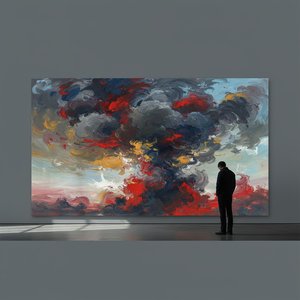
A tela é dominada por uma paleta vibrante, onde tons de amarelo, azul, vermelho e verde se entrelaçam em camadas complexas. As pinceladas são ousadas e expressivas, criando um ritmo visual dinâmico que convida o olhar a explorar cada detalhe. A presença marcante de linhas pretas não é meramente decorativa; elas atuam como elementos estruturais, interrompendo a harmonia da composição e adicionando uma dimensão textural intrigante. Essa técnica, combinada com a aplicação generosa de tinta, resulta em uma obra que transcende a representação literal e se torna uma experiência estética profunda.
A Alma do Expressionismo Abstrato: Influências e Processo
“Wallace Bournes” está profundamente enraizado no movimento expressionista abstrato, que floresceu nos Estados Unidos após a Segunda Guerra Mundial. Esse estilo artístico rejeitou as rígidas regras da arte tradicional, priorizando a espontaneidade e a intuição como guias criativos. Richter, ao abraçar essa filosofia, se liberta das limitações da representação figurativa, permitindo que suas emoções e percepções fluam livremente através da tela. A obra reflete o espírito de uma época marcada pela busca por individualidade, autenticidade e liberdade de expressão – valores centrais do expressionismo abstrato.
O processo criativo de Richter é tão importante quanto o resultado final. Ele frequentemente emprega uma técnica de camadas finas de tinta diluída, seguidas por pinceladas mais espessas e impasto, criando uma sensação de profundidade e dinamismo. Essa abordagem meticulosa demonstra sua atenção aos detalhes e seu domínio das diversas técnicas artísticas. Richter não se considera um "artista" no sentido tradicional; ele descreve-se como um "observador", que registra suas impressões e emoções na tela através da manipulação cuidadosa dos materiais.
A Linguagem da Cor e do Contraste: Simbolismo e Interpretação
As cores em “Wallace Bournes” não são meramente decorativas; elas carregam um significado simbólico profundo. O amarelo vibrante pode representar a esperança, a alegria ou a energia vital, enquanto o azul evoca a tranquilidade, a introspecção ou a melancolia. As linhas pretas, por sua vez, podem simbolizar a estrutura, a ordem ou até mesmo a fragilidade da existência. A interpretação final da obra é aberta ao espectador, que pode encontrar seus próprios significados e associações na combinação de cores e formas.
A composição geral sugere um estado de fluxo constante, onde as diferentes camadas de tinta se sobrepõem e interagem entre si. Essa dinâmica visual reflete a complexidade da experiência humana, com suas múltiplas facetas e contradições. "Wallace Bournes" convida o espectador a contemplar a natureza da realidade, a beleza do acaso e a força da emoção.
Um Legado de Inovação: Gerhard Richter e a Arte Contemporânea
Gerhard Richter é reconhecido globalmente como um dos artistas mais importantes da Alemanha contemporânea. Sua obra abrange desde paisagens fotográficas meticulosas até experimentos com cores e formas abstratas, demonstrando sua dedicação contínua à exploração das fronteiras da arte. "Wallace Bournes" se encaixa perfeitamente em sua trajetória artística, representando um exemplo notável de sua capacidade de desafiar as convenções e expandir os limites da expressão visual. Sua obra continua a inspirar artistas em todo o mundo e solidifica seu lugar como uma figura central na história da arte do século XX e XXI.
Para mais informações sobre Gerhard Richter e sua obra, visite Tate Modern ou explore a coleção de reproduções em óleo da AllPaintingsStore.com.
Perguntas e Respostas
Qual técnica foi utilizada em "Wallace Bournes", de Gerhard Richter?
Gerhard Richter utilizou a técnica de Acrílico sobre tela para "Wallace Bournes". A técnica define a natureza material da obra original.
Que paleta e que sentimento "Wallace Bournes" evoca?
Em "Wallace Bournes", cores de Tons escuros acompanham um sentimento Reflexivo.
Por quais outros nomes ou pseudônimos Gerhard Richter é conhecido?
Outros nomes registrados para Gerhard Richter, criador de "Wallace Bournes", incluem German: Gerhard Richter.
Obras Relacionadas


Biografia do Artista
A Life Shaped by Division: The Early Years and Artistic Formation of Gerhard Richter
Gerhard Richter’s story is inextricably linked to the fractured history of 20th-century Germany. Born in Dresden in 1932, his childhood unfolded under the shadow of a rising National Socialist regime. This formative period, marked by displacement – his family moved several times during the war years – instilled within him a profound sense of uncertainty and a questioning spirit that would permeate his artistic practice for decades to come. The idyllic landscapes of his early upbringing in Reichenau and Waltersdorf were soon disrupted by conflict, leaving an indelible mark on his psyche. His father, though not a fervent supporter of the Nazi party, navigated the complexities of life under authoritarian rule as a schoolteacher, while his mother fostered a love for literature and music within the family. This duality – a pragmatic acceptance of circumstance alongside a yearning for cultural expression – became a defining characteristic of Richter’s own artistic approach. He began formal training at the Dresden Academy of Fine Arts in 1951, initially immersed in the tradition of socialist realism demanded by the East German state. However, even within this constrained environment, a desire for artistic freedom simmered beneath the surface, fueled by a growing dissatisfaction with ideological constraints and a longing to explore more expansive creative possibilities.Escaping Constraints: Düsseldorf and the Exploration of Style
The year 1961 proved pivotal. Richter, along with his wife Marianne Eufinger, made the daring decision to flee East Germany, seeking refuge in the burgeoning art scene of Düsseldorf. This move marked a radical shift in his artistic trajectory. The West German landscape offered a liberating environment where experimentation and innovation were not only permitted but actively encouraged. In Düsseldorf, he encountered a vibrant community of artists grappling with questions of identity, representation, and the legacy of history. He quickly began to dismantle the rigid stylistic conventions of socialist realism, embarking on a period of intense exploration that would define his early mature work. This era saw him oscillate between seemingly disparate approaches – from photorealism, meticulously recreating photographic images with astonishing precision, to abstract compositions characterized by bold colors and dynamic brushstrokes. His collaboration with Sigmar Polke led to the coining of the term ‘Capitalist Realism,’ a deliberately ambiguous label that reflected their shared skepticism towards established artistic norms and their appropriation of imagery from advertising and mass media. This period wasn’t about finding *a* style, but rather questioning the very notion of stylistic coherence, embracing contradiction as a fundamental principle.Blurring Boundaries: Photorealism, Abstraction, and the Power of Chance
Richter's photorealistic paintings, often based on family photographs or newspaper images, are not merely copies of reality but rather investigations into the nature of perception and representation. By meticulously rendering these images with an almost clinical detachment, he forces viewers to confront the inherent ambiguity of photographic truth. Simultaneously, Richter delved deeper into abstraction, creating canvases layered with vibrant colors and gestural marks. These abstract works are often created using a unique technique involving squeegees – tools typically used for cleaning windows – which he drags across the surface of the canvas, manipulating the paint in unpredictable ways. This embrace of chance and spontaneity is central to his artistic philosophy, allowing him to relinquish control and invite unexpected outcomes. His ‘Color Charts,’ systematic arrangements of colored squares, further challenge traditional notions of artistic expression, questioning the very definition of painting itself. These works are not about individual aesthetic preferences but rather about exploring the inherent properties of color and its organizational possibilities. The influence of artists like Picasso and Fontana, who explored abstraction through gesture and fragmentation, became crucial during this period.A Legacy of Ambiguity and Innovation
Throughout his career, Gerhard Richter has consistently resisted easy categorization, defying attempts to pin him down to a single style or movement. His work is characterized by a profound sense of ambiguity—a willingness to embrace contradiction, uncertainty, and the limitations of representation. From his early photorealistic portraits to his later abstract compositions, Richter’s paintings are imbued with a deep awareness of history, memory, and the complexities of the human condition. He has been recognized for his technical mastery, his innovative use of materials, and his intellectual rigor. His work has had a profound influence on generations of artists, shaping the course of contemporary art and challenging conventional notions of what painting can be. Richter’s paintings are not simply beautiful objects; they are complex statements about the nature of reality, the power of image, and the enduring legacy of the past. His continued exploration of these themes ensures that his work will remain relevant and thought-provoking for years to come.
Gerhard Richter
1932 - , Alemanha
Dados Rápidos
- Artistic Movement Or Style:
- Fotorealismo
- Abstração
- Realismo capitalista
- Artists Or Movements Influenced By This Artist: ['Pintores contemporâneos']
- Artists Who Influenced This Artist:
- Picasso
- Arp
- Date Of Birth: 9 fevereiro 1932
- Full Name: Gerhard Richter
- Nationality: Alemão
- Notable Artworks:
- Pintura abstrata 610-1
- Gilbert
- S. com Criança
- 18 de outubro de 1977
- Place Of Birth: Dresden, Alemanha
Artigos Relacionados

Top 10 Obras-Primas do Expressionismo Abstrato: Arte para Decorar e Inspirar | AllPaintingsStore.com
Descubra as 10 obras-primas do Expressionismo Abstrato com Jackson Pollock, Mark Rothko e mais! Explore a história, técnica e emoção por trás de cada pintura. Encontre reproduções de arte exclusivas para decorar sua casa em AllPaintingsStore.com.

Kandinsky: As 25 Obras-Primas que Definem o Abstracionismo | AllPaintingsStore
Descubra as 25 obras-primas de Wassily Kandinsky, pioneiro da arte abstrata! Explore a história, cores e significado por trás de cada pintura. Encontre reproduções de alta qualidade e inspire sua decoração em AllPaintingsStore.com.

Navegando a Expressão Abstrata: Um Guia aos Movimentos Contemporâneos para Ressonância Emocional na Seleção de Arte
Descubra os movimentos da Expressão Abstrata e aprenda a selecionar obras que ressoam com suas emoções. Guia completo sobre Rothko, Pollock, Newman e mais! Encontre a arte perfeita para o seu espaço.
Beyond Representation: Exploring the Emotional Landscape of Abstract Expressionism
Explore the profound emotional world of Abstract Expressionism with AllPaintingsStore. Discover key artists like Pollock & Rothko, learn about collecting, and find museum-quality reproductions to inspire your space.

Gerhard Richter: A Retrospective on Abstraction, Memory & the Photographic Source
Explore the profound world of Gerhard Richter's abstract paintings. Discover his techniques, influences, and lasting impact on contemporary art – a guide for discerning collectors.


