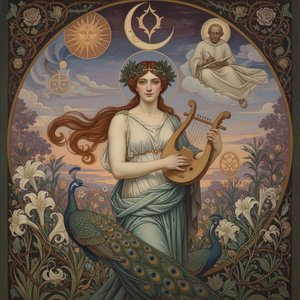
1799. Tempera, 38.0 x 55.0 cm.

§ 1Catalogue data
 Tempera
- WallArt
- Romantic Symbolism
 1799
1799- 19th Century
 38.0 x 55.0 cm
§ 2Abstract
Descrição do Item
A radiant golden starburst illuminates Jesus at the center of this profound Romantic masterpiece by William Blake, offering a visionary glimpse into a spiritual realm that you can bring to your own collection.
 Ler mais
Biografia do Artista
Descubra 'Hecate' de William Blake: uma obra-prima da arte romântica que explora a figura mística da deusa grega, seus símbolos e a visão única do artista. Uma jornada visual e espiritual.
§ 3Commentary
A Visionary Encounter with the Divine
In the quiet intensity of William Blake’s 1799 masterpiece, The Last Supper, the boundaries between the earthly and the eternal seem to dissolve. This is not merely a historical reconstruction of a biblical event; it is an immersive descent into the prophetic psyche of one of the Romantic era's most singular geniuses. As the viewer approaches this tempera on canvas, they are immediately struck by a profound sense of spiritual weight. The scene captures the pivotal moment of the Eucharist, yet Blake transcends traditional iconography to present a vision where light and shadow perform a sacred dance. At the heart of the composition sits Jesus Christ, framed by a radiant, golden starburst that emanates from his very presence, casting a celestial glow upon the gathered disciples. This deliberate use of light serves as more than a focal point; it acts as a window into Blake’s belief in the divine spark residing within all humanity.
The atmosphere is one of solemn grandeur, sculpted through a masterful application of chiaroscuro. Blake utilizes dramatic contrasts to pull the figures out of a nearly black, infinite background, creating a sense of depth that feels both intimate and cosmic. The palette is a sophisticated tapestry of symbolic hues: the skin tones and tabletop are bathed in a transformative golden yellow, hinting at the alchemical process of spiritual transmutation. These warm, luminous tones are punctuated by unexpected accents of aquamarine blue, salmon pink, and a deep, earthy rust red. Such colors do not merely decorate the garments of the apostles; they resonate with Blake’s complex symbolic language, representing the interconnectedness of the sea, the flesh, and the earth, all held within the embrace of divine grace.
Symbolism and the Romantic Spirit
To gaze upon The Last Supper is to engage with the very essence of the Romantic movement—a period defined by an intense preoccupation with emotion, imagination, and the sublime. Blake, a man whose life was shaped by vivid visionary experiences, imbues every gesture on the canvas with profound meaning. The way the disciples lean toward or away from Christ, their hands raised in prayer or resting in contemplation, tells a story of human reaction to the divine. One can almost feel the tension in the room as the weight of betrayal and sacrifice hangs in the air. Even the objects upon the table—the goblets, plates, and bowls—are rendered with a meticulousness that grounds this supernatural event in a tangible, physical reality.
For the discerning collector or interior designer, this artwork offers much more than aesthetic beauty; it provides a focal point of deep intellectual and emotional resonance. The painting’s ability to command attention through its stark contrasts and rich textures makes it an extraordinary addition to any curated space. Whether placed in a study filled with literature or as a centerpiece in a room designed for reflection, the piece invites conversation and contemplation. It serves as a reminder of the power of the human imagination to bridge the gap between the seen and the unseen, making it a timeless acquisition for those who seek art that speaks to the soul.
Perguntas e Respostas
A que fase da carreira de William Blake pertence "The Last Supper" (1799)?
Dada a sua data de 1799, "The Last Supper" insere-se no período Mature Romanticism de William Blake.
Onde posso comprar reproduções pintadas à mão de "The Last Supper", de William Blake?
"The Last Supper" está disponível como uma reprodução a óleo pintada à mão sobre tela de linho. O pedido pode ser feito em sua página de Reprodução Pintada à Mão, com escolha de tamanhos.
Como faço para baixar a imagem de "The Last Supper", de William Blake?
"The Last Supper", de William Blake pode ser descarregado na página de Download da obra, como download de imagem digital em alta resolução.
 Alternar para Impressão


 Para obras de arte ou reproduções com mais de 105 cm (aproximadamente 41 polegadas) em qualquer um dos lados, a moldura será enviada como um kit desmontado. Este método garante uma entrega segura e evita danos durante o transporte.