A Life Between Ireland and London
Born in Clonakilty, Ireland, the life of Alfred Elmore was defined by a journey from the quiet landscapes of his youth to the vibrant, competitive heart of the British art scene. As the son of Dr. John Richard Elmore, a surgeon who had retired from the British Army, Elmore’s early years were shaped by this transition from Ireland to London. It was in London that his true artistic destiny began to unfold, as he sought formal training at the Royal Academy of Arts. This period of education laid the foundation for a career that would eventually see him elected an associate of the Academy and later become a full member, marking him as a significant figure within the nineteenth-century artistic establishment.
His early creative explorations were deeply influenced by the troubadour style of Richard Parkes Bonington, a delicate and romantic approach to subject matter. However, Elmore’s ambitions soon expanded beyond these initial stylistic boundaries. Between 1840 and 1844, his travels through the great cultural centers of Europe—including Munich, Venice, Bologna, and Florence—broadened his visual vocabulary and deepened his understanding of classical and historical themes. These continental experiences infused his work with a richness that would characterize his most celebrated compositions.
Narrative Mastery and Historical Grandeur
Elmore’s oeuvre is a fascinating tapestry of history, religion, and social commentary. While he gained early recognition for religious works, such as The Martyrdom of Thomas à Becket—a piece commissioned by Daniel O'Connell for Westland Row Church in Dublin—his true passion lay in the art of historical narrative. He possessed a unique ability to capture pivotal moments in time, often setting scenes from Shakespearean plays or episodes from the French Revolution with a dramatic flair that captivated the Victorian imagination.
His paintings frequently explored the tension between tradition and progress. This is perhaps most evident in his subtle explorations of technological innovation, seen in works like The Invention of the Stocking Loom and The Invention of the Combing Machine. In these pieces, Elmore masterfully depicts the picturesque nature of pre-industrial handicrafts, using the contemplative figure of the inventor to bridge the gap between manual skill and the mechanical future. His ability to weave complex themes of industrialization into a narrative format allowed him to engage with the profound societal shifts of his era.
Legacy and Artistic Significance
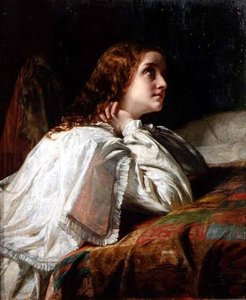
Beyond the grand historical stages, Elmore was also a master of the moral genre painting. His most renowned work, On the Brink, serves as a haunting example of his ability to use light and shadow to convey psychological depth. In this piece, the use of a lurid, red light to depict a seducer creates an atmosphere of intense moral conflict, illustrating the precarious position of a young woman facing ruin. This capacity for emotional resonance ensured that his work remained deeply impactful to contemporary audiences.
Though he experienced periods of relative obscurity later in life, Elmore’s contribution to the Victorian era remains significant. His association with The Clique, a group of artists following the traditions of Hogarth and David Wilkie, placed him at the center of important artistic dialogues of his time. Through his diverse range of subjects—from the religious to the Shakespearean and the industrial—Alfred Elmore left behind a body of work that continues to offer a window into the complex social and cultural landscape of the nineteenth century.
Perguntas e Respostas
Quais obras de Alfred Elmore são as mais visualizadas?
A página de Estatísticas de Alfred Elmore apresenta estatísticas calculadas a partir das obras do artista listadas em este site.
Quantas obras de Alfred Elmore estão disponíveis para explorar?
Você pode explorar 18 obras de arte obras de Alfred Elmore na página Todas as obras.
Onde as obras de Alfred Elmore estão organizadas por cor?
O Índice de Cores de Alfred Elmore organiza as obras do artista por cores.